Also called: Vasopressin treatment, (2) Para for low BP
The Vasopressin formula is the shortest formula in Neurotherapy (LMNT): the parathyroid point given in its (2) Para form, and nothing else. It is used for blood pressure that has stayed low for years, in people who tire very quickly, and for diabetes insipidus — but never for pressure that has fallen suddenly after blood loss.
Overview
What is the Vasopressin formula?
It was found by chance. A man whose blood pressure had stayed low for years was being given the calcium formula, which in those days began with the parathyroid point. Partway through that point he said he was feeling extremely well. His pressure was checked and it had risen. The next day the same small treatment was given again and his pressure came to normal — and when it was checked some days later, it was still normal.
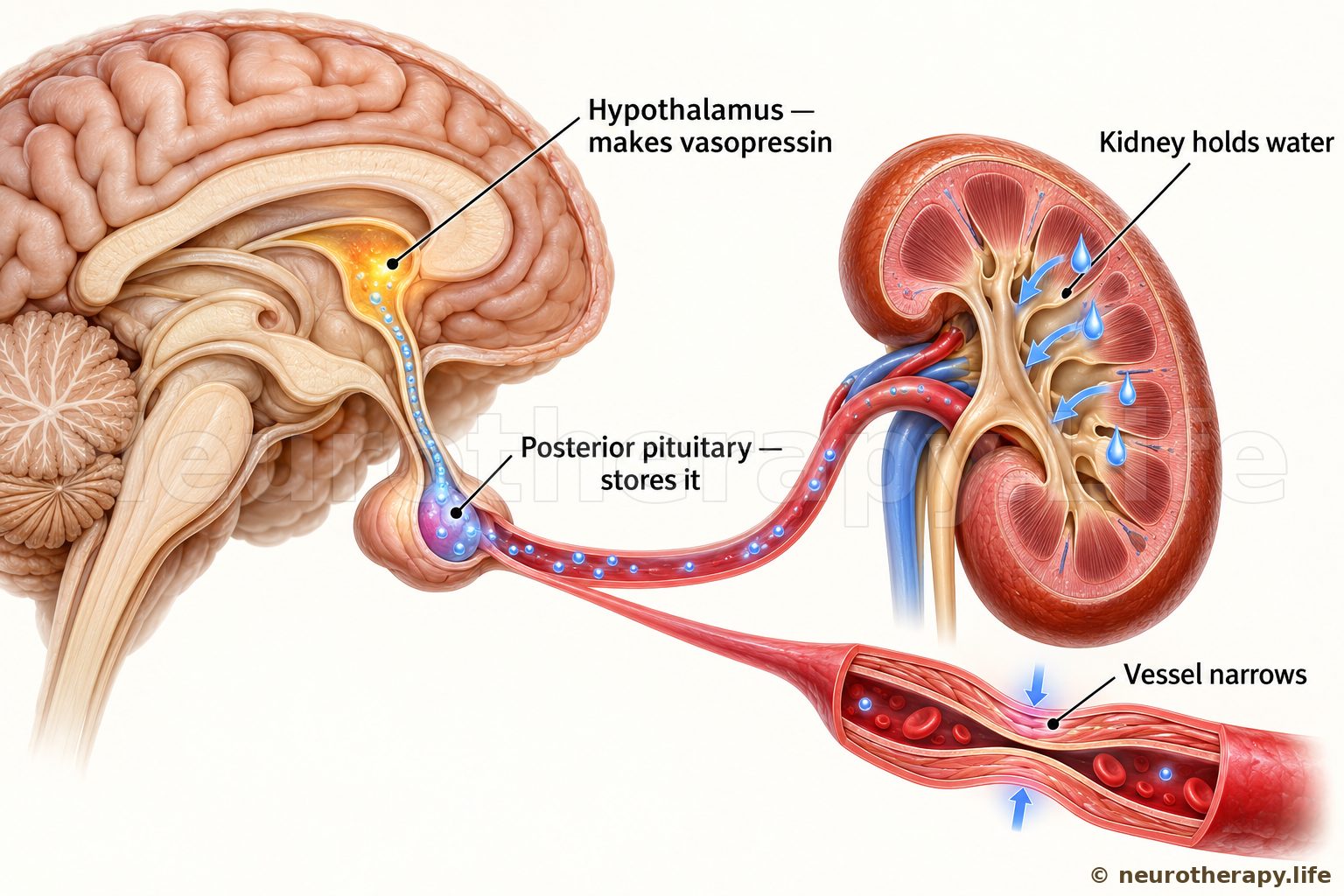
Guruji then read about the chemicals that narrow blood vessels, and inferred that this treatment was rousing vasopressin. Vasopressin is a hormone made in the hypothalamus of the brain and stored in the posterior pituitary gland. It narrows blood vessels and tells the kidneys to hold on to water, so the blood volume grows and the pressure rises.
The teaching records that the treatment has since been tried on many patients with long-standing low blood pressure, with the same kind of result. The formula has not changed since it was found.
Vasopressin, the body's own water-holding hormone, narrows the vessels and helps the kidneys keep water — the effect this formula is named after.
What it is for
What is the Vasopressin formula used for?
Low blood pressure of many years — a pressure that always stays below normal, for example around 100/70 — in people who become tired very quickly from working.
Diabetes insipidus, a rare illness in which the body does not make enough of this hormone (ADH), so the person drinks a great deal of water and soon passes a great deal of urine.
Points it works through
Which point does the Vasopressin formula work through?
(2) Para
Just one. The whole formula is a single point in one named form. The exact method is taught hands-on in the Neurotherapy (LMNT) course. This page lists the points of the formula and what each one contributes; it does not describe how any point is given. For the method, watch the demonstration video of each point on its own page and learn hands-on from a trained Neurotherapist. Please do not give a formula from a written description alone.
The parathyroid point given in its (2) Para form, at the elbow and shoulder. In Neurotherapy (LMNT) this form is held to rouse vasopressin from the posterior pituitary — a different treatment from (4) Para, even though the place is the same.
Position:Lying on the back (supine).
The exact technique is taught hands-on in the Neurotherapy (LMNT) course. See the course →
How it works
One place, two treatments — how does that work?
Neurotherapy (LMNT) gives the parathyroid point in two named forms. (2) Para is linked with vasopressin, which holds water and so raises a long-standing low pressure. (4) Para is linked with parathormone (PTH), which raises calcium in the blood, and is given inside the calcium formula. The same site, two different glands, two different jobs. That is why the therapist reads the named form before the point.
Vasopressin holds water only. Angiotensin No. 2 and aldosterone hold both salt and water. So the shape of the story decides the formula: low for years points to Vasopressin; suddenly low after blood has been lost points to Angiotensin No. 2.
Its family
Which formulas are related?
The Vasopressin formula belongs with the other water, salt and pressure formulas.
Angiotensin No. 2 — For pressure that has fallen suddenly after about half a litre of blood has been lost. It holds salt and water — the formula to use instead of Vasopressin in that case.
Multivitamin formula 4 — Opens with the same (2) Para, then adds steps for weakness — for low pressure with weakness in the body.
1,25 DCC (ordinary form) — The calcium formula, which uses the other form of the same point, (4) Para. Vasopressin was discovered during an early version of it.
ADK — A three-part treatment for the after-effects of pneumonia, which begins with Angiotensin No. 2.
What it is used for
When is the Vasopressin formula used?
It is chosen by the story of the pressure — years, not days.
Diabetes insipidusToo little of this hormone, with great thirst and much urine
Safety: when it is held back
Never for blood pressure that has fallen suddenly after blood loss — an accident, a miscarriage, an operation, very heavy periods. What has been lost is blood, and this formula answers only water. Angiotensin No. 2 is the formula for that picture. Angiotensin No. 2
(2) Para is not given to people with high blood pressure. High blood pressure
Fainting, chest pain, a racing or irregular heartbeat, black stool, or low pressure that comes on newly should be seen by a doctor first. Long-standing heavy periods need a gynaecologist's check as well.
Do not confuse it with (4) Para. And (4) Para is never given on its own in osteoporosis. (4) Para
Diabetes insipidus must be diagnosed and followed by a doctor. Children get light treatment. Diabetes insipidus
Keep taking the medicines your doctor prescribed. Neurotherapy (LMNT) works alongside your medical care, never instead of it.
A teaching case
Teaching case: low pressure, but not this formula
A teaching case, assembled to show the reasoning. A young schoolteacher with low pressure felt giddy for a few days every month — always just after very heavy periods. Because her story was blood lost each month, not pressure low for years, she was given Angiotensin No. 2, not the Vasopressin formula, and was sent for a scan that later found a fibroid. The formula is chosen by the shape of the story, not by the number on the cuff.
A composite case written to teach the reasoning — not one patient’s file.
Common questions
Is this formula for everyone with low blood pressure?
No. It is for pressure that has been low for years. Pressure that dropped suddenly after blood loss needs a different formula, and often a doctor first.
Is any hormone given to me?
No. Nothing is injected or swallowed. The formula is named after the body's own hormone that it is held to rouse.
Why is the formula so short?
Because that is how it was found: a single point, in one form, raised the pressure. Nothing has needed to be added since.
I have high blood pressure. Can I have it?
No. (2) Para is not given to people with high blood pressure.
What should I ask?
Is my low pressure the long-standing kind, or did something cause it recently?
(To the doctor) Should my haemoglobin, thyroid or heart be checked for my low pressure?
Surprising facts
1Vasopressin is made in the brain
It is made by nerve cells in the hypothalamus, carried down their long fibres and stored in the posterior pituitary until it is needed.
Source: Cuzzo B, Padala SA, Lappin SL. Physiology, Vasopressin. StatPearls (NBK526069).
2It opens water gates in the kidney
Vasopressin makes the collecting-duct cells of the kidney put water channels, called aquaporin-2, into their walls, so water flows back into the body instead of into the urine.
Source: Cuzzo B, Padala SA, Lappin SL. Physiology, Vasopressin. StatPearls (NBK526069).
3Its other name says what it does
Vasopressin is also called antidiuretic hormone (ADH) — 'anti-diuretic' means against making a lot of urine.
Source: Cuzzo B, Padala SA, Lappin SL. Physiology, Vasopressin. StatPearls (NBK526069).
Watch
(2) Para vs (4) Para — One Point, Two Powerful Actions | LMNT Neurotherapy Explained
This video explains the Para point and how (2) Para differs from (4) Para, in relation to low calcium, bone pain and blood pressure.
Test yourself
Research
Strong evidence
A medical reference on vasopressin: made in the hypothalamus, it makes the kidney hold water through aquaporin-2 channels and, at higher levels, narrows blood vessels and raises blood pressure.
This page explains what a Neurotherapy (LMNT) treatment is for; it is not a self-treatment guide and does not diagnose. Neurotherapy (LMNT) works alongside your medical care — keep taking the medicines your doctor prescribed.
Ready to begin?
Send COURSE for course details, or your name, age and health issue for a consultation.