Also called: Parathyroid, Para point, पैराथायरॉइड पॉइंट
Para is the Neurotherapy (LMNT) point named for the parathyroid glands, the tiny glands in the neck that keep blood calcium steady. It is given on the right arm only, with the patient lying on the back, and the number before it decides whether it works on calcium, as (4) Para, or on blood pressure and water, as (2) Para.
Overview
What is the Para point?
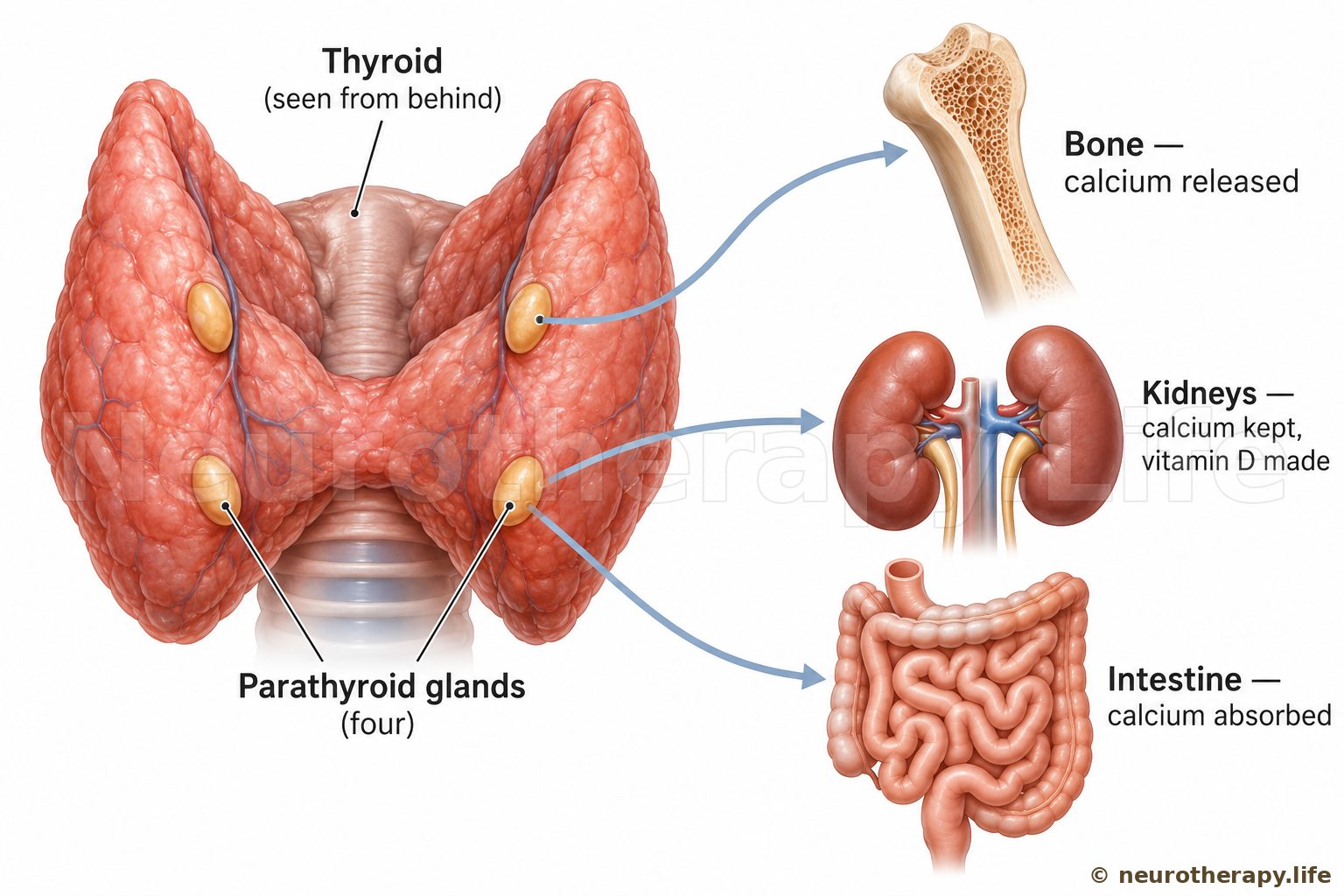
Para is short for parathyroid. The parathyroids are four tiny glands, each about the size of a grain of rice, tucked behind the thyroid in the front of the neck. They make parathyroid hormone (PTH), the body's calcium manager.
Calcium is not only for bones. Muscles, nerves and the heart all need the right amount in the blood. When blood calcium falls, PTH tells the bones to release some; when it rises, a thyroid hormone called calcitonin puts the extra back into the bones.
In Neurotherapy (LMNT), Para is a chemical point: it is named for what it rouses. Its two numbered forms are two different treatments at the same site. (4) Para works through PTH on blood calcium. (2) Para, found by chance, works through the posterior pituitary and the hormone vasopressin, and is used for long-standing low blood pressure.
Para matters because it is the step in the 1,25 DCC formula that asks for PTH — and without PTH, the body cannot make active vitamin D at all.
The four parathyroid glands sit behind the thyroid and steer blood calcium through bone, kidney and gut.
Where it is given
Where is Para given?
PositionLying on the back
Body areaRight arm only — just above the elbow (beside the bony knob) and at the shoulder joint, alternately; lying on the back with a pillow under the upper arm
You lie flat on your back. In the demonstration video a pillow is placed under the right upper arm. Para is given on the right arm only — one place just above the elbow beside the bony knob, and one at the shoulder joint — taken alternately. The video shows the exact places.
The parathyroid glands themselves are four tiny glands, each about the size of a grain of rice, at the back of the thyroid in the neck. Nothing touches the neck in Para.
How it is given
How is Para given?
How this point is given — the tool, the pressure, the count and the exact movement — is deliberately not described here. Watch the demonstration video on this page, and learn the method hands-on from a trained Neurotherapist before giving it. Please do not give any point from a written description alone: a point given in the wrong place or the wrong way can do harm.
The number written before a point's name is not a strength setting. Each numbered form is a separate named treatment with its own method and timing, taught hands-on in the course.
SideRight arm only
PlacesNear the elbow, then near the shoulder
The number before itChooses the treatment — (2) and (4) Para act on different glands
The exact technique is taught hands-on in the Neurotherapy (LMNT) course. See the course →
What it does
What does Para do in the body?
Neurotherapy (LMNT) teaching describes Para as a way of rousing the parathyroid glands, and — at its smaller number — the posterior pituitary. Body science confirms what these hormones do; how a press on the arm reaches the glands is the therapy's own explanation, offered from clinical experience.
(4) Para — inside the 1,25 DCC formula, to keep the calcium in the blood steady through PTH; for cramps from calcium shortage and for very heavy periods.
(4) Para alone — lifts calcium out of bone into the blood, so it is used where bone has grown where it should not.
(2) Para — rouses the posterior pituitary to release vasopressin, which holds water in the body; used for long-standing low blood pressure and diabetes insipidus.
Pituitary gland — Its back lobe releases vasopressin — the work of (2) Para.
Kidneys — PTH makes them keep calcium and finish making active vitamin D; vasopressin makes them keep water.
Blood — Calcium and water in the blood are what Para's two forms steer.
Its family
What are the forms and neighbours of Para?
Para is given at one site, and the number before it decides which gland is being asked: two for vasopressin, four for parathyroid hormone. Read the number before you read the point.
(2) Para — Vasopressin, through the posterior pituitary — long-standing low blood pressure, diabetes insipidus. Not in high BP.
(4) Para — Parathyroid hormone and blood calcium — calcium cramps, heavy periods. In osteoporosis only inside the full 1,25 DCC formula.
Pit — Pit — the pituitary point, its neighbour among the glands of the head and throat.
Thrd — Thrd — the thyroid point; thyroid and parathyroid share the calcium balance.
What it is used for
What is Para used for?
Para is chosen by its number and from the patient's findings, after the blocked list has been checked.
Calcium — (4) Para
Muscle crampsCramps from calcium shortage, by day or at night.
Osteoporosis (thin bones): (4) Para is never given alone — given by itself it lifts calcium out of the bone. It is given only inside the full 1,25 DCC formula, and these patients are treated with the hand only. Osteoporosis
High blood pressure: (2) Para is not given — vasopressin narrows the vessels and raises the pressure. High blood pressure
Low blood pressure that came on suddenly after blood loss (accident, miscarriage, operation, very heavy periods) is not treated with (2) Para — the Angiotensin No. 2 formula is the one written for it. Active bleeding is a hospital matter. Angiotensin No. 2
No. Para is given on the right arm only, near the elbow and near the shoulder. Nothing touches the neck.
Why only the right arm?
That is where the point is taught to be given. In this therapy the side is part of the point, and the other arm is not treated.
I have thin bones. Can I have Para?
Only as (4) Para inside the full 1,25 DCC formula, given by hand. Given alone, (4) Para lifts calcium out of the bone — the last thing a thin bone needs.
How was (2) Para found?
By chance. Guruji was giving the parathyroid step of the 1,25 DCC formula to a man with years of low blood pressure. Partway through it the man said he felt extremely well; his pressure had risen, and the next day it became normal. Guruji then read about the vessel-narrowing hormones and concluded it was vasopressin.
Surprising facts
1Four grains of rice
The four parathyroid glands together weigh only about a tenth of a gram or so, yet without them blood calcium can fall low enough to cause life-threatening muscle spasms.
Source: Gray's Anatomy (parathyroid glands); Guyton & Hall, Textbook of Medical Physiology (hypocalcaemic tetany).
2Found last of all
The parathyroids were the last major organs to be discovered in humans — described by Ivar Sandström, a Swedish medical student, in 1880.
Source: History of the parathyroid glands (Sandström, 1880), standard endocrine-surgery history.
3No PTH, no vitamin D
PTH switches on the kidney enzyme that makes active vitamin D. That is why the 1,25 DCC formula places Para between the liver and the kidneys.
Source: Khan M et al., Physiology, Parathyroid Hormone, StatPearls (NCBI Bookshelf NBK499940).
4Rhythm changes the result
PTH present all the time thins bone, while the same hormone given in short pulses thickens it — a fact modern osteoporosis medicine uses.
Source: Intermittent PTH (teriparatide) as an anabolic bone treatment — e.g. Neer RM et al., N Engl J Med 2001;344:1434–41.
Watch
(2) Para vs (4) Para — One Point, Two Powerful Actions | LMNT Neurotherapy Explained
This video explains the Para point and how (2) Para differs from (4) Para, in relation to low calcium, bone pain and blood pressure.
Test yourself
Research
Strong evidence
A physiology review: parathyroid hormone raises blood calcium by releasing calcium from bone, by making the kidneys hold calcium back, and by switching on the kidney step that makes active vitamin D (1,25-dihydroxycholecalciferol).
A physiology review: vasopressin is made in the hypothalamus and released from the posterior pituitary; it makes the kidneys hold water and, at higher levels, narrows blood vessels. A failure of its release causes central diabetes insipidus.
This page explains what a Neurotherapy (LMNT) treatment is for; it is not a self-treatment guide and does not diagnose. Neurotherapy (LMNT) works alongside your medical care — keep taking the medicines your doctor prescribed.
Ready to begin?
Send COURSE for course details, or your name, age and health issue for a consultation.