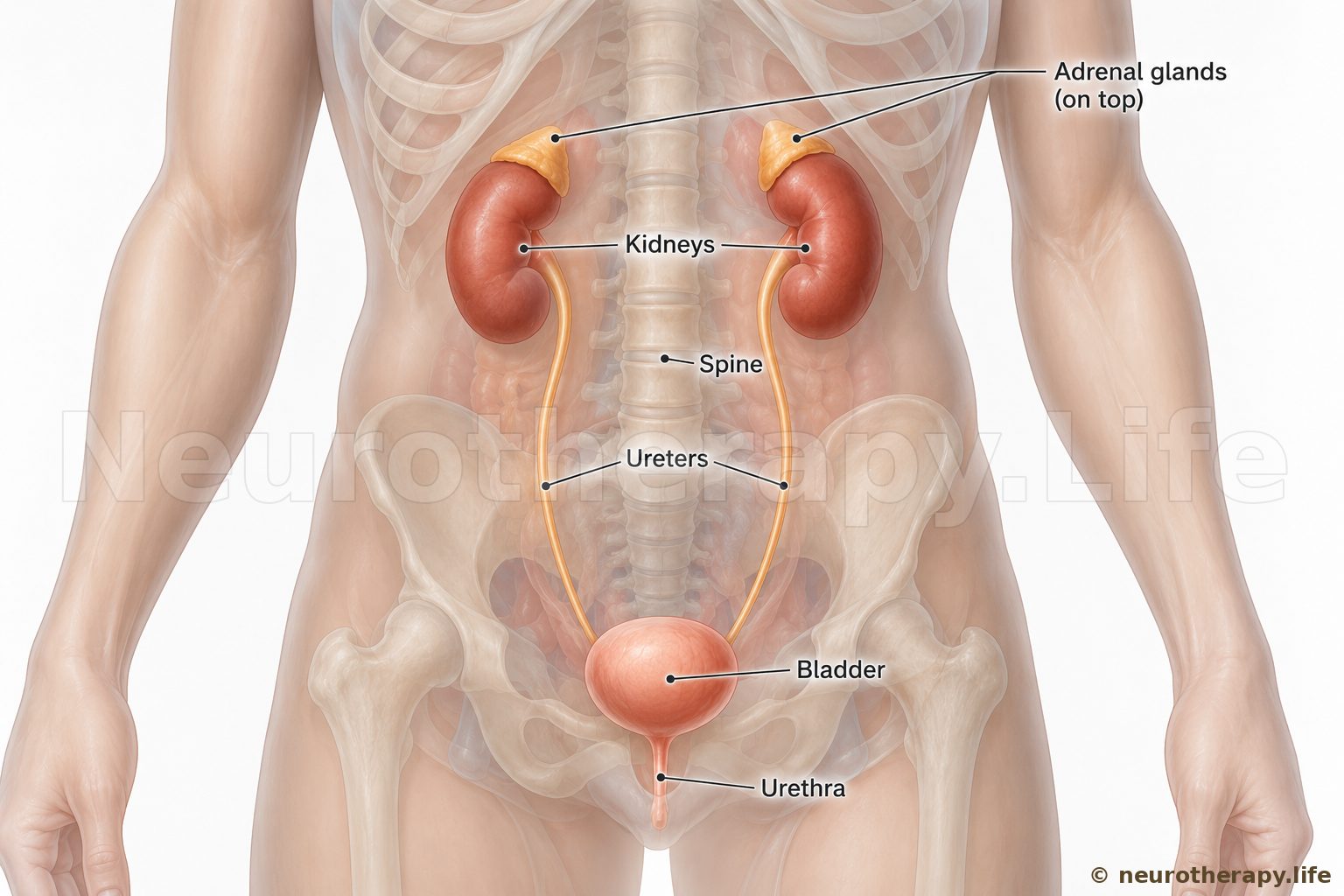
Two kidneys clean your blood all day and night, and a set of tubes and a stretchy bag store the waste and let it go when you choose. Guruji counted the kidneys among the three organs that keep disease away.
Overview
What is the urinary system?
The urinary system is the group of organs that makes urine and carries it out of the body. It has two kidneys, two thin tubes called ureters, the bladder that stores urine, and the urethra, the tube through which urine leaves.
The kidneys filter the blood, remove waste and extra water, and keep the body's salts, acid balance and blood pressure steady. They also make hormones that build red blood cells and keep bones strong.
Guruji taught that if the stomach, the lungs and the kidneys work properly, disease simply cannot come. In Neurotherapy (LMNT) the two kidneys are checked first in every examination, under their own code names, Liv° and Mu°.
The urinary system: two kidneys that filter, two tubes that carry, one bag that stores, one tube that empties.
Function
What does the urinary system do?
The kidneys are not just drains. They sort: they throw out what is in excess and hold back what is short, from the same blood, at the same time. The rest of the system stores and empties the result.
Removes wastes such as urea, creatinine and uric acid, and many medicines, from the blood.
Balances water: more urine when you drink a lot, less when you are short of water.
Balances salts such as sodium, potassium and calcium.
Keeps the blood from becoming too acid or too alkaline.
Helps control blood pressure, through salt and water and a hormone called renin.
Makes erythropoietin, the hormone that tells the bone marrow to make red blood cells.
Turns vitamin D into its active form, which the gut needs to absorb calcium for bones.
Stores urine and lets it out only when you choose.
How does the urinary system work with other systems?
Heart, blood and circulation — About a fifth of the blood pumped by the heart goes to the kidneys; in return they help set the blood pressure and the blood volume.
Glands and hormones — Hormones from the adrenal glands (aldosterone) and the pituitary (the water-holding hormone, ADH) tell the kidneys how much salt and water to keep.
Lungs and breathing — The lungs and kidneys share the job of acid balance: the lungs act in minutes by breathing out carbon dioxide, the kidneys over hours and days.
Four kinds of organ in a row: the filters, the carrying tubes, the store and the outlet — held up by the muscles of the pelvic floor.
The kidneys
Cortex and medulla — The outer layer holds the filters; the inner layer is made of cone-shaped pyramids of tiny tubes.
Nephrons — About a million filtering units in each kidney: a tuft of tiny blood vessels (the glomerulus) that filters, and a long tubule that sorts.
Renal pelvis — A funnel in the middle of each kidney that collects the urine and passes it to the ureter.
The ureters
Two carrying tubes — Muscular tubes, each about 25–30 cm long and only a few millimetres wide, that squeeze urine down from each kidney to the bladder in small spurts.
One-way entry — They enter the bladder at a slant, so a filling bladder presses them shut and urine does not flow back to the kidneys.
The bladder
Detrusor muscle — The stretchy muscular wall that relaxes as the bladder fills and squeezes to empty it.
Internal sphincter — A ring at the bladder's outlet that stays closed without your thinking about it.
External sphincter and pelvic floor — Muscles you control, which hold urine in until you are ready; weakness here causes leaks on coughing or sneezing.
The urethra
The outlet tube — About 4 cm long in women and about 20 cm in men, where it passes through the prostate. The short female urethra is one reason urine infections are more common in women.
The journey
Blood arrivesEvery minute, about a litre
The renal arteries bring about a fifth of all the blood the heart pumps.
FilterAbout 180 litres a day
In the glomeruli, water and small molecules are pressed out of the blood; blood cells and proteins stay behind.
SortAbout 99% taken back
Along the tubules, the body takes back the water, sugar and salts it needs and adds some wastes and acid.
CollectMinutes
What is left — urine — drains into the renal pelvis.
Carry downA spurt every 10–15 seconds
The ureters squeeze urine down to the bladder in small waves.
StoreUsually 2–5 hours
The bladder relaxes as it fills; stretch nerves send the urge when it is getting full.
EmptyWhen you choose
The sphincters and pelvic floor relax, the bladder wall squeezes, and urine leaves through the urethra.
Where is the urinary system located?
The kidneys sit high at the back of the belly, one on each side of the spine, partly tucked under the lowest ribs — roughly from the twelfth thoracic to the third lumbar vertebra. The right kidney sits a little lower than the left, because the liver is above it.
The ureters run down the back wall of the belly into the pelvis. The bladder sits low in the pelvis, just behind the pubic bone; the urethra leaves from its base.
LMNT examines the kidneys at the flanks — the soft place between the last rib and the rim of the hip bone — Liv° on the right and Mu° on the left. The back pain chart also places urinary tract trouble at the junction of the low back and the sacrum.
Each kidney is bean-shaped and reddish-brown, with a smooth, shiny covering and a notch on its inner side where the blood vessels and the ureter join. It sits in a cushion of fat.
The ureters are thin, pale, muscular tubes. The bladder is a small flattened bag when empty and a rounded balloon when full. Healthy urine is clear and pale straw to amber in colour, depending on how much you have drunk.
How big is the urinary system?
Each kidney is about 10–12 cm long — about the size of a fist — and weighs about 120–170 g. The ureters are about 25–30 cm long.
A healthy adult bladder can comfortably hold about two cups of urine (roughly 400–500 ml) for two to five hours.
Each day the kidneys filter about 180 litres of fluid from the blood, but return about 99% of it, so only about 1–2 litres leave as urine.
Conditions and disorders
What conditions and disorders affect the urinary system?
Urinary problems range from a simple urine infection to long-term kidney disease. Kidney disease is often silent until late, which is why blood and urine tests matter for people at risk.
The kidneys
Kidney diseaseKidneys that filter less well — from diabetes, high blood pressure, infection or other causes.
Kidney stonesHard crystals that form in the kidney and can cause severe pain as they move down the ureter.
AcidosisIn LMNT teaching, acid-side diseases come when the left kidney is not working properly.
AlkalosisThe other direction, read at the right kidney.
Low back painThe back chart places kidney pain in the flanks and urinary tract pain at the low back and sacrum.
Pneumonia in childhood (past history)In LMNT teaching, pneumonia affects the kidneys too, so the Kidney Clear treatment is part of the ADK sequence.
What are common signs of a urinary problem?
Burning or pain when passing urine
Needing to go often, urgently, or several times at night
Cloudy, strong-smelling or red or brown urine
Leaking when coughing, sneezing or laughing
A weak stream, dribbling, or feeling the bladder has not emptied
Swelling of the feet or around the eyes, or passing very little urine
Pain in the side or back below the ribs, especially with fever — see a doctor
What tests check the urinary system?
Urine test — A dipstick and microscope look for blood, protein, sugar and signs of infection; a culture finds the germ.
Blood tests — Creatinine and eGFR show how well the kidneys are filtering; urea, salts and uric acid are checked too.
Urine protein test (ACR) — An early warning of kidney damage in diabetes and high blood pressure.
Ultrasound (KUB) — Shows the kidneys, ureters and bladder, stones, swelling, and how much urine is left after passing.
CT scan — The most accurate test for stones.
Flow tests and cystoscopy — Measure the urine stream, or look inside the bladder with a thin camera.
How are urinary problems treated?
Water and habits — Enough water for your climate and work, not holding urine for very long, and less salt.
Antibiotics — For urine infections, chosen and dosed by a doctor.
Protecting the kidneys — Good control of blood sugar and blood pressure, and avoiding painkillers that strain the kidneys, as your doctor advises.
Stone treatment — Pain relief and fluids for small stones; shock-wave or telescope procedures for larger ones.
Pelvic floor and bladder training — Squeeze exercises and timed toilet visits help many people with leaking.
Prostate treatment — Medicines or surgery for a prostate that blocks the stream.
Dialysis and transplant — When the kidneys fail, a machine or a donated kidney takes over their work.
Neurotherapy (LMNT)
Guruji counted the kidneys with the stomach and the lungs as the three organs that keep disease away, and LMNT gives them a special place. The two kidneys carry code names — Liv° for the right and Mu° for the left — chosen to spare anxious patients the word 'kidney', and because each kidney lies straight behind the front point it is named after. Tenderness at these two flank points is the first thing checked in an LMNT examination, and it sorts the patient into one of two families: in LMNT teaching the left kidney filters acid, and the right kidney reduces alkali. Guruji described a working kidney as a sorting office, not a sieve — it throws out more of what is in excess and holds back what is short, in the same pass. The Kidney Clear formula stimulates both kidneys and then balances the result, in four graded strengths chosen by the patient's condition that day; its reversed form, Ulta Kidney Clear, is for days when the body leans the other way. For the bladder, the same two points on opposite sides do opposite jobs: one pair opens a narrow, jetting outlet, the other tightens a slack one that leaks. At the sacrum, the Triangle for Piles tightens and helps control of urine, while (2) S4–S5 relaxes and helps urine come. This is support alongside medical care, never instead of it.
Points
Liv° — The right kidney code: stimulates the right kidney and, in LMNT teaching, reduces alkali in the blood.
Mu° — The left kidney code: stimulates the left kidney and, in LMNT teaching, reduces acid in the blood.
Ch. Only — Chest Only — given after the kidney points in Kidney Clear to keep the acid–alkali balance.
Round Arrow — The Round Arrow down one side of the spine and up the other — the other balancing step of Kidney Clear.
(15) Medulla — With (6) Swt on the same side: the left pair opens a tight urinary outlet; the right pair closes a slack one.
(6) Right Swt — With (15) Right Medulla, three times, for urine leaking on sneezing or laughing.
Triangle for Piles — Heels at S5, S3 and S1 with an upward jerk: tightens the muscles around the pelvis — for piles and for control of urine in children and the elderly.
(2) S4 – S5 — The opposite of the Triangle: relaxes the rings of the bladder, uterus and anus; in LMNT teaching it helps obstructed urine to come.
Folded Legs — The patient's own thighs press the therapist's fists into the lower belly; in LMNT teaching the pressure on the bladder greatly increases blood flow to the kidneys.
Both pairs reversed — Mu° first, the Round Arrow before Ch. Only — for days of loose motions, more pain at Liv°, or morning swelling; given for a limited time.
“If the stomach, the lungs and the kidneys work properly, then disease simply cannot come.”
— Dr. Lajpatrai Mehra
“No other drink can be a substitute for water.”
— Dr. Lajpatrai Mehra
“Neurotherapy (LMNT) treats according to the condition of the body.”
— Dr. Lajpatrai Mehra
Never do this
(2) S4–S5 is not given to someone who passes too much urine; the Triangle for Piles and Gal are not given when too little urine is passed. (2) S4 – S5
(6) Right Swt is not given with high blood pressure, and (6) Left Swt is not given with diabetes. (6) Right Swt
In kidney failure or kidney cancer the kidney points Liv° and Mu° are never stimulated, and (10) Medulla is not given in kidney failure. No firm pressure on a tender flank, and none over a transplanted kidney, a recent biopsy, or a tube or stent. Liv°
Ulta Kidney Clear works against the body's usual direction and is given for a few days only; after that the Normal formula brings the body back. Ulta Kidney Clear
Children get half the adult dose and light treatment only, from a trained therapist.
Go to hospital the same day if you cannot pass urine with a full, painful bladder; pass very little or no urine; have fever with pain in the side or back; see blood in the urine; or have severe, wave-like pain in the side. A urine infection with fever or loin pain needs a doctor first.
Keep taking prescribed medicines, and never stop or skip dialysis. Neurotherapy (LMNT) works alongside your doctor's care, not in place of it.
Care
How can I keep my urinary system healthy?
Your kidneys work quietly for decades. A few simple habits protect them.
Drink water through the day
Pale straw-coloured urine is a good sign you are drinking enough. Tea and other drinks do not replace water. If you have heart or kidney disease, follow your doctor's limit.
Go when you need to
Don't hold urine for very long, and empty the bladder fully. Pass urine after sexual intercourse to help prevent infection.
Keep sugar and blood pressure in check
Diabetes and high blood pressure are the two biggest threats to the kidneys. Get them checked regularly.
Go easy on salt
Less salt helps blood pressure and lowers the risk of some stones.
Be careful with painkillers
Regular use of some painkillers can harm the kidneys. Ask your doctor before taking them often.
Strengthen the pelvic floor
Daily squeeze exercises help prevent leaks, especially after childbirth and with age.
Wipe front to back
For women and girls, this keeps bowel germs away from the short urethra.
Common questions
How much water should I drink?
It depends on your size, the weather and your work. For most healthy adults, enough to keep the urine pale and to pass about 1.5–2 litres a day is a good guide. People with heart or kidney disease may be told to drink less — follow your doctor. LMNT teaching adds: drink water itself, a little at a time, between meals.
How often is it normal to pass urine?
Most people go about four to eight times in 24 hours, and perhaps once at night. Going much more often, getting up many times at night, or passing very little should be checked.
Why are urine infections more common in women?
A woman's urethra is only about 4 cm long and its opening is close to the back passage, so bacteria reach the bladder more easily. About half of all women have at least one urine infection in their lifetime.
I leak a little when I cough or laugh. Is that just age?
It is common, especially after childbirth and in middle age, but it is not something you have to accept. Pelvic floor exercises help many women, and doctors have other treatments too. Guruji described the same picture — the muscles below the navel become loose — and the LMNT Incontinence treatment is written for it.
Why do Neurotherapists call my kidneys Liv° and Mu°?
It is shorthand. The word 'kidney' frightens many people, so Guruji gave the kidneys code names. Each kidney lies behind the front point it is named after — Liv on the right, Mu on the left — and the small ring reminds the therapist to give the treatment at a single point, high near the shoulder. If you ask, your therapist should tell you plainly.
Can I live with one kidney?
Yes. One healthy kidney can do the work of two, and people who donate a kidney generally live long, normal lives. They are advised to have regular check-ups of blood pressure and kidney function.
What should I ask my doctor or therapist?
What are my creatinine and eGFR, and is there protein in my urine?
How much water should I drink each day?
Could any of my medicines affect my kidneys or bladder?
Do I need an ultrasound, a urine culture or a flow test?
Which warning signs mean I should come back at once?
For my therapist: which is more tender today, Liv° or Mu°, and which grade of Kidney Clear are you giving?
Surprising facts
1Your kidneys filter about 180 litres a day
That is enough to fill a large barrel. Yet about 99% of it is taken back into the blood, so only about 1–2 litres leave as urine.
Source: Guyton & Hall, Textbook of Medical Physiology — GFR about 125 mL/min, about 180 L/day; more than 99% reabsorbed
2Urine is pushed down, not just poured
The ureters are muscle. They squeeze urine towards the bladder in small spurts every 10 to 15 seconds, which is why urine still reaches the bladder when you lie down — or float in space.
Source: NIDDK (NIH), 'Your Urinary System & How It Works' — ureter muscles tighten and relax; urine emptied into the bladder about every 10–15 seconds
3Your bladder holds about two cups
A healthy adult bladder can hold about two cups of urine comfortably for two to five hours. Its wall stretches as it fills, and nerves tell you well before it is full.
Source: NIDDK (NIH), 'Your Urinary System & How It Works' — a healthy bladder holds up to 2 cups for 2 to 5 hours
4About half of all women get a urine infection
A woman's urethra is about 4 cm long; a man's is about 20 cm. That short distance is a big reason why almost half of all women have at least one urine infection in their lifetime.
Source: Foxman B. Epidemiology of urinary tract infections. Am J Med 2002;113(Suppl 1A):5S–13S; urethral lengths: Gray's Anatomy
5Urine's yellow comes from old red blood cells
When red blood cells wear out, their pigment becomes bilirubin. Gut bacteria turn part of it into urobilinogen, which is absorbed and leaves in urine as the yellow pigment urobilin. In 2024 scientists identified the bacterial enzyme that does it.
Source: Hall B et al. BilR is a gut microbial enzyme that reduces bilirubin to urobilinogen. Nature Microbiology 2024;9:173–184; Guyton & Hall (urobilin)
6About 1 in 11 people will have a kidney stone
In a large US survey, about 9% of people had had a kidney stone — men more often than women. Drinking enough water is one of the simplest ways to lower the risk.
Source: Scales CD Jr et al. Prevalence of kidney stones in the United States. Eur Urol 2012;62(1):160–165 (8.8%)
7A simple squeeze exercise helps leaks
For women who leak when they cough, sneeze or laugh, regular pelvic floor muscle training is much more likely to bring cure or improvement than doing nothing — enough that it is recommended as the first treatment.
Source: Dumoulin C, Cacciari LP, Hay-Smith EJC. Pelvic floor muscle training versus no treatment for urinary incontinence in women. Cochrane Database Syst Rev 2018;10:CD005654
Strengthens the muscles that hold urine in — the best-tested self-help for leaking.
Helps after childbirth and with age, in women and in men.
Can be done anywhere — sitting, standing or lying.
How to do it
Sit comfortably with a straight back.
Squeeze the muscles you would use to stop passing urine and wind, and lift them gently inward and upward.
Hold for up to 5–10 seconds while breathing normally, then relax completely for the same time.
Repeat 8–10 times, three times a day. Add a few quick squeezes at the end.
Take care
Do not practise by stopping your urine stream on the toilet. Do not hold your breath or tighten the belly and buttocks. If it causes pain, or leaking does not improve after three months, see a doctor or a pelvic health physiotherapist.
Setu Bandhāsana — the bridge Setu Bandhāsana
Benefits
Works the buttocks and the pelvic floor together, supporting bladder control.
Strengthens the low back gently.
Easy to combine with a pelvic floor squeeze as you lift.
How to do it
Lie on your back, knees bent, feet flat and hip-width apart.
Breathing out, gently squeeze the pelvic floor and lift the hips.
Hold for 3–5 slow breaths, keeping the neck relaxed.
Lower slowly, one part of the spine at a time. Repeat 5 times.
Take care
Avoid with neck injury, recent back or belly surgery, or late pregnancy. With high blood pressure keep the lift low and do not hold the breath.
Baddha Koṇāsana — the butterfly Baddha Koṇāsana
Benefits
Gently opens the hips and inner thighs around the pelvis.
A calm seated pose in which to practise the pelvic floor squeeze and release.
Eases stiffness from long sitting on chairs.
How to do it
Sit tall and bring the soles of the feet together.
Draw the heels in as far as is comfortable and hold the feet.
Let the knees drop outward without pushing them.
Breathe slowly for 1–2 minutes; you may add gentle pelvic floor squeezes.
Take care
Sit on a folded blanket and support the knees with cushions if the hips or groin are tight. Avoid with a groin or knee injury. Do not bounce the knees.
Watch
UTI PROLONGED - WITH INFLAMATION - LMNT Neurotherapy
A Hindi demonstration of the treatment given when a urine infection has gone on long enough to become inflamed: Liv° and Mu°, Chest Only, 20 Round Arrow along the spine, then (6) Adr on the back.
A urine infection — especially with fever, loin pain or blood in the urine — needs a doctor first. (6) Adr is not given with high blood pressure or when immunity is already low; the video does not say this.
LMNT Mu Zero (Mu°) Point Practical Demo | Diagnosis & Treatment by Dr. Diwakar Shukla | For Students
Dr. Diwakar Shukla shows students where the Mu° point lies and how it is pressed, both to examine the body and as part of treatment.
LMNT Liv Zero (Liv°) Point को कैसे समझें? | Clinical Guide by Dr. Diwakar Shukla | Practical Demo
Dr. Diwakar Shukla explains and demonstrates the Liv° point — where it lies on the right side and how it is pressed to examine the body.
Test yourself
Research
Strong evidence
A review of trials found that women with urine leaks who did pelvic floor muscle training were much more likely to report cure or improvement than those who did not.
This page explains how the body works; it does not diagnose. Neurotherapy (LMNT) works alongside your medical care — keep taking the medicines your doctor prescribed, and see a doctor for any new or severe symptom.
Ready to begin?
Send COURSE for course details, or your name, age and health issue for a consultation.