Also called: 15 Medulla, (15) Left Medulla, the acetylcholine treatment, एसिटिलकोलीन ट्रीटमेंट
(15) Medulla is the member of the Medulla family linked to acetylcholine, the nerve messenger for breathing and for the muscles we move at will. Given behind the ears, it is used in breathing difficulty, motor neuron disease, GBS, myasthenia and MS — and it is given first, before many other treatments.
Overview
What is (15) Medulla?
(15) Medulla is one of the nine numbered Medulla treatments given behind the ears. Above twelve, the Medulla number no longer points to a cranial nerve but to a body chemical — and fifteen points to acetylcholine.
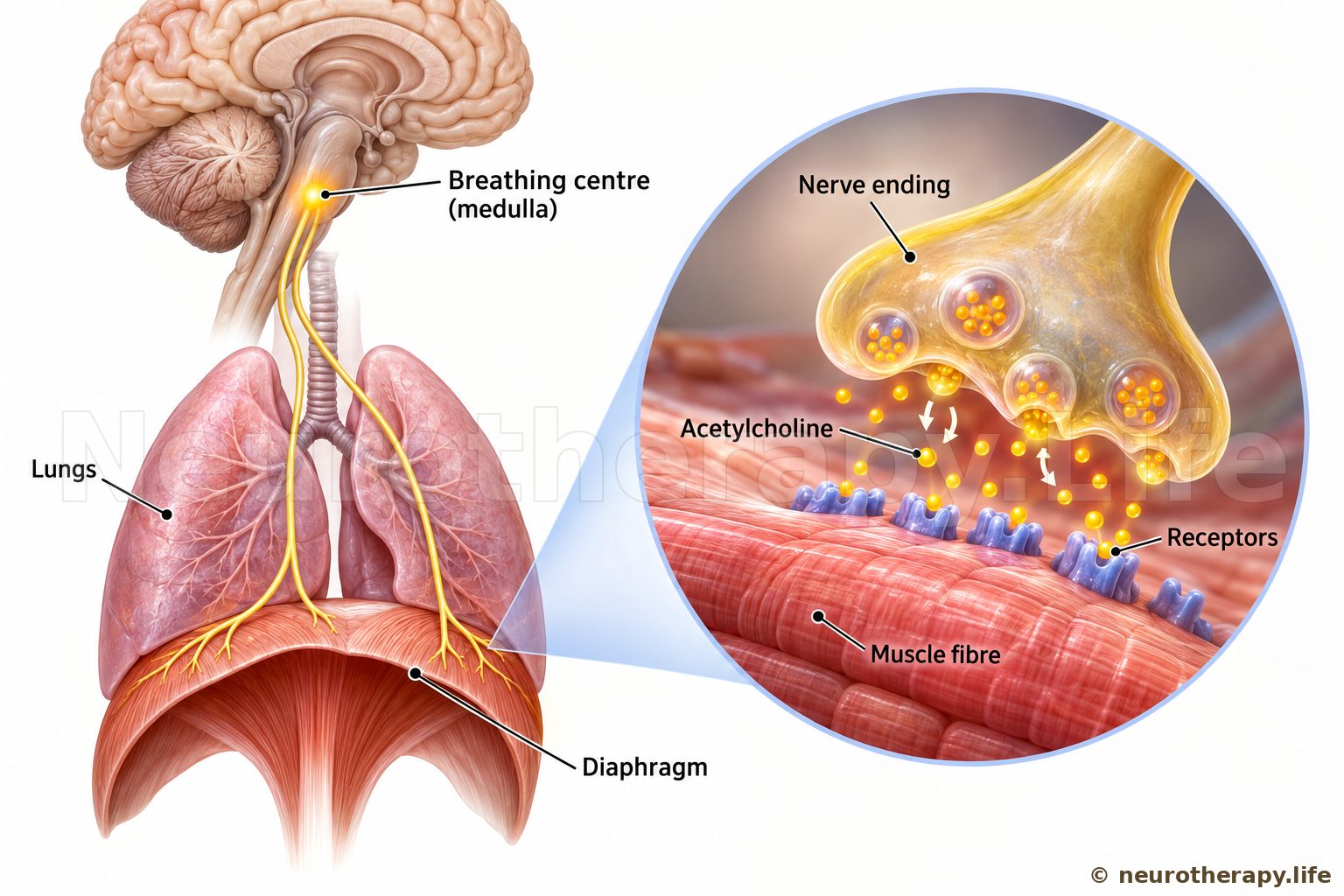
It was not reasoned out first; it was found in an emergency. A patient had difficulty breathing, (15) Medulla was given, and relief came at once. Only then came the reading: the breathing centre in the medulla works when acetylcholine is released, so (15) Medulla must make or stimulate acetylcholine.
Acetylcholine is the messenger at every nerve-to-muscle joint of the muscles we move at will, and at the relay stations of both automatic nerve systems. That is why (15) Medulla carries a standing rule: give it before stimulating the calming nerves, the gut's nerves, the smooth muscles or any cranial nerve. It is not the strongest member — it is the first.
Acetylcholine drives the breathing centre and every voluntary muscle — the two worlds of (15) Medulla.
Where it is given
Where is (15) Medulla given?
PositionSitting
Body areaBoth sides of the neck behind and below the ears (left only when written Left)
You sit on a firm chair, feet flat, back supported. A very ill or very weak patient — common in muscle diseases — can receive it lying down.
It is given on both sides of the neck, one side at a time, behind each ear and down the side of the neck towards the shoulder. In some formulas it is written as (15) Left Medulla, and then only the left side is worked.
How it is given
How is (15) Medulla given?
How this point is given — the tool, the pressure, the count and the exact movement — is deliberately not described here. Watch the demonstration video on this page, and learn the method hands-on from a trained Neurotherapist before giving it. Please do not give any point from a written description alone: a point given in the wrong place or the wrong way can do harm.
The number written before a point's name is not a strength setting. Each numbered form is a separate named treatment with its own method and timing, taught hands-on in the course.
The exact technique is taught hands-on in the Neurotherapy (LMNT) course. See the course →
What it does
What does (15) Medulla do in the body?
LMNT teaching holds that (15) Medulla makes or stimulates acetylcholine. Body science confirms that acetylcholine does each of the jobs below; the link from the neck is the therapy's own finding, and some uses are marked by the therapy as still to be tried.
Breathing: the medulla's breathing centre needs acetylcholine; especially for people whose breath stops and starts during sleep.
Voluntary muscles: needed for every muscle we move at will — the basis of its use in MND, GBS, myasthenia and MS.
Digestion: acetylcholine is one of the three signals needed for stomach acid, which is why it heads the undigested-food formulas.
Saliva and sweat: helps a dry mouth, and those who do not sweat at all.
Prostaglandins and red cells: acetylcholine stimulates prostaglandins, the reasoning behind the first erythropoietin formula — offered as reasoned, still to be tried.
Organs it reaches
Medulla (brainstem) — Holds the breathing centre that acetylcholine keeps working.
Muscles — Every voluntary muscle is switched on by acetylcholine.
Lungs — Breathing difficulty, and breath that stops in sleep.
Stomach — Acetylcholine is one of the signals for acid.
Combined with it over months in muscle diseases such as MND, in one practitioner's experience.
Safety: when it is held back
Where (2) Pan is being given to check a tumour, (15) Medulla is not given — acetylcholine puts down somatostatin, the brake that (2) Pan works through. The bar turns on why (2) Pan is given. (2) Pan
Food poisoning that affects breathing, swallowing or the eyes (as in botulism) is a hospital emergency. Call 108/112 first; any treatment is only alongside hospital care. Food poisoning
Breathlessness at rest, blue lips, or weakness spreading quickly up the legs (possible GBS) needs emergency care now. How to tell a patient to see a doctor
Never stop myasthenia, MS or breathing medicines because of this treatment. The neurologist decides every change.
A teaching case
Teaching case: the woman who was carried in
A teaching case from one practitioner's reported experience: a bed-ridden woman with motor neuron disorder, who could not lift her neck, was brought in held up by two men. Over several months she received the Oxygen-Hormonal treatment daily, with (15) Medulla added from the second month. The practitioner reported that she later walked holding just a finger — an observation, not a promise, and her own doctor's care continued throughout.
A composite case written to teach the reasoning — not one patient’s file.
Common questions
Why is (15) Medulla given before (10) Medulla?
Because acetylcholine is the messenger the vagus uses. The rule is: supply the messenger first, then stimulate the nerve.
Does it cure motor neuron disease?
No cure is claimed. Patients have reported more strength for a while; the disease itself is managed by the neurologist, and this works alongside that care.
I am diabetic. Can I have (15) Medulla?
Yes — diabetes does not bar it. Only (10) Medulla is barred in diabetes.
Why does it help a dry mouth?
Acetylcholine tells the salivary glands to release saliva and widens their blood vessels. That is also one more benefit of starting the undigested-food formulas with it.
Surprising facts
1The first messenger ever found
Acetylcholine was the first nerve messenger ever identified, by Otto Loewi in 1921, using two frog hearts and a nerve that slowed them.
Source: Guyton & Hall, Textbook of Medical Physiology (14th ed.); Nobel Prize in Physiology or Medicine 1936 (Loewi and Dale).
2When the receptors are attacked
In myasthenia gravis the body's own antibodies attack the acetylcholine receptors on muscle, so muscles tire quickly — often first seen as drooping eyelids or double vision.
Source: Gilhus NE et al. Myasthenia gravis. Nat Rev Dis Primers 2019;5:30.
3The sweat exception
The alarm nerves almost always use adrenaline-type messengers — except at sweat glands, where they use acetylcholine. That is why fear brings sweat and a dry mouth together.
Source: Guyton & Hall, Textbook of Medical Physiology (14th ed.), the autonomic nervous system.
Watch
UDF (Anpacha Khaana) ka Neurotherapy Ilaaj | 40+ Bimariyon ki Jad | LMNT
A step-by-step demo of the full UDF (undigested food) treatment: 15 Medulla, Parkhoo at both hips, Half Kundli, 10 Medulla with 1 Gas Only and 1 Gas 'I', then the Gal, Spleen, Liver and Mucus points and Ajay Normal on the thighs and forearms. It is given to support digestion when food passes through undigested.
Test yourself
Research
Strong evidence
A major review of myasthenia gravis: antibodies attack the acetylcholine receptor where nerve meets muscle, and the main symptom is muscle weakness — showing how central acetylcholine is to every voluntary movement.
This page explains what a Neurotherapy (LMNT) treatment is for; it is not a self-treatment guide and does not diagnose. Neurotherapy (LMNT) works alongside your medical care — keep taking the medicines your doctor prescribed.
Ready to begin?
Send COURSE for course details, or your name, age and health issue for a consultation.