(2) Pan is the form of the Pan point aimed at somatostatin, the body's own braking hormone. It is used where a gland or hormone is working too much and to check unwanted growths such as fatty lumps, cysts and fibroids — and it carries the strictest timing rule of any point.
Overview
What is (2) Pan?
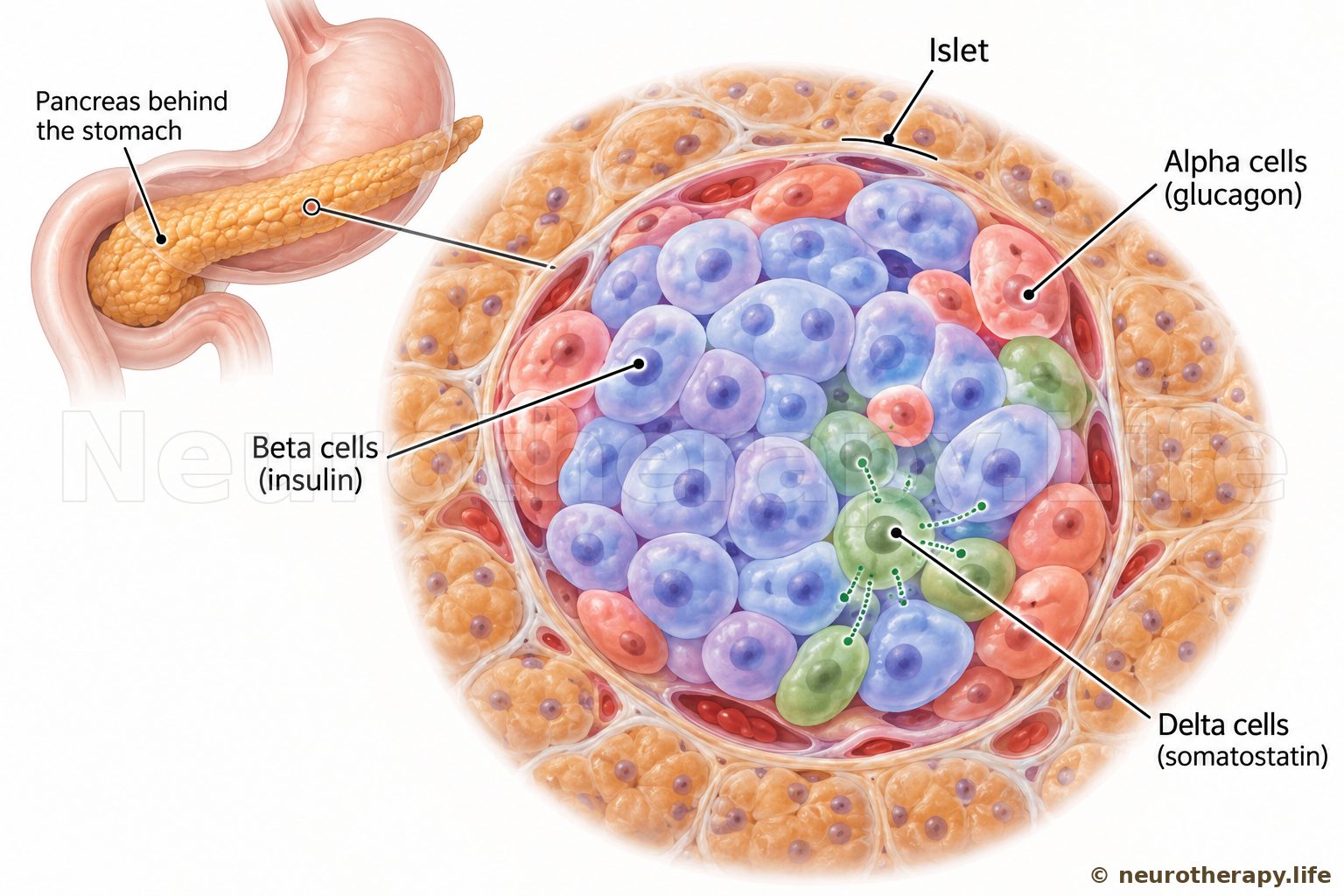
Pan is short for pancreas, the soft gland that lies deep behind the stomach. Besides digestive juice, the pancreas makes three hormones (chemical messengers carried in the blood): insulin, glucagon and somatostatin.
Guruji taught that by Pan we stimulate the pancreas, and that stimulating it in different numbers produces different effects. (2) Pan is the form aimed at somatostatin. Somatostatin is a brake: it slows the release of other hormones, including growth hormone.
So (2) Pan is the 'stop' form of Pan. It is used where something is working too much or growing where it should not. That makes it useful — and it is also why it is kept away from a child who still needs to grow.
The small number does not mean a light or gentle Pan. The bracket number chooses the treatment; it is not a dose. (2) Pan and (18) Pan, for example, do quite different jobs.
Somatostatin comes from the delta cells of the islets — the brake (2) Pan is aimed at.
Where it is given
Where is (2) Pan given?
PositionLying on the back
Body areaFront of both thighs, middle of each thigh, just below the thigh–hip crease
You lie flat on your back, with one pillow under both thighs and nothing under the head or the waist. (2) Pan is given on the front of both thighs together, in the middle of each thigh, just below the crease where the thigh meets the hip.
This is exactly the same spot as every other form of Pan. The place does not change from one number to the next — only the treatment does. The middle of the thigh is chosen on purpose: further inward lies the groin, where the main artery, vein and nerve of the leg run close under the skin.
Why the thigh, when the pancreas lies deep in the belly? The Neurotherapy (LMNT) map works by a crossing rule: pressure on the legs answers pains above the navel. The point is named for what it is meant to move, not for the place it is given on.
How it is given
How is (2) Pan given?
How this point is given — the tool, the pressure, the count and the exact movement — is deliberately not described here. Watch the demonstration video on this page, and learn the method hands-on from a trained Neurotherapist before giving it. Please do not give any point from a written description alone: a point given in the wrong place or the wrong way can do harm.
The number written before a point's name is not a strength setting. Each numbered form is a separate named treatment with its own method and timing, taught hands-on in the course.
The number before itNames the treatment; it is not a strength setting
The exact technique is taught hands-on in the Neurotherapy (LMNT) course. See the course →
What it does
What does (2) Pan do in the body?
In Neurotherapy (LMNT) teaching, (2) Pan rouses the pancreas to make somatostatin, and somatostatin's job is to stop. Body science confirms that somatostatin really is a braking hormone; how a press on the thigh reaches it is the therapy's own explanation, offered from clinical experience.
If any gland or hormone is 'hyper' — working too much — it is used to calm it down.
To check unwanted, abnormal growth: lipoma (soft fatty lumps), cysts and fibroids.
In psoriasis and other skin disease, to stop the skin becoming overactive and to support the kidneys in clearing toxins.
In kidney failure, uraemia and nephrotic syndrome, given with (10) Pan to increase urine.
For stiffness in the muscles, and named for goitre (swelling of the thyroid gland).
In cancer care it is the form given in place of (4) Pan, as support alongside the oncologist — never as a treatment for the cancer itself.
Organs it reaches
Pancreas — Its delta cells make somatostatin, the local brake on insulin and glucagon.
Pituitary gland — Somatostatin from the brain holds back growth hormone from the pituitary — the reason for the height bar.
Kidneys — Used with (10) Pan to increase urine in kidney failure.
Every number of Pan is given at the same place, and each is its own treatment with its own uses and its own cautions. A caution written against one number does not travel to the others — but the general Pan cautions apply to all.
Pan — The parent Pan point — the pancreas point and its five numbered forms.
(4) Pan — Glucagon — for weakness from low sugar; appetite and height in small children. Not in diabetes or cancer.
(8) Pan — Digestive enzymes and bicarbonate — the everyday form that opens the Normal and Heparin formulas.
(10) Pan — Insulin — for diabetes, long-standing joint pain and eye disease.
(18) Pan — The highest number — to reduce prolactin in women; cataract and eye disease; opens F. Heparin.
What it is used for
What is (2) Pan used for?
(2) Pan is chosen from the patient's findings, after the blocked list has been checked — never from the name of a disease alone.
Unwanted growths
Lipoma and cystTo check fatty lumps and cysts — after a doctor has seen the lump.
Uterine fibroidsNamed in its uses; a fibroid stays under a gynaecologist's care.
The full Heparin assembly for multiple infarcts or calcification; one of its parts is Anti F. Heparin.
Safety: when it is held back
Blocking comes first. Before any treatment, the points not to be given for the patient's disease are marked on the diagnosis card. Where a caution and a use both apply, the caution wins. Conditions that block certain points: the six families
Exact timing is the safety: if (2) Pan is held longer than it should be, it begins to act like (4) Pan, which makes glucagon and feeds all cells — harmful in cancer. Only a trained therapist gives it. Cancer care: Neurotherapy (LMNT) support
Children and height: (2) Pan stops growth hormone, so it is never given to a child who is short or under treatment to increase height. (4) Pan or (10) Pan may be given instead. Children always receive light treatment. Low height in children (short stature)
Never stimulate the organ the cancer is in: in cancer of the pancreas, (2) Pan is not given either. Nothing in this therapy treats cancer; it is support alongside the oncologist. Cancer care: Neurotherapy (LMNT) support
Where (2) Pan is given to set right a tumour, (15) Medulla is not given with it, because acetylcholine holds back somatostatin. (15) Medulla
Fits, convulsions and epilepsy: Pan raises alkali, so it is not given — except where it sits inside a Heparin formula. Epilepsy (fits)
Schizophrenia: Pan is not given. It has been seen to make these patients hear voices. Schizophrenia
Never stop or change your medicines because of Pan. Neurotherapy (LMNT) works alongside your doctor's care; any change of dose is the doctor's decision.
Guruji says
“By Pan we stimulate the pancreas. Stimulating in different numbers produces different effects.”
— Dr. Lajpatrai Mehra
Common questions
Is (2) Pan just a lighter (8) Pan?
No. The number chooses the treatment, not the strength. (2) Pan is aimed at somatostatin, a braking hormone; (8) Pan is aimed at digestive juices. They are different treatments given at the same spot.
Why is my child given (4) Pan and not (2) Pan?
Because (2) Pan holds back growth hormone. A child who is short, or being treated for height, is never given it; (4) Pan or (10) Pan is used instead.
Can (2) Pan remove my lump or fibroid?
It is used to check unwanted growth, and patients have reported improvement. But every lump must first be seen by a doctor, and a fibroid stays under your gynaecologist's care. Neurotherapy (LMNT) works alongside that care.
Why is timing so important with (2) Pan?
Because, in Guruji's teaching, a hold that runs too long turns it into (4) Pan, which has the opposite effect. This is the one place where staying longer changes a treatment into its contrary — so it is never given casually or at home without training.
Surprising facts
1One hormone, two homes
Somatostatin is made both in the pancreas and in the brain. In the brain it holds back growth hormone; in the pancreas it brakes insulin and glucagon.
Source: Guyton & Hall, Textbook of Medical Physiology (somatostatin: hypothalamic growth-hormone inhibiting hormone and islet delta-cell hormone).
2A brake on both pedals
Inside each islet, somatostatin from the delta cells holds back the release of both insulin and glucagon — the two hormones that push blood sugar in opposite directions.
Source: Röder PV et al., Pancreatic regulation of glucose homeostasis, Exp Mol Med 2016;48:e219.
3Medicine copied it
Because natural somatostatin lasts only a few minutes in the blood, doctors use longer-lasting copies of it to calm certain overactive hormone conditions.
Source: Standard pharmacology of somatostatin analogues (e.g. octreotide), Goodman & Gilman's The Pharmacological Basis of Therapeutics.
4The islets are tiny
All the hormone-making islets together are only about 1 to 2% of the pancreas, yet they steer the blood sugar of the whole body.
Source: Röder PV et al., Exp Mol Med 2016;48:e219.
Watch
How to Give 1, 2, and 8 PAN Point in Neurotherapy | Practical Demo for Students - Dr. Diwakar Shukla
A practical demo by Dr. Diwakar Shukla on how to give 1, 2 and 8 Pan — the pancreas point — to support a weak pancreas.
How to Stimulate Pancreas Naturally? | LMNT Pan Point | Diabetes और Indigestion का जादुई इलाज
Shows how to find the Pan (pancreas) point in the fold at the top of both thighs, and how to give 1 Pan, 2 Pan, 2 Pan × 6 and 8 Pan with the feet, holding chairs for support. It is used to support the pancreas in diabetes and indigestion.
Test yourself
Research
Strong evidence
A review of how the pancreas controls blood sugar. It confirms that delta cells make somatostatin, which holds back the release of both insulin and glucagon, and that the islets are only 1–2% of the organ.
This page explains what a Neurotherapy (LMNT) treatment is for; it is not a self-treatment guide and does not diagnose. Neurotherapy (LMNT) works alongside your medical care — keep taking the medicines your doctor prescribed.
Ready to begin?
Send COURSE for course details, or your name, age and health issue for a consultation.