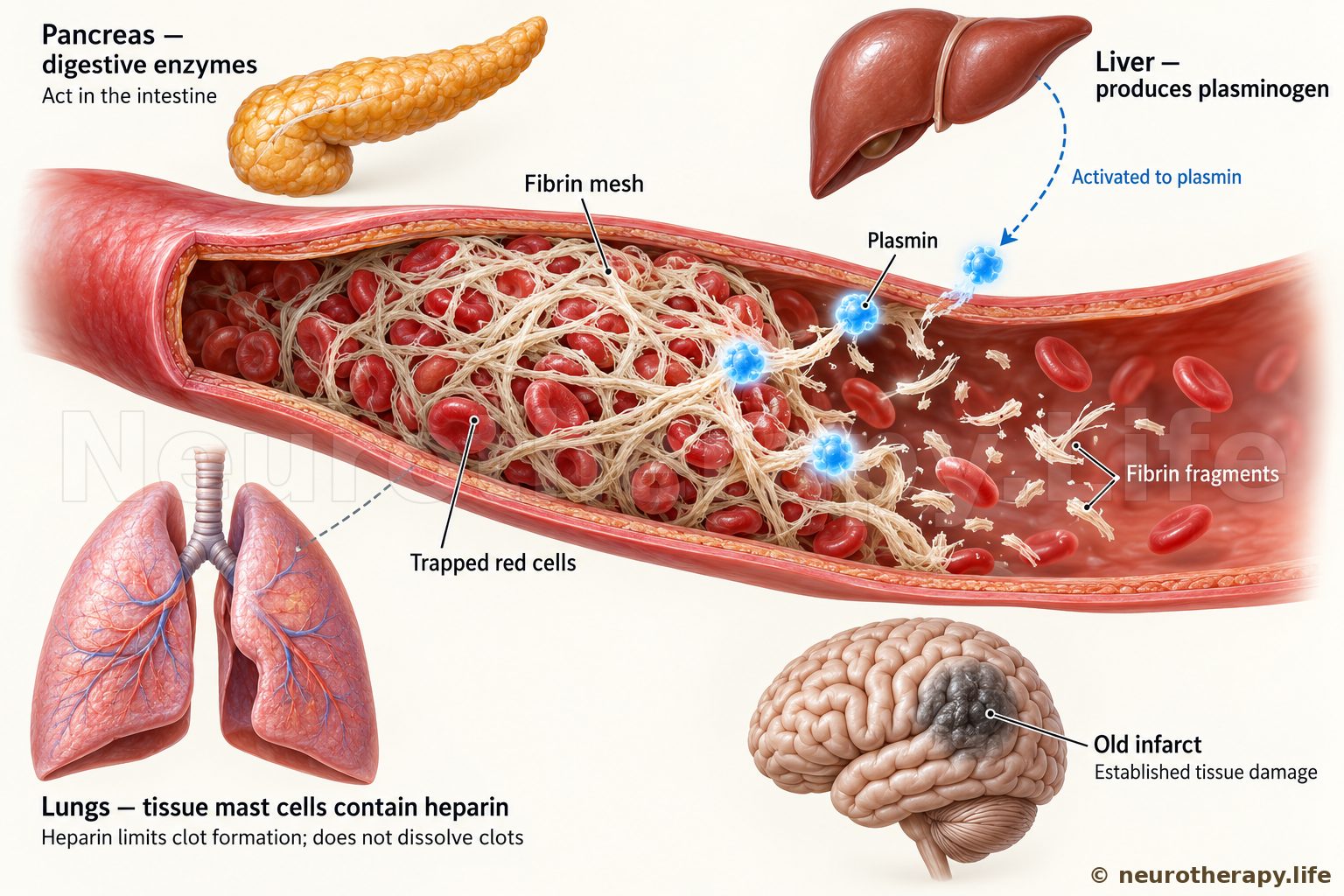
F. Heparin is one of the newest members of Neurotherapy (LMNT)'s Heparin family. It keeps the three points of the parent formula but changes the pancreas point to (18) Pan, aiming to break the fibrin that has set in old clots — for example in paralysis after an infarct many years ago.
Overview
What is F. Heparin?
Blood is safe while it moves. When it slows or stops in the wrong place, it can set into a clot. Heparin is the body's own anticoagulant — a substance that stops clots from forming — and the body makes most of it in the liver and the lungs.
Guruji's parent Heparin formula, P. Heparin, works through three points: the pancreas, the liver and the lungs. The liver and lungs are roused to make heparin, so no new clot forms. The pancreas is roused to digest fibrin, the tough protein mesh of an old clot — because plasmin, the body's clot-dissolving enzyme, resembles trypsin, which the pancreas makes.
F. Heparin — F for fibrinolysin — changes one thing only: the pancreas point becomes (18) Pan. It is aimed at old diseases, to break fibrin that has already set in clots.
F. Heparin keeps the parent formula's pancreas, liver and lungs, but changes the pancreas point to aim at fibrin that has already set in an old clot.
What it is for
What is F. Heparin used for?
In old diseases, breaking the fibrin set in clots.
Paralysis after an infarct (a part of the brain that lost its blood supply) that has lasted many years.
Paralysis with infarct or ischaemia (poor blood supply) and pain, alongside PT. Heparin as the other choice.
The teaching says the newest Heparin formulas have proved useful for all kinds of paralysis — and that research on them is continuing.
Points it works through
Which points does F. Heparin work through?
(18) Pan (7) Liv (8) Ch. Only
The same three points as the parent formula, listed as a set. Only the pancreas point is different. The exact method is taught hands-on in the Neurotherapy (LMNT) course. This page lists the points of the formula and what each one contributes; it does not describe how any point is given. For the method, watch the demonstration video of each point on its own page and learn hands-on from a trained Neurotherapist. Please do not give a formula from a written description alone.
(8) Ch. Only, a light upward sweep across the chest — the lungs, roused to make heparin.
Position:Lying on the back (supine).
The exact technique is taught hands-on in the Neurotherapy (LMNT) course. See the course →
How it works
How is it different from the other Heparin formulas?
Every Heparin formula is the parent sequence with one thing done to it. Some put a point in front; one replaces the last step. F. Heparin and Anti F. Heparin are the only two that change a number — and both change the same one, the pancreas point.
F. Heparin raises it to (18). Anti F. Heparin lowers it to (2). It is tempting to read them as a strong and a weak version of one treatment. They are not. In Neurotherapy (LMNT) the number at a chemical point is a selector, not a dose: (18) Pan and (2) Pan are different treatments with different jobs.
F. Heparin breaks the fibrin that has set in an old clot. Anti F. Heparin is for obstruction caused by unwanted growth — fibroids, cysts, stones. Giving the 'lighter-looking' one to a frail patient with an old stroke would not be a smaller dose of the right thing; it would be the other thing.
Its family
Which formulas are related?
F. Heparin is one of eleven named Heparin formulas, all built from one parent.
P. Heparin (plasmin) — The parent formula — pancreas, liver and lungs — which can be given to all patients.
Anti F. Heparin (anti-fibrin) — The twin that changes the same point the other way, to (2) Pan — for obstruction from unwanted growth.
PT. Heparin — The other newest member, with Thymus + Chest at the end — also named for infarct or ischaemia with pain.
Multi Heparin — Six parts run as one treatment, for multiple infarcts or calcification; F. Heparin is one of its parts.
M. Heparin (medulla) — The Heparin formula headed by (6) Medulla, for headache, brain and eye disease.
G. Heparin ('glandins) — The Heparin formula headed by (30) Medulla, for paralysis from high blood pressure.
What it is used for
Where is it used?
The Heparin family has its own selection table. These are the rows that choose F. Heparin, and the neighbouring row that chooses its twin instead.
Old clots and paralysis
Paralysis and strokeParalysis after an infarct, present for many years; or with infarct or ischaemia and pain
Pan is not given at all in schizophrenia, which puts every Heparin formula out of reach. In fits or seizures, Pan is ordinarily withheld; its own entry allows it within the Heparin formula, which is the therapist's decision. Pan
Never swap F. Heparin and Anti F. Heparin as if one were a lighter dose of the other. They are different treatments for different problems. Anti F. Heparin (anti-fibrin)
A sudden new weakness, numbness, drooping face or loss of speech is a stroke emergency. Call emergency services (108/112) at once — every minute matters. How to tell a patient to see a doctor
If you take blood thinners or clot medicines, keep taking them exactly as prescribed and tell your therapist. Neurotherapy (LMNT) works alongside your medical care.
Guruji says
“In old diseases, F. Heparin is useful for breaking the fibrin set in clots. It will be known further from experience. Research upon these is continuing.”
— Dr. Lajpatrai Mehra
Common questions
Does F. Heparin put heparin into my body?
No. Nothing is injected or swallowed. The idea is that the body's own organs are roused to make their own heparin and clot-digesting enzymes.
My stroke was ten years ago. Is it too late?
F. Heparin is the formula the teaching names for infarct with paralysis of many years. Results vary from person to person, and the teaching itself says research is continuing. Your therapist will examine you and keep a record of progress.
Is (18) Pan just a bigger dose of (8) Pan?
No. At chemical points the number chooses a different treatment. (18) Pan is used here for breaking fibrin; (2) Pan is used in the twin formula for unwanted growth.
Can I have it during my period?
No treatment is given during the four days of the period, and no Heparin formula is given when the flow is heavy.
Surprising facts
1A clot is built in three steps
Prothrombin, with calcium, becomes thrombin. Thrombin turns fibrinogen into fibrin threads. The fibrin net traps blood cells and becomes a clot. The liver makes both prothrombin and fibrinogen.
Source: Guyton & Hall Textbook of Medical Physiology, 14th ed., mechanism of blood coagulation.
2The clot carries its own dissolver
Plasminogen gets trapped inside a clot as it forms. Later, tissue plasminogen activator (tPA) turns it into plasmin, which cuts the fibrin apart. tPA works about a thousand times better when fibrin is present.
Source: Miszta A, et al. Assessing Plasmin Generation in Health and Disease. Int J Mol Sci. 2021;22(5):2758.
3Heparin was discovered in the liver
Heparin was first isolated from liver tissue in 1916, which gave it its name (from the Greek 'hepar', liver). It is stored in mast cells, which are plentiful in the liver and lungs.
Source: Guyton & Hall Textbook of Medical Physiology, 14th ed., heparin as an intravascular anticoagulant (mast cells of liver and lungs).
Test yourself
Research
Strong evidence
A review explaining how the body dissolves clots: tPA turns plasminogen into plasmin, which cuts fibrin apart — the body science behind the idea of breaking an old clot's fibrin.
This page explains what a Neurotherapy (LMNT) treatment is for; it is not a self-treatment guide and does not diagnose. Neurotherapy (LMNT) works alongside your medical care — keep taking the medicines your doctor prescribed.
Ready to begin?
Send COURSE for course details, or your name, age and health issue for a consultation.