Why blood must keep moving: clots, heparin and the P. Heparin idea
Blood that slows down begins to clot. The body protects itself with heparin, made mostly in the liver and lungs, and with plasmin, which dissolves old clots. P. Heparin, the parent of the Heparin formulas, was built on these facts.
Overview
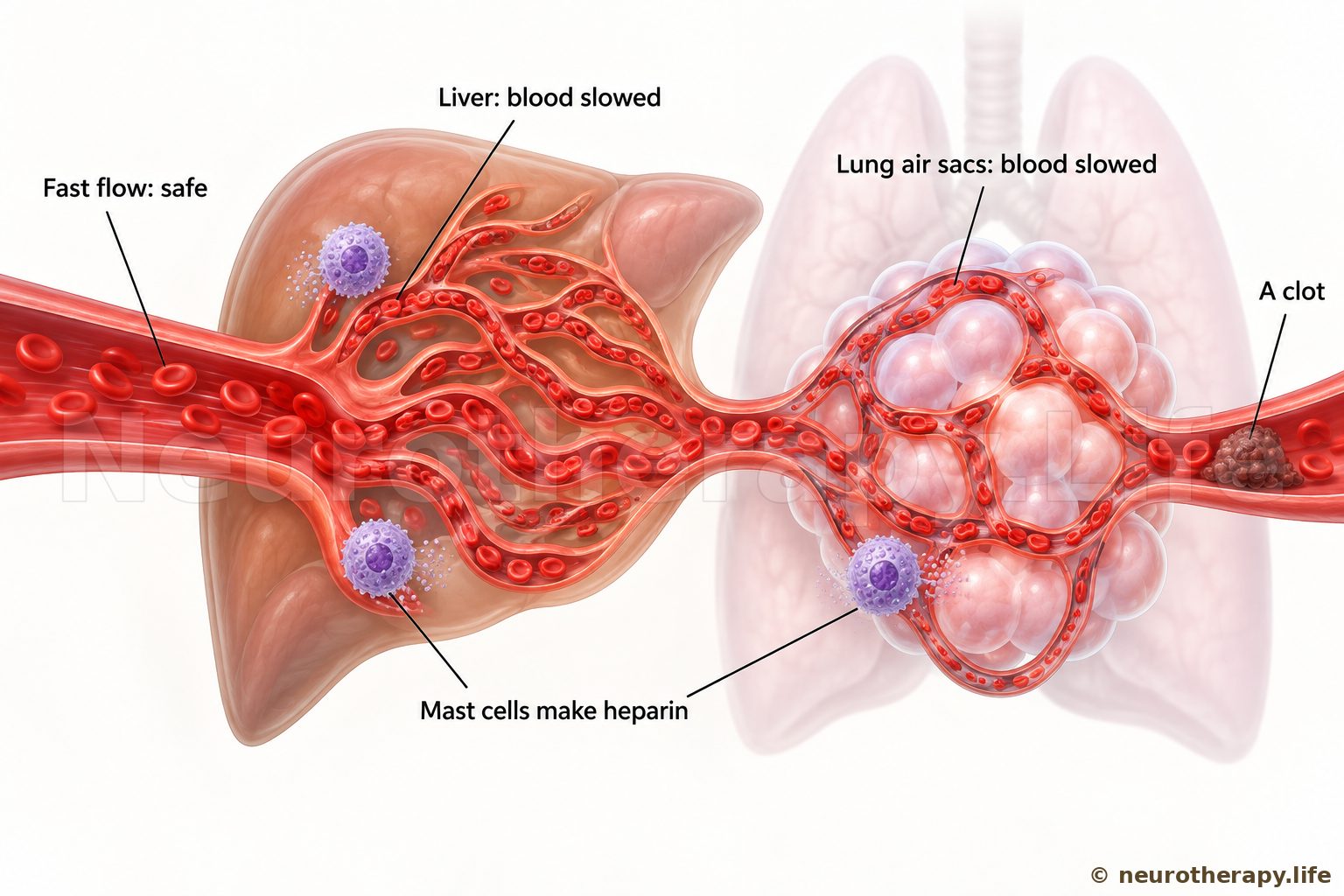
Blood is safe while it moves fast. If it stops or slows down, it begins to set, which is called clotting. This protects us: without it, a single wound could bleed a person to death. Yet a clot that forms inside a vessel is just as dangerous. The body stands between these two dangers every second.
Heparin is the body's own anti-clotting chemical. The therapy states that most of it is made by mast cells in the liver and lungs, the two places where blood is deliberately slowed: in the liver so that its cleaning cells can remove worn-out red cells and germs, and in the lung air sacs so that oxygen and carbon dioxide can be exchanged. Slow blood risks setting, so heparin is made right there.
A clot that has already formed is opened by plasmin, an enzyme that digests the fibrin net of the clot. Plasmin resembles trypsin, a digestive enzyme of the pancreas. If plasmin does not work properly, clots keep growing and can lead to paralysis and other illness.
From this reasoning came P. Heparin, which works through Pan, Liv and Chest Only: the pancreas for the old clot, the liver and lungs for heparin. A hold at Ku for the mast cells now opens every Heparin formula. The exact method is taught hands-on in the Neurotherapy (LMNT) course.
Key points
- Moving blood is safe; slow or still blood begins to clot.
- Heparin prevents new clots; plasmin dissolves old ones.
- The liver and lungs slow the blood on purpose, so they make heparin.
- P. Heparin works through the pancreas, liver and lungs.
Go deeper
P. Heparin (plasmin)
P. Heparin, the parent formula
Liver
The liver, where blood is slowed and cleaned
Lungs
The lungs and their air sacs
Pancreas
The pancreas and its protein-digesting juices
Thrombosis (blood clots)
Thrombosis: clots that form where they should not
Blood
Blood and the clotting factors
Heart, blood and circulation
The heart and blood vessels
The River: Heparin and the Heparin Formulas
The full guide to the Heparin family
Read the full guide
This topic is part of: The River: Heparin and the Heparin Formulas
Safety: when it is held back
- If blood is flowing or there is an open wound, no Heparin treatment of any kind is given until the wound heals. P. Heparin (plasmin)
- Bleeding that will not stop, very heavy periods, or bruising without injury must be checked by a doctor to find the cause. Period problems (irregular, heavy or painful)
- Pan is never given to people with schizophrenia; Liv is not given in liver cancer and Chest Only not in lung cancer. Pan
- Neurotherapy (LMNT) works alongside your medical care. Do not stop or change any medicine on your own, especially a blood thinner; ask the doctor who prescribed it.
Watch

Shows the P. Heparin formula: (8) Pan at the top of the thighs, (7) Liv on the thigh and forearm, and (8) Chest Only with the palms on the chest. In the video it is given as the last part of the Angina treatment, to support circulation.
This page explains what a Neurotherapy (LMNT) treatment is for; it is not a self-treatment guide and does not diagnose. Neurotherapy (LMNT) works alongside your medical care — keep taking the medicines your doctor prescribed.