Your heaviest internal organ and the body's chemical factory: it cleans the blood, makes bile and most blood proteins, and stores fuel and vitamins. In Guruji's teaching it is one of the two 'raw-materials works' that every other gland depends on.
Overview
What is the liver?
Your liver is a large, soft, reddish-brown organ in the upper right part of your belly, tucked under the ribs. It is the heaviest organ inside your body — about 1.4 to 1.5 kg in an adult.
It does hundreds of jobs. It handles everything absorbed from the gut, clears old blood cells, germs, medicines and alcohol, makes bile to digest fat, and makes most of the proteins in blood plasma — including the ones that make blood clot. It stores sugar, iron and several vitamins. And it is the only organ inside you that can grow back to nearly full size after a large part is removed.
In Guruji's teaching the liver and the pancreas are the body's 'raw-materials works': between them they make many of the base substances from which the other glands build their hormones and enzymes. That is why a course of LMNT treatment spends its first days on the belly, and why liver points appear in digestive, blood, clot and blood-pressure formulas alike.
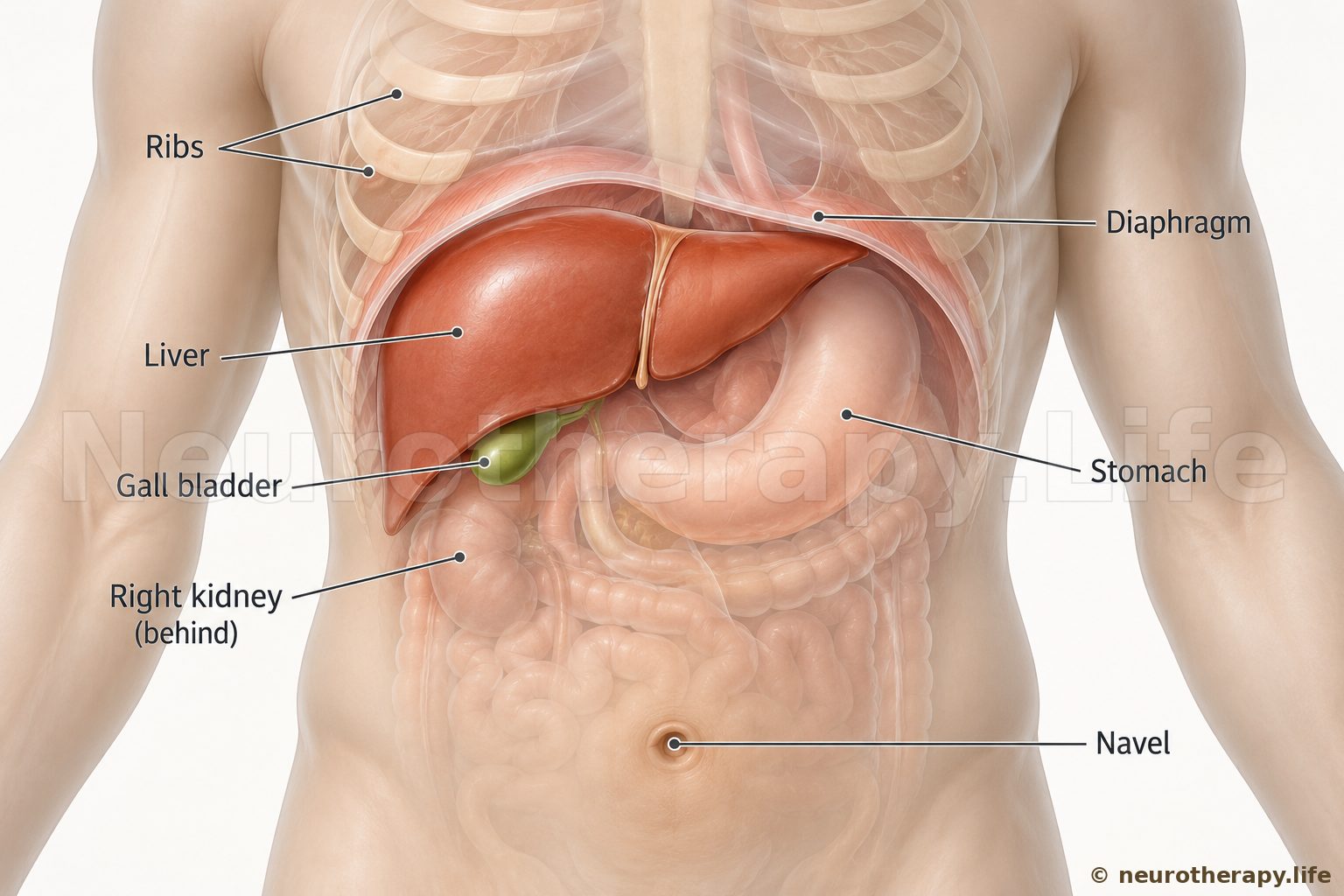
The liver fills the upper right of the belly, sheltered by the ribs, with the gall bladder tucked beneath.
Function
What does the liver do?
The liver is a filter, a factory and a warehouse at the same time. Almost everything you absorb passes through it before it reaches the rest of the body.
Makes bile — about 600 to 1,000 ml a day — which the intestine needs to digest fat and absorb fat-soluble vitamins.
Keeps blood sugar steady: it stores sugar as glycogen after meals and releases it between meals.
Makes most blood-plasma proteins — albumin, the clotting factors, and angiotensinogen, which helps control blood pressure.
Makes cholesterol and handles fats, sending them where they are needed.
Clears the blood: breaks down medicines, alcohol and used hormones, and turns poisonous ammonia into urea for the kidneys to remove.
Its Kupffer cells catch germs and worn-out red blood cells, and recycle their iron.
Stores vitamins A, D and B₁₂, and iron and copper.
Blood arrives by two pipes
About three-quarters comes through the portal vein, loaded with what the gut and spleen send; the rest comes through the hepatic artery, bringing oxygen.
It slows down to be inspected
The blood seeps slowly through narrow, winding channels called sinusoids, past rows of liver cells. Kupffer cells lining the channels pick out germs and old red cells.
Liver cells take what they need
Sugars, amino acids and fats are taken up, then stored or built into new substances such as glycogen, proteins and cholesterol.
Waste is made safe
Medicines, alcohol and ammonia are changed into forms that the kidneys can pass in urine or that can leave in bile.
Bile flows the other way
Bile made by the liver cells runs in tiny canals, against the blood's direction, into the bile ducts — then to the gall bladder for storage, or straight into the duodenum.
Clean blood leaves for the heart
Processed blood collects in the hepatic veins and flows straight up into the large vein that enters the heart.
How does the liver work with other organs?
Gall bladder — Stores and concentrates the bile the liver makes, and releases it after a fatty meal.
Intestines — Send almost all absorbed food to the liver first, through the portal vein; receive its bile in return.
Pancreas — The other 'raw-materials works'. Its duct and the bile duct share one opening into the duodenum.
Kidneys — Pass out the urea and other waste the liver has made safe; together with the lungs they turn the liver's angiotensinogen into a hormone that raises blood pressure.
Blood — Depends on the liver for albumin and clotting factors; the liver recycles the iron of worn-out red cells.
Spleen — Its vein joins the portal vein, so the spleen's blood passes through the liver; both clear old red cells.
Heart — Receives the liver's clean blood; the liver's handling of cholesterol matters for the heart's arteries.
Anatomy
What are the parts of the liver?
The liver has lobes you can see, blood vessels and bile ducts that run through it, and a tiny repeating unit — the lobule — that does the work.
Lobes
Right lobe — The largest part, filling the upper right of the belly.
Left lobe — A thinner part that reaches across the midline over the stomach. A fold of tissue, the falciform ligament, marks the border on the front.
Caudate and quadrate lobes — Two small lobes on the underside, near where the vessels enter.
Eight segments — Surgeons divide the liver into eight segments, each with its own blood supply and bile drainage — which is why part of it can be removed safely.
Vessels and ducts
Portal vein — Brings blood from the stomach, intestines, pancreas and spleen — about three-quarters of the liver's supply.
Hepatic artery — Brings oxygen-rich blood from the heart.
Hepatic veins — Carry processed blood out, straight into the large vein that enters the heart.
Bile ducts — Right and left ducts join into the common hepatic duct; with the gall bladder's duct it becomes the common bile duct, which opens into the duodenum.
The working unit
Look through a microscope and the liver is built of about a million tiny six-sided units called lobules, each a millimetre or two across.
Hepatocytes (liver cells) — Arranged in plates like the spokes of a wheel; they do nearly all the liver's chemistry.
Sinusoids — Narrow, leaky channels between the plates, where blood flows slowly past the cells.
Kupffer cells — Resident cleaner cells in the sinusoids that swallow germs and old red cells.
Central vein — At the centre of each lobule; it collects the processed blood.
Where is the liver located?
The liver sits in the upper right part of your belly, just under the diaphragm, sheltered by the lower right ribs — roughly the seventh to the eleventh. Its thin left part stretches across the midline over the stomach. In a healthy adult its lower edge lies at about the edge of the right ribs, and it moves down a little every time you breathe in.
The gall bladder hangs beneath it. The stomach lies to its left, the right kidney and adrenal gland behind and below, and the bend of the large intestine below. The heart and right lung sit just above, on the other side of the diaphragm.
In LMNT the Liv point is two to three finger-breadths to the right of the navel, level with it. Guruji's teaching is careful that this name records where tenderness is found in liver trouble — not where the liver itself lies. The similar-sounding Liv° is a different point: it is read at the back, for the right kidney.
A healthy liver is smooth, glossy and reddish-brown, soft and slightly rubbery to the touch. It is shaped roughly like a wedge or a rounded triangle — thick and domed on the right, where it fits under the diaphragm, and thin on the left.
It is wrapped in a thin, tough capsule. A fatty liver looks paler and yellowish; a scarred (cirrhotic) liver becomes firm, shrunken and lumpy.
How big is the liver?
An adult liver weighs about 1.4 to 1.5 kg — about as much as a large bottle of water — and is roughly 20 cm across. It holds about 450 ml of blood at any moment, nearly a tenth of all your blood.
About 1.4 litres of blood flow through it every minute — roughly a quarter of everything the heart pumps at rest.
Conditions and disorders
What conditions and disorders affect the liver?
Liver disease is often silent for years, because the liver has great reserve and feels little pain. Fatty liver, viral hepatitis and alcohol are the commonest causes of damage.
The liver itself
HepatitisInflammation of the liver — from viruses, alcohol, fat or some medicines. Jaundice is its best-known sign.
ObesityExtra body weight is the main driver of fatty liver.
AlkalosisA tender Liv° is linked with the alkaline direction — but UDF is treated first.
What are common signs of a liver problem?
Often none at all in the early years — which is why check-ups matter
Yellow eyes or skin (jaundice)
Dark, tea-coloured urine and pale, clay-coloured stool
Tiredness, poor appetite and nausea
A dull ache or heaviness under the right ribs
Itching all over the body
Swelling of the belly or legs, easy bruising, or confusion — see a doctor urgently
What tests check the liver?
Liver function tests (LFT) — Blood levels of liver enzymes (ALT, AST, ALP), bilirubin and albumin.
Clotting test (PT/INR) — Shows how well the liver is making clotting factors.
Viral hepatitis tests — Blood tests for hepatitis A, B, C and E.
Ultrasound — Shows the liver's size and whether it is fatty, and checks the gall bladder and bile ducts.
FibroScan (elastography) — A painless scan that measures stiffness — a sign of scarring.
CT, MRI or biopsy — For a closer look, or a tiny tissue sample when the cause is unclear.
How are liver problems treated?
Weight, food and exercise — Losing even 5–10% of body weight and exercising regularly can reduce liver fat.
Stopping alcohol and harmful medicines — The liver often recovers well once the harm is removed.
Antiviral medicines — Hepatitis B can be controlled and hepatitis C can usually be cleared with a course of tablets.
Vaccines — Safe vaccines protect against hepatitis A and B.
Treating complications — Medicines and procedures for fluid build-up, bleeding veins or confusion in advanced disease.
Liver transplant — When the liver fails, a whole or part liver from a donor can be transplanted — often from a living relative, because the liver grows back.
Neurotherapy (LMNT)
Guruji's teaching gives the liver a place near the centre of the therapy. It reads the liver as one of two 'raw-materials works' — with the pancreas — on which the other glands depend. It reads the liver reports closely, because the liver decides three other values in a patient's file: when it does not work properly, cholesterol builds up in the arteries, uric acid rises, and the white-cell picture changes. It explains why so much of the body's anti-clotting heparin is made here: the blood is slowed almost to a stop in the liver's narrow channels, so that the Kupffer cells can finish off old red cells and germs within a hundredth of a second — and blood that slow must be kept from setting. It holds that the liver keeps a store of vitamin B₁₂ for five to six years, and builds the B₁₂ formula around it: the gall bladder first, then the liver — 'first empty the godown, and afterwards send the new thing'. And it answers the natural worry about stimulating such a busy organ: through the body's own feedback, the teaching says, the liver makes only what the body needs at that time. The Liv point itself is given on the left arm and left thigh, because pressure on the left limbs relieves pain on the right of the navel. This is support alongside your doctor's care, never instead of it.
Points
Liv — The liver point: given on the patient's left forearm just below the elbow and the left thigh, together; the method is shown in the demonstration video on the Liv page.
Liv – 3 points — Three paired stations, arm and thigh together. For pain right of the navel, fever, appetite, fat metabolism and cholesterol; the teaching says it may be given in any disease — but never where there is cancer in the liver.
(7) Liv — The count carried by the Heparin, 1,25 DCC and Angiotensin No. 2 formulas.
(12) Liv — The highest count, described as very beneficial for dissolving gallstones — 'perhaps it works something like cholic acid', the teaching says, keeping its own hedge.
(1) point Liv × 6 treatments — The six stations given one at a time, an hour apart through the day — in hepatitis, jaundice, fatty liver and long illnesses; and in heart patients in place of (3) Gal (7) Liv.
Gal — The gall bladder, the 'godown of the liver'. Given before Liv in the B₁₂ formula.
Lt. Parkhoo — The B₁₂ point at the left hip — the third step of the B₁₂ formula, after the gall bladder and the liver.
(8) Pan — Opens the Heparin formulas, before (7) Liv: the pancreas to digest the fibrin of an old clot, the liver to make heparin.
Liv° — Not a liver point: Liv° is the right-kidney point, read at the back and given at the left shoulder and thigh.
“We cannot provoke the organs in an order of our own choosing.”
— Dr. Lajpatrai Mehra
“In this therapy we do not treat the disease; rather, we improve the body.”
— Dr. Lajpatrai Mehra
“It is not enough that one eats protein. The thing that matters is that it is digested.”
— Dr. Lajpatrai Mehra
Never do this
If there is cancer in the liver, no form of the Liv point is given. Liv
In heart patients, (3) Gal (7) Liv is not given — it improves the digestion of fats, from which cholesterol would rise. (1) single point Liv × 6 treatments is given instead. (1) point Liv × 6 treatments
No Heparin formula — all of which carry (7) Liv — is given while anything is bleeding or there is an open wound. P. Heparin (plasmin)
At the elbow, the foot goes flat on the muscle, never on the bony knobs. If the patient feels pins and needles or numbness running into the hand, release at once. Never load an arm with a dialysis fistula, or one that swells after breast surgery. Liv
Keep taking prescribed medicines. Tell your doctor about any herbal or 'detox' products — some can harm the liver. Never take more paracetamol than the label or your doctor allows.
See a doctor promptly for yellow eyes or skin, dark urine with pale stool, or a swelling belly. Vomiting blood, black stool, or drowsiness and confusion in someone with liver disease is an emergency — call 108/112. How to tell a patient to see a doctor
Care
How can I keep my liver healthy?
The liver forgives a lot and repairs itself well — if the cause of harm is taken away.
Keep a healthy weight
Fatty liver is now the commonest liver problem, and it follows weight and blood sugar. Even a small weight loss helps.
Move every day
Regular exercise lowers liver fat even before the scale moves much.
Go easy on alcohol — or skip it
Alcohol is broken down almost entirely by the liver, and too much scars it.
Less sugar, less fried food
Sugary drinks and fried food add to liver fat. Vegetables, dal and whole grains are kinder.
Get vaccinated
Hepatitis B vaccine — and hepatitis A where advised — prevents two common liver infections.
Safe water, safe needles
Hepatitis A and E spread through dirty water and food; B and C through blood — never share razors, needles or toothbrushes.
Medicines only as advised
The liver processes nearly every medicine and supplement. Stick to the dose, and tell your doctor what else you take.
Common questions
Can the liver really grow back?
Yes. After up to about two-thirds of a healthy liver is removed, the rest grows back to nearly full size within weeks to months. This is why a living person can donate part of their liver. A liver that is badly scarred (cirrhosis) loses much of this power.
What is fatty liver, and can it go away?
It means fat has built up inside the liver cells. It is very common, especially with extra weight, diabetes or high cholesterol, and it usually causes no symptoms. In its early stages it can often be reversed by weight loss, regular exercise and cutting sugar and alcohol.
Do I need a liver 'detox' or cleanse?
No. Cleaning the blood is what a healthy liver already does, all day. There is no good evidence that detox drinks or pills help, and some herbal products have harmed livers. The best 'detox' is less alcohol, a healthy weight and fewer unnecessary pills.
My therapist says my Liv point is tender. Is my liver damaged?
No. Guruji's teaching is clear that a point's name records where tenderness is found in that organ's trouble — not a diagnosis. The right way to say it is: 'There is a tender spot here. In our system it is connected with the working of the liver, and it is one of the things we will work on. It does not mean there is damage.' If you are worried, a doctor can check your liver with a blood test.
Is jaundice always a liver disease?
Not always. Yellowing comes from bilirubin, a pigment made when old red cells are broken down. It can build up because the liver is inflamed, because a stone blocks the bile duct, or because too many red cells are breaking down. Mild jaundice is also common in newborn babies. Any jaundice in an adult needs a doctor.
Why is the liver treated on the left arm and thigh when it is on the right?
In LMNT, pressure on the left limbs relieves pain on the right of the navel, and pressure on the right limbs relieves pain on the left. Legs are used for pain above the navel, arms for pain below. The Liv point uses both the left arm and the left thigh together.
What should I ask my doctor or therapist?
Are my liver tests normal, and if not, what is the likely cause?
Do I have fatty liver, and how much weight should I aim to lose?
Have I been tested and vaccinated for hepatitis B?
Are any of my medicines or supplements hard on my liver?
How much alcohol, if any, is safe for me?
For my therapist: are Liv and Gal tender, and is any liver treatment blocked for me — for example because of my heart?
Surprising facts
1Your liver can grow back
Remove up to about two-thirds of a healthy liver, and the rest grows back to nearly its full size within weeks to months. No other organ inside you regrows on this scale — which is why living people can donate part of their liver.
Source: Michalopoulos GK, Am J Pathol 2010;176:2–13 ('Liver regeneration after partial hepatectomy')
2The heaviest organ inside you
At about 1.4 to 1.5 kg, the liver outweighs the brain and is by far the heaviest organ inside the body. Only the skin, which covers the outside, weighs more.
Source: Gray's Anatomy (41st ed.) — adult liver about 1.4–1.5 kg; brain about 1.3–1.4 kg
3A quarter of your blood flow passes through it
About 1.4 litres of blood run through the liver every minute — roughly a quarter of what the heart pumps at rest, and close to 2,000 litres a day. Three-quarters of it arrives straight from the gut, which is why the liver sees almost everything you absorb first.
Source: Guyton & Hall, Medical Physiology — hepatic blood flow about 1,350 ml/min (about 27% of resting cardiac output); portal vein about 1,050 ml/min
4It keeps a spare half-litre of blood
The liver normally holds about 450 ml of blood — nearly a tenth of the body's total — and can squeeze much of it back into circulation after bleeding. Guruji's teaching gives the same figure, and builds the Angiotensin No. 2 formula for fallen blood pressure around the liver.
Source: Guyton & Hall, Medical Physiology — liver blood volume about 450 ml, about 10% of total; can release blood in haemorrhage. LMNT: wiki_db 35.13
5Its cleaners catch a germ in a hundredth of a second
Blood from the gut often carries bacteria. The Kupffer cells lining the liver's channels are so quick that a bacterium can be swallowed in less than a hundredth of a second, and fewer than 1 in 100 get past. Guruji's teaching gives the same hundredth of a second — and says this is why the blood must be slowed here.
Source: Guyton & Hall, Medical Physiology — Kupffer cells phagocytose bacteria in less than 0.01 s; less than 1% of portal bacteria pass the liver. LMNT: wiki_db 33.3
6It keeps years of vitamin B₁₂ in store
Most things the body runs on are stored for hours or days. Vitamin B₁₂ is different: the liver holds enough to last at least a year and often several — which is why a shortage creeps up so slowly. Guruji's teaching puts the store at five to six years.
Source: Guyton & Hall, Medical Physiology (vitamin storage in the liver — B12 for at least 1 year and possibly several); NIH Office of Dietary Supplements, Vitamin B12 fact sheet. LMNT: wiki_db 34.1
7It makes up to a litre of bile a day
Your liver makes about 600 to 1,000 ml of bile every day. Bile breaks fat into tiny droplets, carries out waste such as bilirubin, and gives stool its brown colour.
Source: Guyton & Hall, Medical Physiology — bile secretion 600–1,000 ml/day
8The liver itself feels almost no pain
The tissue inside the liver has very few pain nerves. Pain comes only when its thin outer capsule is stretched — for example when the liver swells. That is one reason liver disease can grow silently for years, and why blood tests matter.
Source: Gray's Anatomy (innervation of the liver capsule); StatPearls, 'Anatomy, Abdomen and Pelvis, Liver' (NCBI Bookshelf)
A day in the life of your liver
~2,000 Lof blood passed through
600–1,000 mlof bile made
~450 mlof blood held in reserve at any moment
~25%of the heart's resting output
< 1/100 sfor a Kupffer cell to catch a germ
Yoga
Bhujaṅgāsana — the cobra pose Bhujaṅgāsana
Benefits
Stretches the front of the body and the belly, and strengthens the back.
Traditionally taught among the poses for digestion.
Part of the regular movement that helps keep liver fat down.
How to do it
On an empty stomach, lie face down, legs together, forehead on the mat.
Place your palms under your shoulders, elbows close to the body.
Breathing in, slowly lift the head and chest, using the back more than the arms.
Keep the navel on the mat and the shoulders relaxed. Hold for 3–5 breaths.
Breathing out, lower slowly. Repeat 3 times.
Take care
Not after meals. Avoid in pregnancy, with a hernia or recent belly surgery, or with a severe back problem. Do not push up beyond comfort.
Ardha Matsyendrāsana — the half spinal twist Ardha Matsyendrāsana
Benefits
A gentle twist that squeezes and then releases the belly.
Keeps the spine supple and the back muscles active.
Traditionally taught for digestion; done both ways for balance.
How to do it
Sit with both legs stretched out, back straight.
Fold the left leg so the heel is near the right hip; place the right foot outside the left knee.
Put the right hand on the floor behind you and hug the right knee with the left arm.
Breathing out, turn gently to the right, starting from the waist. Hold 3–5 breaths.
Come back to the centre and repeat on the other side.
Take care
Not after meals. Avoid with a slipped disc or severe back pain, in pregnancy, after recent belly or spine surgery, and with an enlarged liver or spleen. Twist only as far as is comfortable.
Śavāsana — the resting pose Śavāsana
Benefits
Deep rest after the other poses.
Slows the breath and calms the body.
Suits almost everyone, including those who cannot do stronger poses.
How to do it
Lie on your back on a mat, legs a little apart.
Rest the arms a little away from the body, palms up.
Close your eyes and breathe slowly through the nose.
Relax each part of the body in turn, from the feet up. Stay 5–10 minutes.
Take care
If lying flat makes you breathless, lie propped up — and tell your doctor, because that is worth checking. In late pregnancy, or with a swollen belly, lie on your left side instead.
Watch
LMNT Liv Point Self Treatment | Fatty Liver और कमज़ोर पाचन का पक्का इलाज | Natural Liver Detox
Shows where the Liv (liver) point sits on the thigh and forearm, and how to give 1, 3 and 7 Liv, and 1 point Liv × 6 with a one-minute gap. It is used to support the liver and weak digestion.
बुखार, थकान, Cholesterol और Fatty Liver का पक्का इलाज | 1 Gal 1 Liv Treatment | Natural Liver Detox
Shows how to give yourself 1 point Gal and 1 point Liv on the left thigh and forearm, six times with a one-minute gap. It is shared to support the liver in fatty liver and raised cholesterol, and as support during fever.
Note: for heart patients LMNT teaching gives 1 point Liv × 6 alone, without Gal.
Vitamin B12 Treatment in Neurotherapy | LMNT Formula for Anaemia, RBC & Nerve Health
Shows the Vitamin B12 treatment: (3) Gal and (7) Liv on the thigh and forearm, then (8) Left Parkhoo at the left hip with the patient lying on their side. It is given to support the body's absorption of vitamin B12.
P HAPARIN FORMULA
Shows the P. Heparin formula: (8) Pan at the top of the thighs, (7) Liv on the thigh and forearm, and (8) Chest Only with the palms on the chest. In the video it is given as the last part of the Angina treatment, to support circulation.
Test yourself
Research
Strong evidence
A review of how the liver regrows after part of it is removed: the remaining cells divide in waves until the original mass is restored, usually within weeks to months.
A review of the liver's Kupffer cells: the body's largest group of resident cleaner cells, catching bacteria and debris from the gut blood before it reaches the rest of the body.
This page explains how the body works; it does not diagnose. Neurotherapy (LMNT) works alongside your medical care — keep taking the medicines your doctor prescribed, and see a doctor for any new or severe symptom.
Ready to begin?
Send COURSE for course details, or your name, age and health issue for a consultation.