The Front of the Body I: The Digestive Points Given Lying on the Back
Most of Neurotherapy (LMNT)'s daily work is given with the patient lying on the back, through a small family of digestive points: Pan, Gal, Spl, Liv, Mu, Gas Only, Gas ‘I’, Liv°, Mu°, Const, Dys and WD. This guide explains where each one is given, what it is used for, why the map crosses from one side to the other, and the safety rules that go with them.
Overview
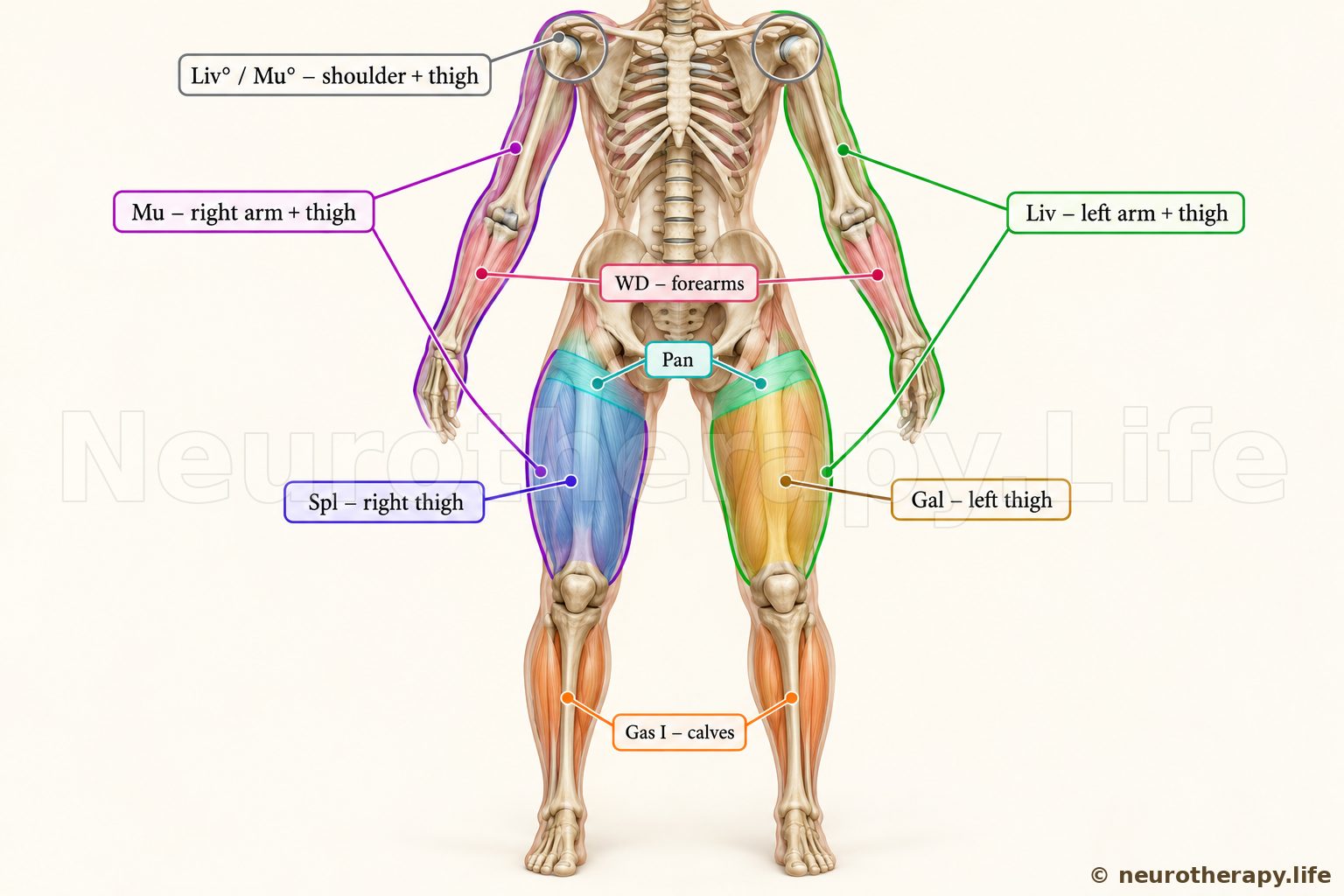
Most of Neurotherapy (LMNT)'s daily work is given with the patient lying on the back, through a small family of digestive points: Pan, Gal, Spl, Liv, Mu, Gas Only, Gas ‘I’, Liv°, Mu°, Const, Dys and WD. This guide explains where each one is given, what it is used for, why the map crosses from one side to the other, and the safety rules that go with them.
The point is not named after the place you press
A teaching case, put together from camps where the same mistake happens every year: a keen student knew that the gall bladder lies on the right. His patient, a tailor with a dull ache under the right ribs after meals, had Gal written on his card, so the student worked carefully on the right thigh for days. Nothing changed. The senior therapist asked him to give the same work on the other thigh, and within days the ache after meals had gone.
The student had carefully given Spl, a different point, to a man who needed Gal. The lesson is the key to this whole group: a point is named for the pain it answers, not for the limb it is given on.
Why the map crosses
Guruji's rule has three parts. Pressure on the legs, between the groin and the ankle, relieves pains above the navel. Pressure on the arms, up to the wrists, relieves pains between the navel and the bottom of the trunk. And pressure on a left limb relieves pain to the right of the navel, while a right limb relieves pain to the left.
So Gal, named for the gall bladder on the right, is given on the left thigh, and Spl, named for the spleen on the left, on the right thigh. None of this is a misprint or a mistake in anatomy. The code names the pain point; the limb is chosen by the rule. Within one limb, a second rule picks the place: the nearer a pain lies to the navel, the further down the limb it is answered.
Pan, Gal and Spl: the thigh points
Pan, the pancreas point, is given on both upper thighs together, near the crease of the hip. It answers the sore place just below the breastbone that is found in all diseases of the pancreas. Unlike the other thigh points, Pan stays at one place. The pancreas itself lies deep at the back wall of the belly; nothing in a thigh touches it. Pan has named variants, such as (2) Pan, (8) Pan and (10) Pan, and each is a separate treatment with its own use.
Gal runs down the left thigh from hip to knee and answers pain below the right ribs, found in gall bladder disease and all bile-related trouble. Spl is its mirror on the right thigh, answering pain below the left ribs, found in blood disorders and diseases of the spleen. If the patient's legs roll outward, a pillow on the outer side supports them, so the patient does not hold them straight with her own muscles.
Liv and Mu: an arm and a thigh together
Liv, the liver point, is given on the left arm and the left thigh at the same moment. Mu — the code for mucus, the lining membrane of the whole digestive tract — is given on the right arm and right thigh. Their pain points sit at the level of the navel itself, on the border between what the legs answer and what the arms answer, which is why each takes one of each. On a card Liv usually comes before Mu.
A flat, even pillow goes under the treated hand. An uneven pillow, or a chair leg touching the hand, can leave the hand or fingers aching for days — a complaint patients rarely connect with its cause. A repeated form of Liv, spaced through the session, is used as support in fevers such as malaria and typhoid, always alongside proper medical tests and treatment.
Gas Only and Gas ‘I’: stomach and intestines
Gas Only is given on both thighs. It helps the stomach digest proteins and reduces gas in the stomach. Gas ‘I’ — the ‘I’ stands for intestine — is given further down the same limbs, on both calves, because the small intestine lies coiled around the navel. It increases blood circulation in the intestines, reduces intestinal gas, and helps the body absorb nutrients from food.
The two belong together in planning. In some conditions, such as constipation, acidity and piles, Gas Only is blocked; and where it is given in the undigested-food work, Gas ‘I’ must follow it, or the constipation can increase.
Liv° and Mu°: the two kidney points
The small ring changes the point. Liv° (Liver Zero) is the code for the right kidney and increases blood circulation in it; Mu° (Mu Zero) does the same for the left kidney. The code was chosen kindly, so that a patient reading her card is not frightened by the word “kidney”. They are given like Liv and Mu, but the arm contact moves up to just outside the shoulder joint and stays in one place there.
Read the crossing carefully: Liv° is given on the left for the right kidney, Mu° on the right for the left kidney. A second pillow supports the shoulder so the joint rests well on it. Writing Liv where Liv° was meant changes the treatment, so the ring is always written large.
Const, Dys and WD
Const, for constipation, is given in the middle of the right thigh and brings relief in constipation. It is never given to someone who has loose motions — and that is judged on the day, not from the file. A patient with lifelong constipation who arrives loose this morning does not get Const today. Dys, its mirror on the left thigh, is for ordinary loose motions, but it is recorded that in practice it is used next to never.
WD stands for White Discharge. It is given on both forearms, from elbow to wrist, with the therapist working from the head end. It reduces pain below the navel and increases blood circulation in the genital organs. Because it is given on the forearms, it carries none of the risk of pressing on the lower belly.
Key points
- Most daily work is given lying on the back, through Pan, Gal, Spl, Liv, Mu, Gas Only, Gas ‘I’, Liv°, Mu°, Const, Dys and WD.
- A point is named for the pain it answers, not for the limb it is given on.
- Legs answer above the navel, arms below it, and each side answers the opposite side.
- Pan stays at one place; Gal and Spl run down a thigh; Liv and Mu take an arm and a thigh together.
- Liv° and Mu° are the kidney codes; the small ring makes them different points from Liv and Mu.
- Const is never given on a day with loose motions.
Topics in this guide
Go deeper
Pan
Pan, the pancreas point, and its named variants
Gal
Gal, the gall bladder point on the left thigh
Liv
Liv, the liver point on the left arm and thigh
Gas 'I'
Gas ‘I’, the intestine point on the calves
Const
Const, the constipation point
Normal Treatment Formula
The Normal formula, built from these points
The Navel Speaks First: The Map of the Pain Points
The pain points around the navel these points answer
The Front of the Body II: Glands, Toes, Lymph, Chest and Arms
The gland points given on the back
Placing the Patient: The Four Positions of Neurotherapy (LMNT)
How the patient is placed and the pillow rules
Safety: when it is held back
- Const is not given to anyone who has loose motions; ask about today's bowel before every session. Const
- A calf that is swollen on one side only, warm and tender may hide a clot. Do not press or rub it; send the patient to a doctor the same day. Ask first about recent bed rest, a long journey, an operation, a plaster cast or pregnancy. Thrombosis (blood clots)
- In malaria, typhoid, blood diseases and long-standing liver trouble the spleen can swell and become fragile: no firm pressure over the upper left belly, and a firm, tender fullness under the left ribs goes to a doctor the same day. Spleen
- Fever with shaking chills, fever lasting more than a few days, or fever with drowsiness, a rash or a stiff neck needs a blood test the same day. Neurotherapy (LMNT) is given alongside medical treatment, never instead of it. Fever and viral fever
- The shoulder contact of Liv° and Mu° is not loaded after a recent dislocation, a torn cuff, a fracture, a replaced joint or recent surgery near the shoulder; in the frail and those with thin bones it is given by hand. Pain running down the arm with numbness means stop. Liv°
- Discharge that smells, is coloured or bloodstained, or comes with pain, fever or itching needs a doctor's examination and tests; WD does not replace them. Leucorrhoea (white discharge)
- In cancer, (10) Pan, Thymus, Pit, Lu + Sh, Rt. Ov / Lt. Ov and (30) Medulla are never given; in cancer of the pancreas, Pan variants that stimulate it are not given. Cancer care: Neurotherapy (LMNT) support
- Small children, the very weak and anyone with osteoporosis are treated with the hand only, lightly. The Child, the Elder and the Frail: Neurotherapy (LMNT) for Delicate Bodies
Guruji says
“Pressure on one or both legs, between the groin and the ankle, relieves pains above the navel. Pressure on the arms or forearms, up to the wrists, relieves pains between the navel and the perineum. Pressure on the left arm or leg relieves pains on the right of the navel; pressure on the right arm or leg relieves pains on the left.”
Common questions
My problem is on the right. Why are you pressing my left leg?
Because this therapy is built that way, consistently: pressure on the left limbs relieves the right side of the abdomen and the right limbs the left, while legs answer above the navel and arms below it.
Is my pancreas really being treated through my thigh?
It is not touched — nothing outside your body can reach it. The pressure is given at a place found to relieve the very pain you came with, under the breastbone. Judge it honestly, by whether that pain eases over the coming weeks.
My hand ached for two days after the last session. Should I have said something?
Yes, at the time. That ache almost always comes from the support under your hand or something touching your fingers, not from the treatment itself. It is easily corrected, and the treatment loses nothing by being adjusted.
I have had loose motions since yesterday. Should I go home?
No — but do tell the therapist, because it changes what is given today. The constipation point is left out until you have settled. A changed stomach is a reason to be treated differently, not to be sent away.
Watch

Dr. Diwakar Shukla explains and demonstrates the Liv° point — where it lies on the right side and how it is pressed to examine the body.
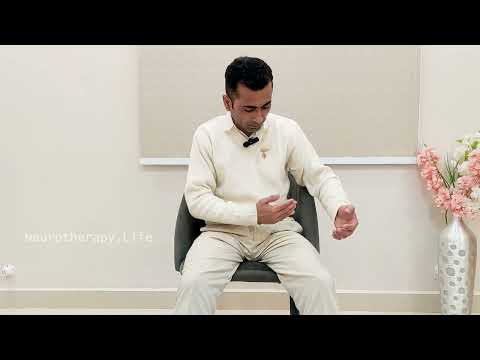
Shows where the Liv (liver) point sits on the thigh and forearm, and how to give 1, 3 and 7 Liv, and 1 point Liv × 6 with a one-minute gap. It is used to support the liver and weak digestion.

Shows how to give yourself 1 point Gal and 1 point Liv on the left thigh and forearm, six times with a one-minute gap. It is shared to support the liver in fatty liver and raised cholesterol, and as support during fever.
Note: for heart patients LMNT teaching gives 1 point Liv × 6 alone, without Gal.
Test yourself
Explore more
Organs
Body systems
Diseases
Points
Formulas
Topics
Read more
This page explains what a Neurotherapy (LMNT) treatment is for; it is not a self-treatment guide and does not diagnose. Neurotherapy (LMNT) works alongside your medical care — keep taking the medicines your doctor prescribed.