The Navel Speaks First: The Map of the Pain Points
Every Neurotherapy (LMNT) examination begins around the navel. Gentle pressure at fixed places there, and at the low back, shows where blood flow is disturbed — and that map, not the name of the complaint, guides the treatment.
Overview
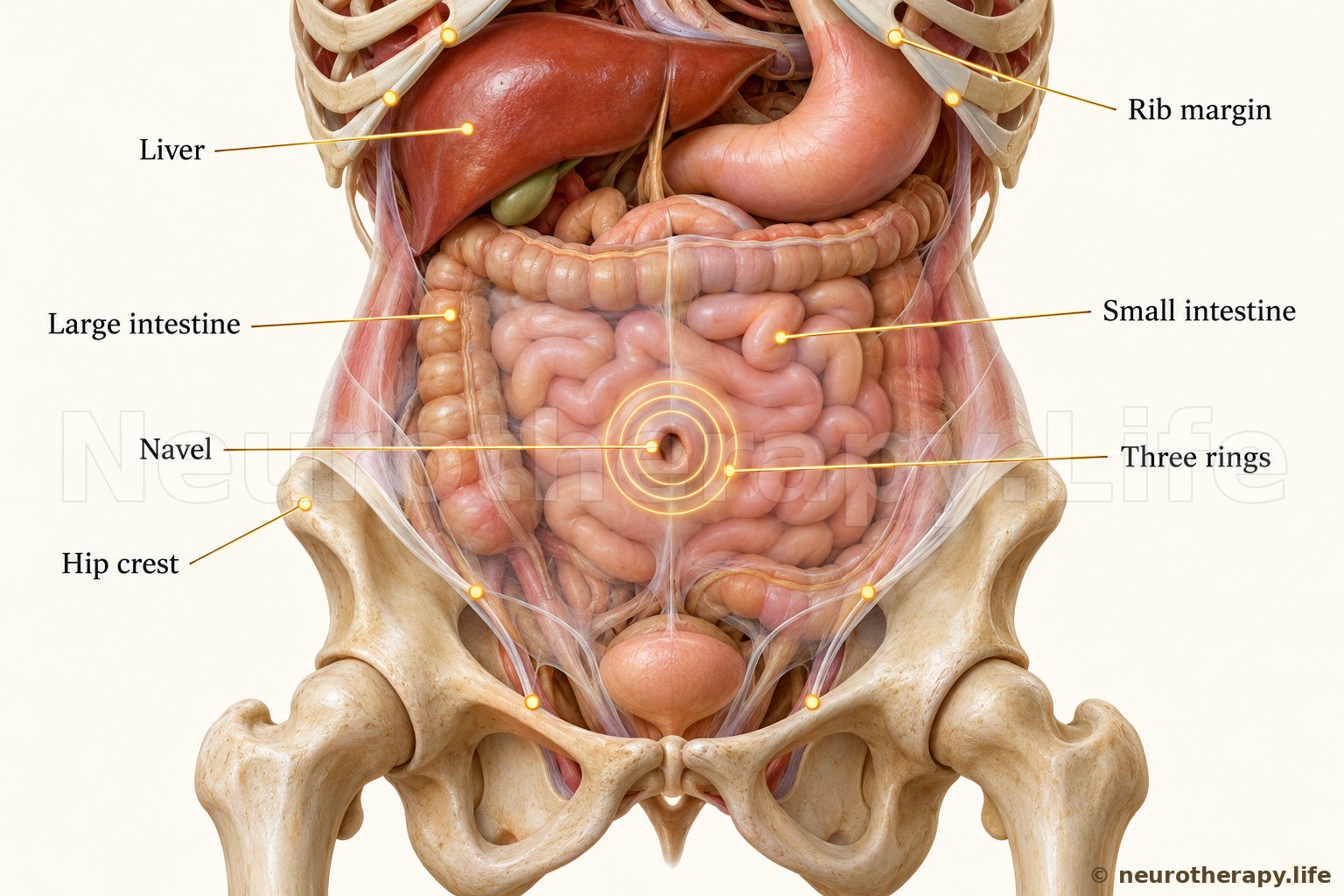
Every Neurotherapy (LMNT) examination begins around the navel. Gentle pressure at fixed places there, and at the low back, shows where blood flow is disturbed — and that map, not the name of the complaint, guides the treatment.
She came about her knees
This is a teaching case, put together from many first visits. A schoolteacher came about her knees and brought an X-ray. The therapist asked her to lie down and pressed gently, with fingertips, a little to the left of her navel. She flinched and asked: "What is that? There has never been pain there." There had been — but nothing in her life had ever pressed that spot. When somebody finally did, it answered at once, and what it said had more to do with her knees than the X-ray did.
Why the navel, and why first
The whole map rests on one observation, made over decades on a very large number of patients. Whatever a person's symptoms, illness is usually accompanied by pain or hardness at one or more fixed points around the navel and the hip. And people who share a symptom, or a group of symptoms, are found tender at the same points.
Pain at a place reports a disturbance in the blood flow to that area and its organs. Read it backwards and it becomes the working rule: when the pain at a point goes, the blood supply has returned. The therapist feels for two things — pain, which belongs to the patient, and hardness, where the wall of the belly has lost its give and meets the finger like a half-filled ball instead of a cushion. A brave patient can hide pain; nobody can hide hardness.
Why the navel? Every one of us was built outward from that point, and the organs of the abdomen sit packed around it with no empty space. For an organ to work, it needs blood and nerve messages without a break, all day and night. So the belly around the navel is where the inner organs report most clearly.
A name for a place, and for its treatment
Each pain point carries a short code name, generally pointing to the main organ or symptom of that region — generally, not always. The same name stands for two things: the place pressed to find out, and the treatment given to correct it. Gal is where you look, and Gal is what you give.
This is different from a doctor's examination of the abdomen. A doctor feels an organ to judge its size, edge and firmness. A Neurotherapist presses places decided in advance, looks for one sign, and then usually treats somewhere else entirely — on an arm or a leg. And a code name is not an address: a healthy spleen sits high and far back and cannot be felt from the front at all. Tenderness at the place called Spl goes with spleen-related trouble; it is not a claim that the finger rests on the spleen.
The front chart at a glance
The front points sit around the navel, under the rib margins and down at the groin and hip crests. Most come in mirror pairs, one on each side.
- Pan (pancreas) — the soft dip at the bottom of the breastbone.
- Gal (gall bladder) under the right rib margin, and Spl (spleen) its mirror on the left.
- Liv (liver) beside the navel on the right, and Mu (the mucous lining of the whole gut) on the left.
- Gas (stomach and duodenum) above the navel, and Gas 'I' (small intestine) right around it.
- Const (constipation) on the left and Dys (loose motions) on the right — named after symptoms, not organs.
- WD (uterus and prostate) below the navel, with Rt.Ov and Lt.Ov (ovary or testis) on each side lower down.
- Acid at the left groin and Fluid at the right — named for what they correct: Acid eases the signs of acidosis, Fluid the signs of alkalosis.
- Four vitamin points on the rim of the hip bone: FA (folic acid) and B12 at the front, Thia (thiamine) and Nia (niacin) at the back.
The back: Mu° and Liv°, the kidney points
At the low back, on each side, there is a soft hollow between the last rib and the rim of the hip bone. It is the one window into the back of the abdomen that no bone covers, and behind it lies the kidney. The left one is called Mu° (Mucus zero) and the right one Liv° (Liver zero). The two sides are always compared one after the other — a flank means little alone and a great deal beside its partner.
Why not just say "kidney"? For two kind reasons. To many patients the word means dialysis and hospital, and hearing it spoken again and again across a room can frighten them. And for memory: the Liv point is on the right of the navel with the right kidney just behind it, so the right kidney is Liv°; Mu is on the left, so the left kidney is Mu°. But a code name may hide a word, never a finding. If a patient asks, the therapist tells them plainly: it is our short name for the kidney, and there is nothing to be afraid of.
The numbers on the chart, and the bowel's own wave
The small numbers around the navel on the chart are not grades of severity — a 3 is not worse than a 1. They are positions: three rings, the innermost close to the navel and the outermost towards the rims of the belly. The ring of a tender point tells the therapist where along the arm or leg the answering treatment is given. The exact way this is read is taught hands-on in the course.
Pressure is never given in a random order. The large intestine moves its contents in one travelling wave — up the right side of the abdomen, across the top, and down the left — like squeezing a toothpaste tube from the closed end. Treatment works with that wave. Working against it slows the bowel and can cause constipation, so it is done on purpose only for a short time, when loose motions need to be slowed.
A pain-point picture belongs to a day
A recorded episode from a Neurotherapy (LMNT) camp: on a crowded second day, a woman asked for yesterday's treatment again because she was in a hurry, and it was given without examining her. Soon after, she was in tears with pain in her whole body. When Guruji examined her himself, her pain points were not those of the day before — the treatment had been right for a body that no longer existed.
The order that came from it still stands: never give treatment without examining the pain points. If the patient is in a great hurry, ask them to come the next day. "Come tomorrow, when I can examine you properly" is a complete and professional answer.
Key points
- Illness is usually accompanied by pain or hardness at fixed points around the navel and hip.
- Pain at a point reports disturbed blood flow; when the pain goes, the supply has returned.
- A code name names both the place pressed and the treatment given — and it is not an anatomical address.
- Mu° and Liv° are the left and right kidney points at the low back, named so as not to frighten patients.
- The numbers on the chart are positions (rings), not grades of severity.
- Treatment works with the bowel's own wave, not against it.
- Never treat without examining the pain points that day.
Topics in this guide
Go deeper
The Educated Hand: How the Pain Points Are Felt
How to press so you find what is there, and nothing more
The Two Kingdoms: Acidic and Alkaline Bodies
What a tender Mu° or Liv° means: acid and alkali
The Hand That Heals: What Neurotherapy (LMNT) Is
What Neurotherapy (LMNT) is, in plain words
Before You Touch Anyone: Room, Conduct and Consent
What is checked before any treatment
Why a point for the right side is given on the left limb
Why the left limbs answer the right of the navel
Mu°
Mu°, the left kidney point
Liv°
Liv°, the right kidney point
Gal
Gal, the gall bladder point
Digestive system
The digestive system, where most work begins
Safety: when it is held back
- Tenderness at a vitamin point is a prompt to test, never a diagnosis. Numb feet, an unsteady walk, a sore smooth tongue or new forgetfulness need a vitamin B12 blood test soon; new confusion or unsteadiness after weeks of vomiting or eating very little needs a doctor the same day. The four vitamin points near the hip bone: FA, B₁₂, Thia and Nia
- Do not press firmly on a flank that is already tender, especially with fever, shivering, burning urine or vomiting — that needs a doctor the same day. Kidney disease
- Keep away from the kidney area with a known kidney swelling, a recent biopsy or a tube or stent; a transplanted kidney lies low in the pelvis, so take care on the lower abdomen too. How to tell a patient to see a doctor
- With blood thinners or a bleeding disorder, use the lightest pressure only; in thin bones or frail elders, never press on the last rib, which breaks easily. The Child, the Elder and the Frail: Neurotherapy (LMNT) for Delicate Bodies
- A vaginal discharge that is persistent, smelly, blood-stained or itchy, or comes with pelvic pain or fever, and any bleeding after menopause, need a doctor — treat alongside, never instead. Leucorrhoea (white discharge)
- A code name may hide a word, never a finding: anything that needs a doctor is said plainly to the patient and written on the card.
Guruji says
“Whenever there is an obstruction or blockage in the blood circulation of any part of the body, then pain or numbness is felt in that part.”
“Do not change your working method on the patient's insistence. If they are in a great hurry, then by all means tell them to come the next day without giving them treatment. But under no circumstances give treatment without examining their pain points.”
Common questions
My problem is my knee. Why are you pressing my stomach?
Because the knee is repaired from the same stores as the rest of the body, and those stores come from the belly. A quick, gentle check around the navel shows how well digestion and blood flow are working. If nothing is found, the therapist will say so.
There is pain there and I never knew. Is something wrong inside me?
It is a common finding and not a frightening one. It shows that a part of the abdomen is not getting the blood flow it should — not that anything is damaged. Most people carry two or three such spots without knowing, and they usually settle as treatment goes on.
What are those short words on my card?
They are short names for places on the body. Ask about any of them and the therapist will explain. Liv°, for example, is the short name for the right kidney — used because the word "kidney" frightens people without reason.
Can you tell what disease I have just by pressing?
No, and be careful of anyone who says they can. Pressing shows which regions of the abdomen are not working freely today. That guides the treatment, but naming a disease needs your doctor's tests.
Watch

An overview of LMNT's diagnostic pain points — the places around the navel that the therapist presses to read the body before choosing a treatment.

Dr. Diwakar Shukla shows students where the Mu° point lies and how it is pressed, both to examine the body and as part of treatment.
Test yourself
Explore more
Organs
Body systems
Diseases
Points
Topics
Read more
This page explains what a Neurotherapy (LMNT) treatment is for; it is not a self-treatment guide and does not diagnose. Neurotherapy (LMNT) works alongside your medical care — keep taking the medicines your doctor prescribed.