1A very narrow window
Healthy blood is kept between pH 7.35 and 7.45. Above 7.45 the state is called alkalaemia; below 7.35, acidaemia.
Source: Hopkins E, Sanvictores T, Sharma S. Physiology, Acid Base Balance. StatPearls. 2022.
Also called: Fluid, Alkali, Alkali or Fluid, फ्लूइड या ऐल्कली
Fluid or Alkali is the Neurotherapy (LMNT) point that mirrors Acid. It is taught as reducing the symptoms of alkali in the blood and is given lying on the left side, along the left thigh. The teaching says honestly that this point has not been used so far — so it is known mainly as an examination point and as the other half of a pair.
Neurotherapy (LMNT) reads many illnesses in two directions, the 'two kingdoms': acid and alkali. A body leaning to the alkali side tends to be wet, heavy and swollen — swelling (oedema), thin frequent stools, a watery nose, pale urine. Fluid and Alkali are two names for one point, named for that picture.
Its name tells what pressing it is meant to do, not what the patient has: the Fluid point corrects the symptoms of alkalosis, just as the Acid point corrects the symptoms of acidosis. Students who read it the other way give the wrong one of the pair.
The teaching adds a sentence it chooses not to tidy away: this point has not been used so far. That does not mean it is forbidden or useless — only that the experience behind it is not the experience behind Acid. The everyday work on the alkali side is done by other points and by the ALTF formula.
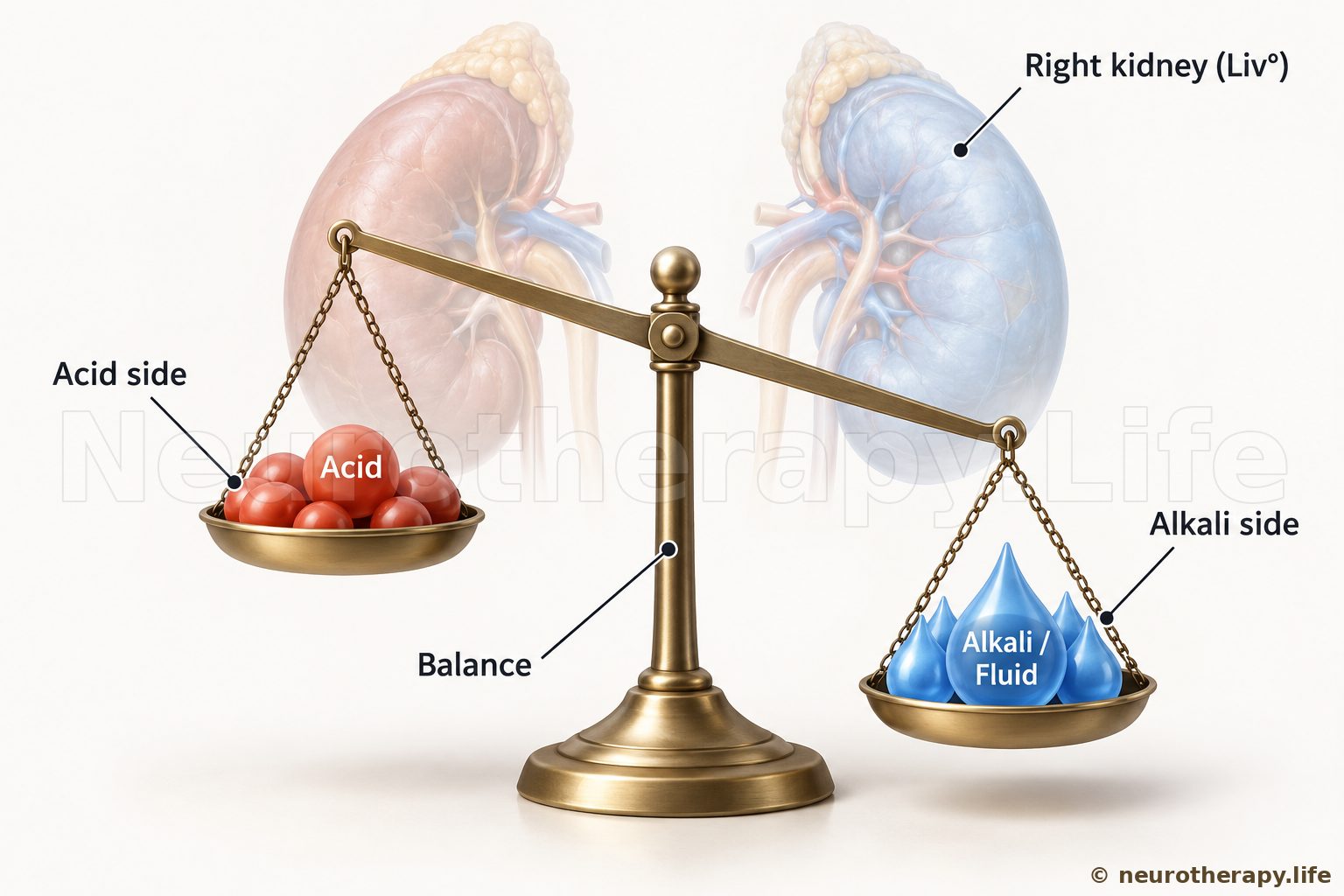
During examination, the Fluid point is felt over the right groin and the crest of the right hip bone — on the soft strip just above the bony rim, never the rim itself, which is tender in everybody. Its partner Acid is felt at the same place on the left.
As a treatment, it is given exactly as Acid, mirrored. You lie on your LEFT side with a pillow under your head and one between your thighs. The lower (left) leg stays straight and long; the upper leg is bent and rests on pillows so the knee is level with the waist; the right shoulder is turned a little outward.
It is given on the outer side of the LOWER thigh — the left one, lying along the mat — from the waist to the knee. The leg resting on pillows is not the one worked; it is only moved out of the way.
How this point is given — the tool, the pressure, the count and the exact movement — is deliberately not described here. A demonstration video for this point is being prepared; until it is on this page, learn the method hands-on from a trained Neurotherapist before giving it. Please do not give any point from a written description alone: a point given in the wrong place or the wrong way can do harm.
The exact technique is taught hands-on in the Neurotherapy (LMNT) course. See the course →
The teaching gives it one stated purpose, and in the same breath says it has not yet been used — so this is a stated aim, not a reported result.
Fluid is the mirror of Acid; the working tools of the alkali side are listed with it.
Because the point has not been used so far, these are the conditions it belongs to by its purpose, not a record of treatment.
“This is exactly how it should be. And this itself is the secret of Neurotherapy (LMNT)'s success.”
Because it completes the pair with Acid, it is an examination point, and the teaching keeps an honest record of what has and has not been tried rather than hiding it.
No. The name says what the point is meant to correct. Tenderness there is one finding among several; the direction of the body is decided from the whole picture.
Mainly the UDF formulas first, and then the ALTF formula if the right-sided findings remain.
Healthy blood is kept between pH 7.35 and 7.45. Above 7.45 the state is called alkalaemia; below 7.35, acidaemia.
Source: Hopkins E, Sanvictores T, Sharma S. Physiology, Acid Base Balance. StatPearls. 2022.
The lungs correct the blood's pH within minutes to hours by breathing out carbon dioxide; the kidneys correct it over days by keeping or releasing bicarbonate and acid.
Source: Hopkins E, Sanvictores T, Sharma S. StatPearls. 2022.
Losing stomach acid, as in repeated vomiting, is one of the classic causes of metabolic alkalosis.
Source: Hopkins E, Sanvictores T, Sharma S. StatPearls. 2022.
A clinical summary of acid–base balance: blood pH is held between 7.35 and 7.45; the lungs adjust it quickly through carbon dioxide and the kidneys slowly through bicarbonate and acid; alkalosis is a pH above 7.45.
This page explains what a Neurotherapy (LMNT) treatment is for; it is not a self-treatment guide and does not diagnose. Neurotherapy (LMNT) works alongside your medical care — keep taking the medicines your doctor prescribed.
Send COURSE for course details, or your name, age and health issue for a consultation.