The Two Kingdoms: Acidic and Alkaline Bodies
The first step of a Neurotherapy (LMNT) examination is to compare two soft spots at the low back, Mu° on the left and Liv° on the right. Which side is tender sorts most patients into one of two directions — acidic or alkaline — and that direction, not the complaint, shapes the whole plan.
Overview
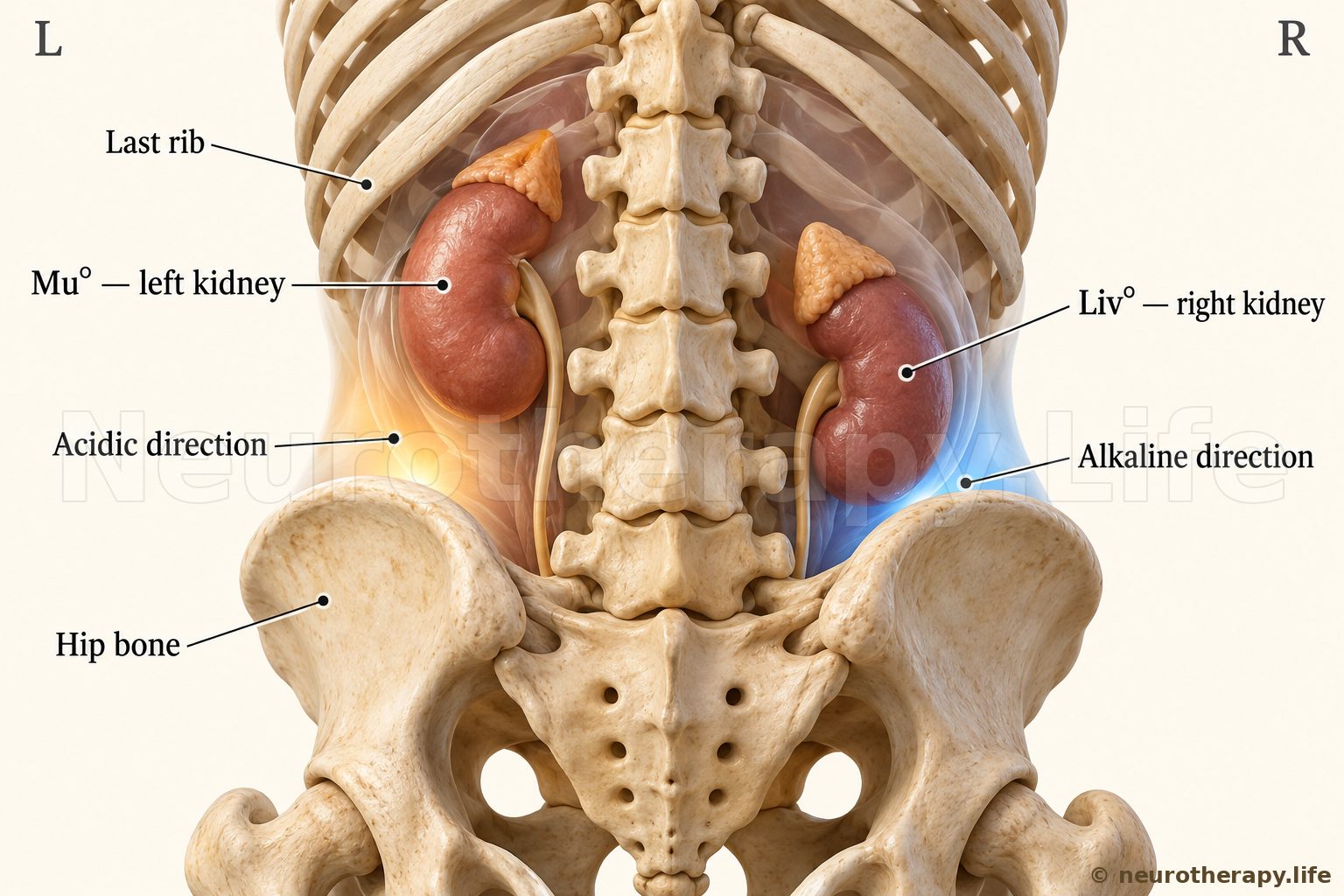
The first step of a Neurotherapy (LMNT) examination is to compare two soft spots at the low back, Mu° on the left and Liv° on the right. Which side is tender sorts most patients into one of two directions — acidic or alkaline — and that direction, not the complaint, shapes the whole plan.
Two men, the same word on both cards
This is a teaching case, put together from ordinary mornings at a busy centre. Two men in their fifties came in with the same complaint: body pain. The senior therapist pressed the soft gap at the low back on each side and asked one question: which is worse? The first said the left; the second, the right. Then the questions changed: the first had hard motions every third day and a blocked nose every morning; the second went three times a day and had a nose that ran like a tap. The complaint was the same. The direction was opposite — and the direction decided everything that followed.
The question the two flanks answer
Looking for a common factor across a lifetime of patients, this was found: in more than 60 of every 100 patients, there is pain at either Mu° (Mucus zero, the left kidney point) or Liv° (Liver zero, the right kidney point). A tender Mu° means the left kidney is sluggish and the patient is read as acidic. A tender Liv° means the right kidney is sluggish and the patient is read as alkaline. Checking which kidney is sluggish is the first step of diagnosis.
"Sluggish" does not mean diseased. It means the kidney is not getting a proper blood supply for most of the day. The commonest reason is simple: most people do not hold themselves straight — the bag always on one shoulder, the child always on one hip — and a body bent one way for years presses on that side. In the other patients, neither point is tender, and the honest answer is "no finding"; the picture is then built from the front points and the history.
What acid and alkali really mean here
pH measures how acidic or alkaline a liquid is, on a scale from 0 to 14; water, being neutral, is 7. Blood is held between 7.36 and 7.44 — slightly alkaline — by several control systems. At 6.8 a person goes into coma from acidosis; above 7.8, severe alkalosis brings muscle spasm and tetany. The whole safe range is narrow, and the body guards it more tightly than almost anything else.
So a patient walking into a centre is never at either extreme — that would be a hospital emergency. In Neurotherapy (LMNT), "acidic" and "alkaline" are clinical directions: whole patterns of symptoms that travel together, anchored to a tender Mu° or Liv°. They are not laboratory numbers. A therapist may say "she is on the acidic side", but never tells a patient "your blood is acidic".
The rule of dilution, and water in, water out
Add water to an acid and it weakens; take water away and it grows stronger. Every kitchen knows this: a spoon of tamarind in a whole pot of water is barely sour, but in a small cup it makes the eyes water. When partly digested food enters the large intestine, it is very watery from the juices of the pancreas, liver and gut, and so strongly alkaline. As the colon draws water out on its long route up the right side, across and down the left, the contents become steadily more acidic — most of all at the rectum, and most of all in hard constipation.
A person loses almost two litres of water a day through sweat, urine and breath, and must replace at least that much with plain water. If not, the body shuts its exits — less sweat, less urine, less saliva, and a stool held tight and acidic. That is why low water goes with constipation, and why reducing acidity and stimulating the descending colon helps constipation and the many symptoms that keep it company. Tea, coffee, buttermilk and cold drinks are not water; no other drink can take its place.
Slack and dry, tight and wet
The two directions can be carried in the head as two temperaments. The acidic body has gone slack and dry: it holds things too long. The alkaline body has gone tight and wet: it passes things too fast. Nobody has a whole column — a reading needs a tender Mu° or Liv° plus two or more matching symptoms. The point is the anchor; the symptoms are the company it keeps.
- Acidic (Mu° tender, left): hard stools and constipation, piles; blocked nose; dry cough or hard yellow mucus; yellow urine with burning; dry, scaly skin and early greying; heavy or long periods; loose, slack muscles; a slow thyroid; low blood pressure; hernia, prolapse and varicose veins; pains mostly on the left side.
- Alkaline (Liv° tender, right): loose, frequent stools, often with undigested food; a watery running nose; a wet white cough; pale, colourless urine; weeping rashes; scanty, short periods; tight, cramping muscles (spasticity); an overactive thyroid; high blood pressure; fits; growths such as fibroids and cysts; pains mostly on the right side.
Why the kidneys sit at the centre
The acidity of the blood is not the acid of the stomach — that hydrochloric acid stays in the stomach. In the blood several acids are dissolved: amino acids from protein digestion, uric acid handled mainly by the liver, lactic and carbonic acids that rise when breathing is poor, and keto acids that rise in diabetes. To balance them, the kidneys must send out bicarbonate, the body's own antacid, at the right time and in the right amount.
Neurotherapy (LMNT) observes that the two kidneys do not work alike: a sluggish left kidney (tender Mu°) goes with the acidic picture, and a sluggish right kidney (tender Liv°) with the alkaline picture. Working through Mu° is followed by relief in acid symptoms, and through Liv° in alkali symptoms. So the side is the finding — "low back tender" alone records nothing usable. Acid conditions are many but correct easily; alkali conditions are fewer but take much more time and effort. And where an alkaline picture rests on a stomach not making enough acid — pain at Gas, undigested food in the stool — the stomach is set right first.
Examine every time, and never harm to prove a point
A direction belongs to a day. A patient who felt wonderful last week may ache all over after the same treatment this week, because the body was corrected and the same work has now pushed it past the middle. That is why the pair is examined at every visit, never assumed.
Working the wrong side would make the symptoms worse — a strong sign that the two kidneys really behave differently. But such a reversal is described only for academic interest. Doing it to win an argument is harm with an audience; if ever needed, it is done only in the presence of a very advanced practitioner.
Key points
- Comparing Mu° (left) and Liv° (right) at the low back is the first step of diagnosis.
- Tender Mu° → acidic direction; tender Liv° → alkaline direction; neither → no finding, and that is honest too.
- Here acidic and alkaline are clinical directions, not laboratory values; blood stays between 7.36 and 7.44.
- Add water and acid weakens; the colon removes water, so its contents grow more acidic towards the rectum.
- About two litres of plain water a day replace what is lost; no other drink is a substitute.
- Acidic is slack and dry; alkaline is tight and wet. A reading needs the point plus two or more matching symptoms.
- Examine the pair at every visit — a direction belongs to a day.
Topics in this guide
Go deeper
Acidosis
The acidic direction in detail
Alkalosis
The alkaline direction in detail
Mu°
Mu°, the left kidney point
Liv°
Liv°, the right kidney point
Correcting the Two Kingdoms: Acid and Alkali Formulas
The two families of treatment for the two directions
The Fire and the Ash: Undigested Food in the Stool
Undigested food in the stool, and what it tells
The Navel Speaks First: The Map of the Pain Points
The map of the pain points
The Educated Hand: How the Pain Points Are Felt
How the two flanks are pressed and compared
How to drink water: seven everyday rules and the reason for each
How water is drunk, and which drinks do not count
Safety: when it is held back
- Never give the Acid Treatment Formula (ATF) in alkalosis, and never give the Alkali Treatment Formula (ALTF) in acidosis. Before the acid treatment, Mu° is checked; if there is no pain there, it is not given. ATF: the acid formula, given only when Mu° hurts
- Removing the tenderness at Mu° or Liv° is not, by itself, proof that the direction has been corrected; examine again each visit. ALTF: the alkali formula, and why undigested food is checked first
- The reversal demonstration (working the wrong side) is never done to prove a point on a patient.
- Fever with a painful loin, blood in the urine, new bleeding with stool, unexplained weight loss or a new lump need a doctor first. How to tell a patient to see a doctor
- People treated for heart, kidney or blood-pressure problems, or whose ankles or face swell, should ask their doctor how much water suits them. How to drink water: seven everyday rules and the reason for each
- Real acidosis or alkalosis measured in the blood is a hospital matter; a patient who is very drowsy, confused or cramping severely needs emergency care. Acidosis
Guruji says
“No such treatment may be given, knowingly or otherwise, which will worsen a patient's condition, even by a fraction of one percent.”
Common questions
You are pressing my back, but my problem is my nose.
That is the method, not a mistake. In this therapy the two are connected through the kidney under the therapist's fingers. That spot shows which way your body is leaning, and the leaning explains the nose. Treating only the nose would help for a few days at most.
Am I acidic? Does that mean there is acid in my blood?
Not in that sense. Your blood's acidity is held very tightly. "The acidic side" means the direction your body is leaning — the dry side, where things sit too long: hard motions, blocked nose, dry skin. It is a pattern, not a lab result; a blood test would very likely be normal, as it should be.
How much water should I drink? Somebody told me four litres.
For most people about two litres of plain water spread through the day replaces what is lost; tea, coffee, buttermilk, juice and cold drinks do not count. But if you are treated for heart, kidney or blood pressure, or your ankles or face swell, ask your doctor what suits you.
Last time I felt wonderful. Today, after the same treatment, I ache all over. What went wrong?
Your body was leaning one way and was corrected. This time it was not leaning the same way, and the same work pushed it a little past the middle. It can be corrected; you will be examined again from the beginning rather than repeating anything.
Watch

Dr. Diwakar Shukla shows students where the Mu° point lies and how it is pressed, both to examine the body and as part of treatment.

An overview of LMNT's diagnostic pain points — the places around the navel that the therapist presses to read the body before choosing a treatment.

A podcast conversation on indigestion: its common signs, causes such as rushed meals, stress and some medicines, and how Neurotherapy (LMNT) looks at digestion through the body's acid–alkali balance. No points are demonstrated.
Test yourself
Research
- Strong evidence
A review of how the body keeps its acid–alkali balance. It confirms that arterial blood is normally held between pH 7.36 and 7.44, that the lungs control carbon dioxide (a gaseous acid) by breathing, and that the kidneys have the main role in setting the blood's bicarbonate — the body's own antacid.
Explore more
Organs
Body systems
Diseases
Points
Formulas
Topics
Read more
This page explains what a Neurotherapy (LMNT) treatment is for; it is not a self-treatment guide and does not diagnose. Neurotherapy (LMNT) works alongside your medical care — keep taking the medicines your doctor prescribed.