Mu° (Mucus Zero): the treatment point for the left kidney, and the care it needs
Mu° is the Neurotherapy (LMNT) treatment that increases blood circulation in the left kidney. It is the mirror of Liv°: given lying on the back, with contact at the shoulder and the thigh, using only the flat middle of the therapist's sole.
Overview
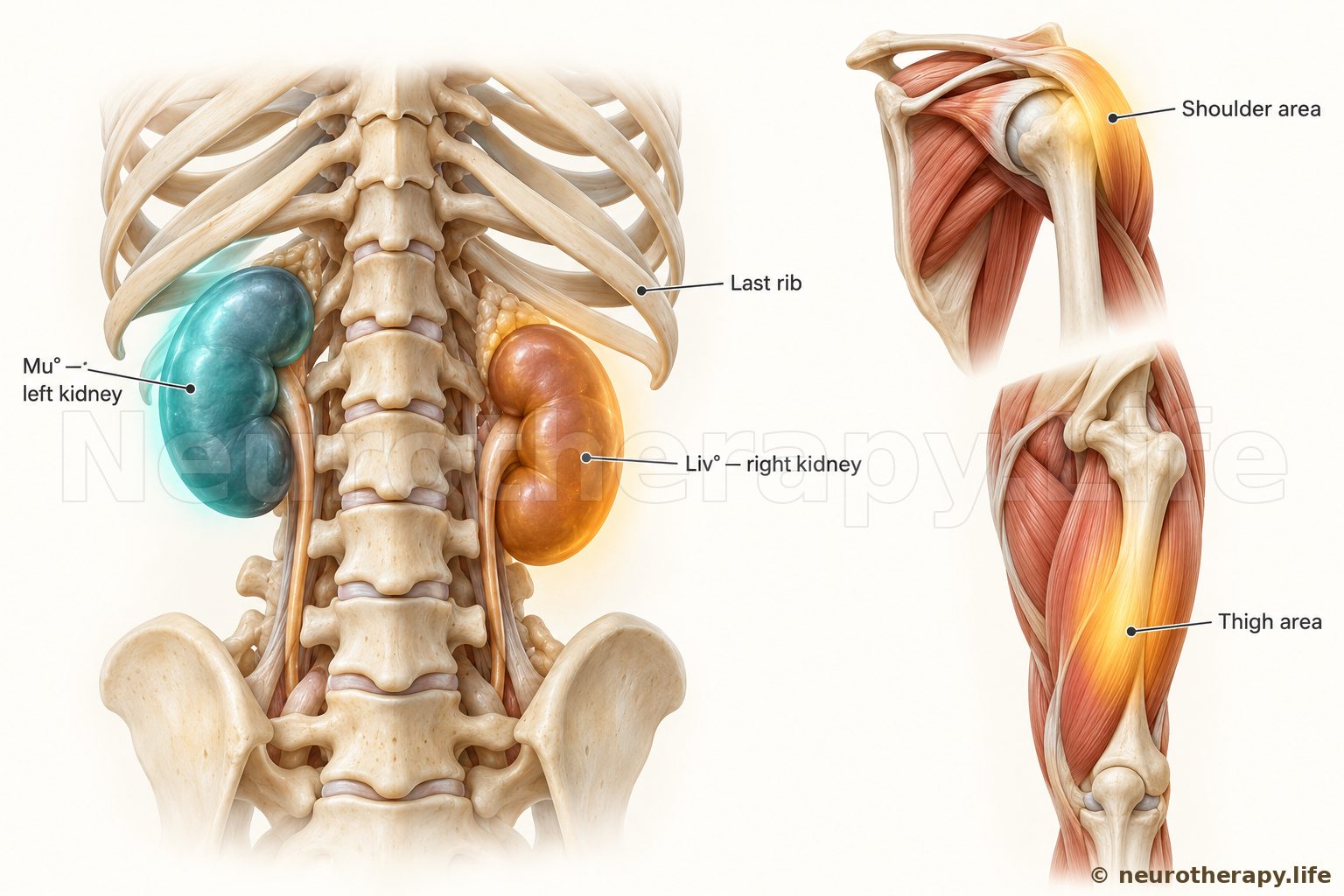
Mu° (read ‘Mu Zero’ or ‘Mucus Zero’) is the Neurotherapy (LMNT) name for the left kidney. The Mu point on the front lies left of the navel, and the left kidney sits just behind it — so the left kidney became Mu°. The code name spares patients the alarm the word ‘kidney’ can cause. As a treatment, Mu° increases blood circulation in the left kidney.
Tenderness at Mu°, felt in the soft hollow of the left flank, is also one of the first findings in a Neurotherapy (LMNT) examination. Compared against Liv° on the right, it sorts a patient towards the acid direction.
As a treatment, Mu° is given like Liv°, but on the opposite side. The patient lies on the back, with one pillow under the thighs and one under the shoulder so that the joint rests well on it. The contact is high at the shoulder and stays in one place there, with a second contact on the thigh. Only the flat middle of the therapist's sole is used. Because Liv° and Mu° cross over in this way, it is easy to reverse them in a hurry; a careful therapist checks the side every time. The exact method is taught hands-on in the course.
Key points
- Mu° is the Neurotherapy (LMNT) code name for the left kidney.
- As a treatment, it increases blood circulation in the left kidney.
- A tender Mu°, compared with a quiet Liv°, points towards the acid direction.
- Mu° and Liv° cross over, so the side is checked every time.
Go deeper
Mu°
Mu° — the full point page
Mu
Mu — the point it is built on
Liv°
Liv° — its partner for the right kidney
Mu° pain (examination sign)
What pain at Mu° can mean
Acidosis
Acidosis — the acid direction
Kidneys
The kidneys
The Front of the Body I: The Digestive Points Given Lying on the Back
Guide: The Front of the Body I
Read the full guide
This topic is part of: The Front of the Body I: The Digestive Points Given Lying on the Back
Safety: when it is held back
- The shoulder is not loaded after a recent dislocation, a torn rotator cuff under treatment, a fracture, a replaced joint, or recent surgery around the shoulder or collarbone. Shoulder dislocation
- Frail elders and anyone with thin bones receive this point by hand, not by foot. Frail and elderly patients (gentle care)
- If pressure brings pain down the arm with numbness or weakness, stop: that is a nerve.
- A tender left flank with fever, shivering, burning urine or vomiting needs a doctor the same day — not treatment. Kidney disease
Watch

Dr. Diwakar Shukla shows students where the Mu° point lies and how it is pressed, both to examine the body and as part of treatment.
This page explains what a Neurotherapy (LMNT) treatment is for; it is not a self-treatment guide and does not diagnose. Neurotherapy (LMNT) works alongside your medical care — keep taking the medicines your doctor prescribed.