Shoulder dislocation
In a shoulder dislocation the ball of the upper arm bone is knocked out of its socket, usually by a fall or a blow. It needs a hospital first — the doctor puts it back. LMNT is for the pain and weak muscles that can remain afterwards.
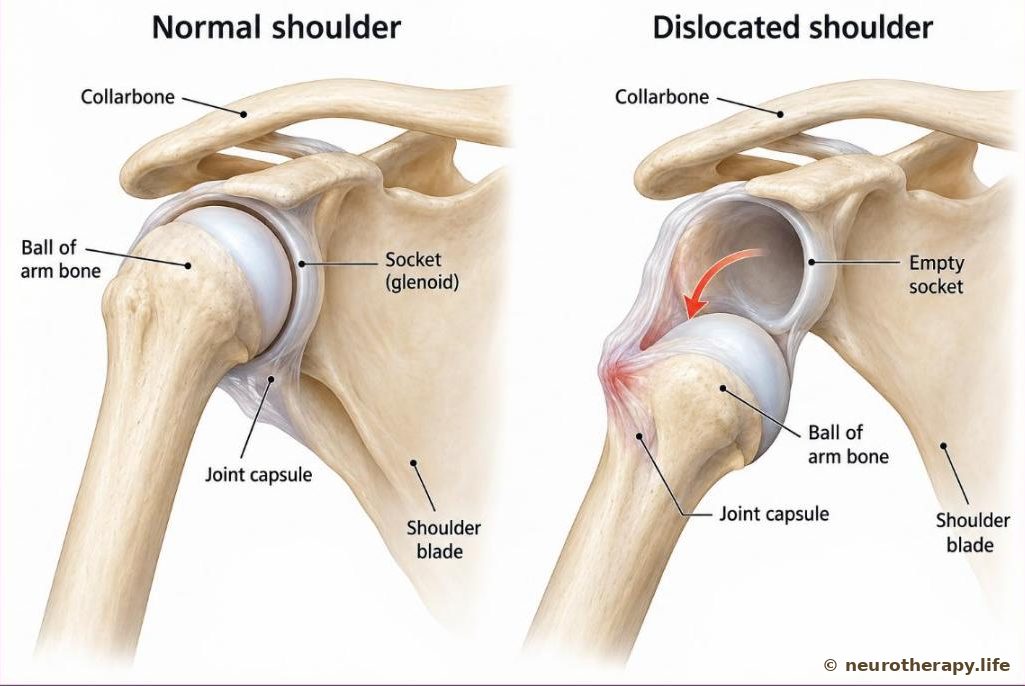
- The shoulder is the most commonly dislocated joint in the body
- Up to 97% of shoulder dislocations are to the front
- Recovery usually takes 6 to 12 weeks
Source: Cleveland Clinic; StatPearls (Abrams & Akbarnia, 2023); NHS
What is Shoulder dislocation?
The shoulder is a ball-and-socket joint. The rounded top of the upper arm bone fits into a small, shallow socket on the shoulder blade. That shallow socket lets the arm move in almost every direction — but it also makes the shoulder the easiest big joint to knock out of place.
A fall on an outstretched arm, a sports tackle or an accident can push the ball out, most often forwards. The capsule and ligaments around the joint stretch or tear, and nerves and blood vessels nearby can be hurt. Once a shoulder has dislocated, it can happen again more easily.
What are the symptoms?
- Severe pain in the shoulder after a fall or blow
- The shoulder looks out of place, squared-off or sloping down
- Cannot move the arm
- Swelling and bruising
- Numbness, tingling or weakness down the arm
What causes it, and who is more likely to get it?
Injury
- A fall, especially on an outstretched hand
- Sports with contact or falls
- Road accidents
Who is at more risk
- Young people aged about 15 to 30, especially athletes
- Men — more than twice as often as women
- Anyone whose shoulder has dislocated before
How is it found?
A dislocated shoulder is an emergency. The doctor examines the arm, checks the feeling and the pulse in the hand, and takes pictures before and after putting it back.
X-ray
Shows which way the ball has moved and whether a bone is broken — breaks come with about a quarter of dislocations.
Nerve and pulse check
Feeling on the outer shoulder and in the hand, and the pulse at the wrist, are checked because nearby nerves and vessels can be hurt.
MRI or CT scan
Sometimes used later to look at torn ligaments, tendons or the rim of the socket.
A neurotherapist never tries to put a shoulder back. The therapist asks for the X-ray and the doctor's notes, and starts only after the doctor has set the joint and allowed movement.
How Neurotherapy (LMNT) sees Shoulder dislocation
LMNT teaching sorts shoulder problems by one rule: left opens, right closes. Where something will not move enough — a neck that will not turn, a frozen shoulder — (11) Left Medulla is given. Where something has moved too far — a shoulder that has come out of its place and dropped, or shoulder pain from a fall or blow — (11) Right Medulla is given.
The side named is the side of the treatment, not the side of the injury. A dislocated left shoulder still gets (11) Right Medulla, because the aim is to close — to help the muscles hold the joint. Where a blow on the shoulder, neck or arm has left the muscles hanging down, LMNT adds the Rocket point.
Whether or not the patient gets immediate benefit from our treatment, let no harm reach him through our carelessness — attend to this.
Neurotherapy (LMNT) treatment for Shoulder dislocation, step by step
Hospital first
Keep the arm still against the body and go to a hospital. Never try to push the shoulder back yourself. The doctor sets the joint, usually with pain relief, and checks for a broken bone.
Examine first
After the doctor's care, the therapist looks at the X-ray and notes, checks the diagnostic points Liv° and Mu°, and checks feeling, warmth and pulse in the hand.
(11) Right Medulla — to close
For the shoulder that came out of its place and dropped, and for shoulder pain after a fall or blow. Right is given whichever shoulder was hurt.
Rocket point — where the muscles have come down
Added where a blow on the shoulder, neck or arm has left the muscles hanging down.
Keep the physiotherapy
The exercises the hospital gives rebuild the muscles that hold the joint and lower the chance of it slipping again.
Points and formulas used
Medulla
(11) Right Medulla — given in LMNT to close: for a shoulder that has come out of its place and dropped, and for shoulder pain after a fall or blow.
Open →Rocket Point
Given where a blow on the shoulder, neck or arm has left the muscles hanging down.
Open →Never do this
- An arm that will not lift after a blow needs a diagnosis before any point. Go to a hospital at once if the shoulder looks out of place, the hand is cold or has no pulse, there is numbness, or the arm cannot be moved at all.
- Never try to put a dislocated shoulder back yourself, and never let anyone pull or jerk it. A broken bone, head injury or heavy bleeding also goes to a hospital first.
- The side in a Medulla row is the side of the treatment, not of the injury. Right closes; left opens. A dislocated shoulder gets (11) Right Medulla, never Left. Medulla
- Cancer: if the person has cancer, (10) Pan, Thymus, Pit, Lu + Sh, Rt. Ov / Lt. Ov and (30) Medulla are never given — the therapist changes the plan.
- Keep taking the medicines your doctor prescribed. Neurotherapy (LMNT) works alongside your medical care, never instead of it.
From Ayurveda and the kitchen
Test yourself
What research says
- Strong evidence
The shoulder socket is shallow and touches only a small part of the ball of the arm bone, so the joint depends on the tissues around it. Shoulder dislocations make up about half of all major joint dislocations, and up to 97% are to the front.
Abrams R, Akbarnia H. Shoulder Dislocations Overview. StatPearls. 2023.
No clinical trial of Neurotherapy (LMNT) in shoulder dislocation has been published yet. Improvements reported by neurotherapists are clinical observations.
For you
Young athletes
A first dislocation raises the chance of another. Finish the full physiotherapy before going back to sport.
Older adults
A fall can break the bone as well as dislocate it. Always get an X-ray, and make the home safe: good light, no loose rugs, a rail in the bathroom.
This page explains; it does not diagnose. Neurotherapy (LMNT) works alongside your medical care — keep taking the medicines your doctor prescribed, and see a doctor for any new or severe symptom.