Your muscles are bundles of long, living fibres that pull on your bones through tough cords called tendons. Each fibre holds hundreds of nuclei and millions of tiny threads that slide to shorten it. Muscles burn sugar for fuel, ache for a day or two after unaccustomed work, and grow stronger whenever they are asked to — at any age.
Overview
What are muscles?
This page is about your skeletal muscles — the muscles that are fixed to your bones and move them when you decide to move. You have more than 600 of them, from the large muscles of the hips and thighs to the tiny muscles that move your eyes.
Every skeletal muscle waits for an order from a nerve. When the order comes, its fibres shorten and pull on a tendon, and the tendon pulls on the bone. When the order stops, the muscle lets go and its partner on the other side of the joint can pull the other way.
Aches, strains and cramps are among the most common complaints of daily life. Most are short-lived. But muscle also shrinks slowly with age and inactivity, and keeping it strong is one of the best ways to stay independent in later life.
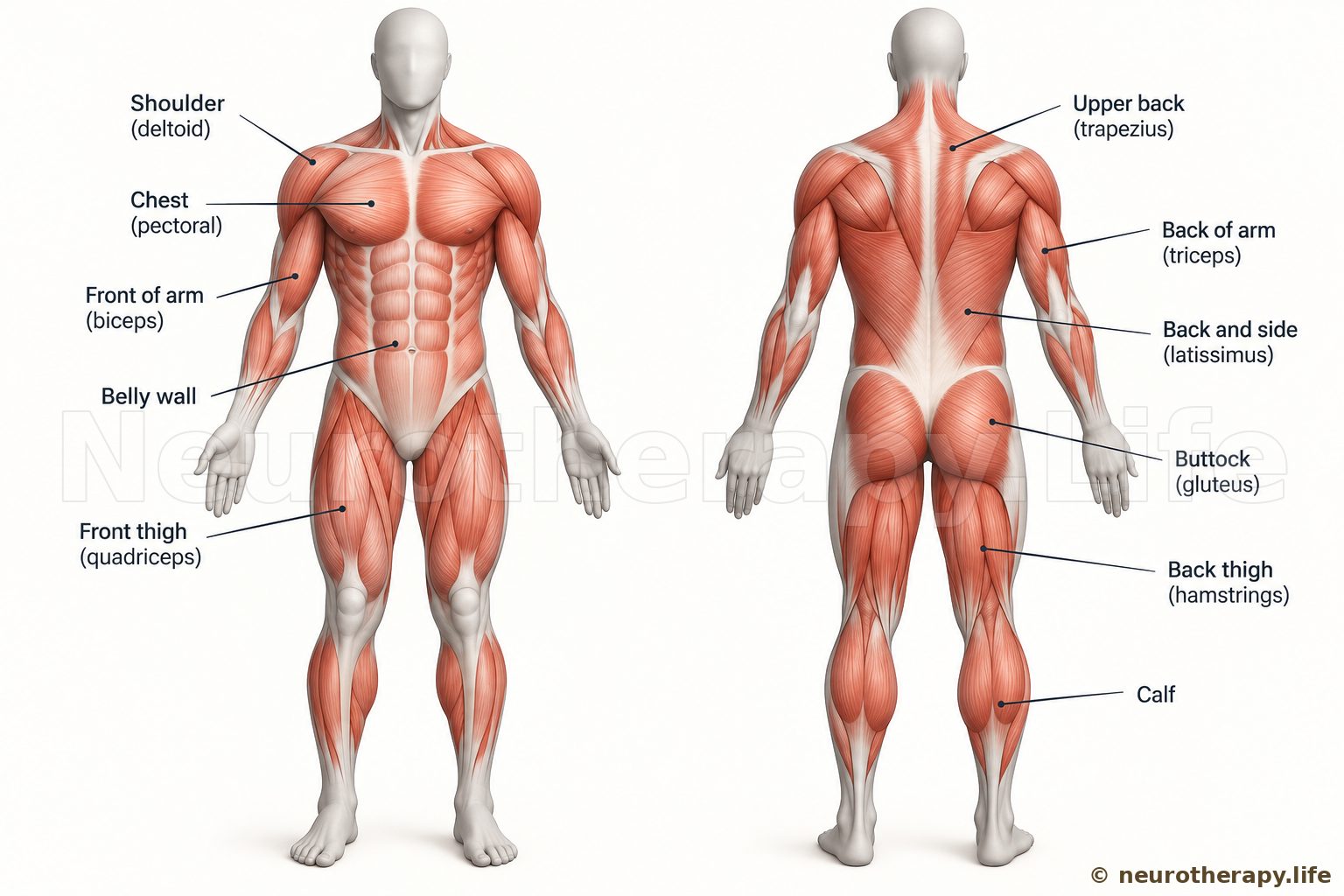
The main muscles from the front and the back. Most of your muscle is in the hips and legs.
Function
What do muscles do?
Muscles turn chemical energy into pulling force. By pulling on bones across joints they move you, hold you still, and protect what lies beneath them.
Move the joints: every step, grip, lift and turn.
Hold posture: small, steady contractions keep you upright against gravity all day.
Steady the joints: muscles around the knee, shoulder and spine act like living braces.
Protect the organs: the muscles of the belly wall shield the gut and help you cough, strain and lift.
Pump blood and lymph: working leg muscles squeeze the veins and lymph channels and push fluid back towards the heart.
Make heat and store fuel: muscle warms the body and keeps sugar in reserve as glycogen.
The first seconds
A sudden effort runs on the tiny amount of ATP already in the fibre — enough for about three seconds.
The quick reserve
Creatine phosphate refills the ATP almost instantly; together they last roughly ten seconds of all-out work.
Burning without oxygen
Stored glycogen is broken down fast without waiting for oxygen. This powers a minute or two of hard work and releases lactic acid.
Burning with oxygen
With enough oxygen, sugar and fat are burned completely in the mitochondria. This is slower but can go on for hours — walking, cycling, housework.
The pause to breathe
When you stop on a staircase landing and breathe hard, oxygen floods back, the quick reserves refill and lactate is reused as fuel by the heart, the liver and other muscles.
How do muscles work with other organs?
Joints — Muscles cross joints and move them; strong muscles take load off the joint surfaces.
Spinal cord — Motor nerves from the spinal cord give every order; reflexes are answered there without waiting for the brain.
Blood — Blood brings oxygen and sugar and carries away heat, carbon dioxide and lactate.
Heart — The heart speeds up to feed working muscle — and burns some of the lactate that the legs release.
Liver — The liver turns lactate back into sugar and stores glycogen for the whole body.
Kidneys — Muscle constantly releases creatinine, and the kidneys clear it — which is why a kidney blood test is read with your muscle mass in mind.
Muscular system — Skeletal muscle is one of three kinds of muscle; the whole system also includes smooth and heart muscle.
Anatomy
What are the parts of a muscle?
A muscle is built like a rope made of smaller ropes. It is wired to a nerve, fed by blood vessels, fitted with sensors and fixed to bone at both ends.
Inside a muscle
Muscle fibre — One long cell, thinner than a hair, with many nuclei along its edge.
Myofibrils — Hundreds to thousands of thread-like strands packed inside each fibre.
Sarcomere — The smallest working unit, repeated end to end; its alternating bands give muscle its stripes.
Actin and myosin — The two protein threads. Myosin heads grab actin and pull, sliding the threads over each other.
Mitochondria, glycogen and myoglobin — The fibre's power stations, its sugar store, and the red protein that holds oxygen.
Where muscle meets bone
Tendons — Strong white cords of collagen that carry the pull of the muscle to the bone.
Origin and insertion — The fixed end of a muscle (origin) and the end that moves (insertion).
Fascia — Thin, tough sheets that wrap each muscle and link neighbouring muscles into long chains.
Bursae — Small fluid-filled cushions where a tendon slides over bone, as at the shoulder and knee.
Wiring and sensors
Motor unit — One nerve cell and all the fibres it controls. In muscles of fine control, such as those of the voice-box, one nerve may drive only two or three fibres; in big leg muscles, several hundred.
Muscle spindles — Stretch sensors inside the muscle; they trigger the knee-jerk reflex.
Tendon sensors — Tension sensors in the tendon (Golgi tendon organs) that help protect the muscle from pulling too hard.
Blood supply — A dense net of tiny capillaries wraps every fibre; blood flow can rise many times over during hard work.
Two kinds of fibre
Slow fibres (type I) — Red, full of mitochondria and myoglobin, and slow to tire. They power posture and walking.
Fast fibres (type II) — Paler and powerful but quick to tire. They are used for sprinting, jumping and lifting.
Everyone has both — Most muscles are a mix. Training changes how each fibre performs, and fast fibres are the first to shrink with age.
Where are the muscles located?
Skeletal muscles cover the skeleton from head to toe, just under the skin and fat. They lie in layers: large flat muscles near the surface, and deeper, shorter muscles close to the bones and joints, such as the small muscles that link one spinal bone to the next.
More than half of your muscle is below the waist, in the hips and legs. The thigh alone holds some of the largest muscles in the body — which is one reason LMNT gives so many of its treatments on the thighs, calves and forearms.
Healthy muscle is deep red and slightly glossy, made of fine parallel fibres, and ends in white, shiny tendons. The colour comes from myoglobin; muscles that work all day are darker than those built for short bursts.
Muscles come in many shapes that suit their job: spindle-shaped like the biceps, fan-shaped like the chest muscle, flat sheets like the belly wall, rings around the eyes and mouth, and feather-like muscles whose short fibres pack in extra strength.
How big are muscles?
A single muscle fibre is about 10 to 80 micrometres thick — about as thin as a hair — yet it can run for several centimetres. A large muscle holds hundreds of thousands of such fibres.
Strength depends on thickness more than length: muscle can pull with roughly 3 to 4 kg of force for every square centimetre of its cross-section. Skeletal muscle as a whole weighs about a third of an adult's body weight.
Conditions and disorders
What conditions and disorders affect the muscles?
Most muscle complaints are strains, aches and cramps that settle within days or weeks. Less often, weakness or wasting points to a problem in the nerves or in the muscle itself, which needs a doctor's assessment.
Strains, cramps and aches
Muscle crampsA sudden, hard, painful tightening — often the calf at night.
Sprain and injuryA pulled or torn muscle, or a twisted joint, from a fall or sudden movement.
Low back painStrain and spasm of the back muscles is the commonest cause of an ordinary backache.
Shoulder blade painTight, overworked muscles between and under the shoulder blades.
Tennis elbowOveruse strain of the forearm muscles where they join the outer elbow.
Frozen shoulderA stiff shoulder joint; the muscles around it tighten and weaken from disuse.
Knee painTight or weak thigh and calf muscles change how load passes through the knee.
Pain or tenderness in a muscle, worse when it is used or stretched
Soreness that starts a day after unaccustomed work and fades within a few days
Cramps or spasms
Weakness — trouble rising from a chair, climbing stairs or lifting the arms above the head
A muscle that looks thinner than the same muscle on the other side
Swelling or bruising after an injury, or a gap you can feel in the muscle
Dark, cola-coloured urine after severe muscle pain
What tests check the muscles?
Examination — Looking at the muscle, feeling it, testing its strength against resistance and checking reflexes.
Grip strength and chair-stand tests — Simple timed tests, used especially in older people, to spot muscle loss early.
Blood tests — CK for muscle damage; potassium, calcium, magnesium, vitamin D, thyroid and sugar for common causes of cramps and weakness.
Ultrasound and MRI — Show tears, bleeding, swelling and wasting.
EMG and nerve conduction — Record the muscle's electrical activity to tell a nerve problem from a muscle problem.
Biopsy and genetic tests — For suspected inherited or inflammatory muscle disease.
How are muscle problems treated?
Protect, then load gradually — A fresh strain is protected for a day or two, then moved and loaded step by step as pain allows.
Cold and warmth — Cold packs may ease pain in the first days after an injury; warmth often eases stiffness later.
Stretching and strengthening — Guided exercise is the main treatment for most aches, cramps and weakness.
Medicines — Short courses of pain relief or anti-inflammatory medicine; specific medicines for conditions such as myasthenia gravis.
Correcting the cause — Treating low thyroid, low vitamin D, low salts or a medicine side effect.
Surgery — Sometimes needed for a complete tear of a muscle or tendon.
Neurotherapy (LMNT)
In LMNT teaching, the muscle is where the therapist's hand meets the circulation. A muscle held tight squeezes the vessels that run through it, so loosening it lets blood in again. Every press lasts six seconds. Guruji fixed that number by intuition, and the teaching later explained it: when a muscle is pressed, its partner across the joint takes its turn on release, and that rhythm must be kept; press longer than six seconds and the blood held under the hand runs out of oxygen and sugar, and lactic acid builds up. The release is counted as carefully as the press. A second rule runs through every treatment: the patient does nothing. A limb that the therapist or a relative lifts is a relaxed limb; a limb the patient lifts is a working one, and the teaching warns that pain can even increase. Many treatments are simply ways of loosening particular muscles — the thigh and calf for the knee, the buttock and back for the low back, the muscles under the skull for pain of the whole body. For the heavy, tired legs of the day after a climb or a return to the gym, Guruji built the Lactic Acid Conversion formula. This works alongside medical care, never instead of it.
Points
Giriraj — Fingers gathered together roll the thigh muscles upward from the knee to the groin, along three or four lines, to loosen the muscles above and below the knee. Calf muscle ghisai follows.
Knee Cap Free — The thigh and shin muscles are kneaded crosswise and the knee-cap is freed from the muscles beneath it. The knee must be completely loose first.
Calf Muscle Ghisai (Left) — Three stages with three tools — thumb tips, four fingers and the thumb edge — to loosen the calf after Giriraj.
Fracture Point — The second half, 1-2-3, walks down the back of the thigh held up at 45° by a relative, to loosen the thigh muscles — never onto the knee joint.
Blood Supply to Legs — The soft middle of the sole sweeps the back of the thigh from hip to knee, usually 30 times each leg; for polio and weakness in the legs.
L5–S1 Ghisai — Three stages with three counts on the low back; among its three stated actions is relaxing the muscles of both buttocks.
Bindu Point — One foot anchors the hip while the other draws the tissue from L5 up to the opposite shoulder — to relax the muscles of the whole back.
Necklace — Close thumb presses along the edge of the skull relax the muscles just below it; the teaching says the pains of the whole body become much less.
Stretch — The fingertips are pressed and pulled outward, which relaxes the neck muscles.
(6) Rt. Ov. (6) Lt. Ov. (8) Pan (12) Liv (6) Adr. Guruji's patient could not lift his knees after many stairs, but was not breathless and recovered by himself — which ruled out the heart before any examination. He was very tender at Liv and Pan and at both ovary points; these five steps gave great relief the same day. The teaching gives it for calf pain on the second day after heavy exercise, a hill climb, a long journey or the gym after a long gap.
“Whether or not the patient gets immediate benefit from our treatment, let no harm reach him through our carelessness — attend to this.”
— Dr. Lajpatrai Mehra
Never do this
Emergency: sudden weakness or numbness of the face, arm or leg on one side, or slurred speech — call 108/112. It is not a muscle strain. Paralysis and stroke
Weakness that spreads upward over days, or weakness with drooping eyelids, double vision, or trouble swallowing or breathing — hospital the same day. Myasthenia gravis
Severe muscle pain with very dark urine after extreme exercise, a crush injury or heat — see a doctor the same day. How to tell a patient to see a doctor
A hot, swollen, tender calf or thigh on one side may hide a clot. It is never rubbed, pressed or walked on — it is sent to a doctor. Thrombosis (blood clots)
No foot is ever placed on the knee joint itself; the thigh and calf are worked, the joint is not. Fracture Point
The Lactic Acid Conversion formula carries the bars of its points: Rt. Ov. and Lt. Ov. not in cancer, nor in children treated to increase height; Pan not in fits or convulsions, never in schizophrenia; Liv not in liver cancer; Adr not in septicaemia, HIV/AIDS, cancer or high blood pressure. Lactic Acid Conversion
Cancer: if the person has cancer, (10) Pan, Thymus, Pit, Lu + Sh, Rt. Ov / Lt. Ov and (30) Medulla are never given — the therapist changes the plan.
Keep taking your prescribed medicines. If a medicine such as a cholesterol tablet seems to cause muscle aches, tell your doctor — do not stop it yourself.
Care
How can I keep my muscles healthy?
Muscles need three things: work, fuel and rest.
Strengthen at least twice a week
Rising from a chair without using the hands, climbing stairs, lifting water bottles or working with a band all count. Build up slowly.
Warm up, and return slowly after a break
A few minutes of easy movement before hard work helps. After weeks off, start at half your old effort.
Stretch gently
Hold an easy stretch for 20 to 30 seconds without bouncing, especially the calves and the backs of the thighs.
Eat protein at every meal
Dal, pulses, milk, curd, paneer, eggs, fish or nuts. Guruji's teaching reminds us that what matters is not only eating protein but digesting it.
Drink water through the day
Muscle is about three-quarters water. Cramps come more easily when the body is dry, in heat and during long travel.
Sleep and rest
Muscle repairs itself during rest. Seven to nine hours of sleep supports recovery.
Common questions
Is next-day muscle soreness caused by lactic acid?
Mainstream science says mostly not: lactate is cleared from muscle within about an hour after exercise, and the soreness that peaks one to three days later comes mainly from tiny strains in the fibres and the repair that follows. Guruji's teaching links this second-day calf pain with a shortage of oxygen in the muscle and gives the Lactic Acid Conversion formula for it. Either way, it usually settles within a few days.
Why do I get cramps at night?
Night cramps in the calf are very common, especially after 50. Tired muscles, long sitting or standing, too little water and some medicines can all play a part. Stretching the calf — pulling the toes towards you — usually ends a cramp. Frequent cramps are worth a check-up and a blood test.
Does muscle turn into fat if I stop exercising?
No. Muscle and fat are different tissues and one cannot turn into the other. If you stop exercising, muscle slowly shrinks; if you keep eating the same amount, fat may grow. The two changes happen side by side.
Should I put ice or heat on a pulled muscle?
In the first day or two, a cold pack wrapped in a cloth for 10 to 15 minutes may ease pain. Later, warmth often eases stiffness. Neither should be put straight on the skin. If you cannot bear weight, the area is badly swollen or bruised, or you felt a snap, see a doctor.
Why does the Neurotherapist ask my relative to lift my leg?
Because a muscle holding itself up is working and tight. LMNT teaching insists that the patient does nothing: a limb held by somebody else is slack and open to treatment. If you lift it yourself, the teaching says the benefit is less, and in some people the pain may even increase.
Why is each Neurotherapy (LMNT) press held for only six seconds?
The teaching explains that the press and the release follow the natural turn-taking of a muscle and its partner. Held longer, the blood trapped under the hand runs short of oxygen and sugar and lactic acid builds up — so a longer press is not 'more treatment'.
What should I ask my doctor or therapist?
Is this a strain that will settle, or does my weakness need tests?
Should I check CK, vitamin D, thyroid, sugar or salts?
Could any of my medicines be causing aches, cramps or weakness?
When can I go back to work, sport or the gym, and how should I build up?
Would a physiotherapist's programme help me?
(To the therapist) Which muscles are you loosening, which points are blocked for me, and who should lift my legs?
Surprising facts
1One muscle cell, hundreds of nuclei
Most cells have one nucleus. A skeletal muscle fibre is formed when many young cells fuse together, so a single fibre can carry hundreds of nuclei along its length — each one looking after its own stretch of the cell.
Source: Gray's Anatomy (42nd ed.) and Guyton & Hall — structure of skeletal muscle fibres (multinucleated syncytium).
2A square centimetre of muscle lifts about 3–4 kg
The strength of a muscle depends on how thick it is. At full effort, each square centimetre of cross-section pulls with roughly 3 to 4 kg of force. A thick thigh muscle can therefore pull with hundreds of kilograms through its tendon.
Source: Guyton & Hall, Medical Physiology — maximal contractile force about 3–4 kg/cm² of muscle cross-sectional area.
3Your muscle has three fuel tanks
All-out effort runs on the stored ATP and creatine phosphate for about 8 to 10 seconds, then on glycogen burned without oxygen for about a minute and a half, and only after that on sugar and fat burned with oxygen, which can last for hours. That is why you can sprint up a flight of stairs but must slow down on the fifth — and why a pause to breathe brings the strength back.
Source: Guyton & Hall, Medical Physiology — sports physiology: phosphagen system (~8–10 s), glycogen–lactic acid system (~1.3–1.6 min), aerobic system (unlimited). LMNT staircase story: db section 35.9.
4Some nerves drive just two or three fibres
Each nerve cell controls a group of fibres called a motor unit. In muscles that need very fine control, such as some muscles of the voice-box, one nerve drives only two or three fibres. In the large muscles of the legs, one nerve may drive several hundred. Fine control and raw power are built differently.
Source: Guyton & Hall, Medical Physiology — motor units (as few as 2–3 fibres in some laryngeal muscles; several hundred in large muscles).
5Soreness arrives late
The ache after unaccustomed exercise usually starts many hours later and peaks one to three days afterwards. Doctors call it delayed-onset muscle soreness. It fades within about a week, and repeating the same exercise produces far less soreness the next time.
Source: Cheung K, Hume P, Maxwell L. Sports Med 2003;33(2):145–164.
6Your knee-jerk skips the brain
When a doctor taps below your knee cap, the tendon stretches the thigh muscle for a split second. Stretch sensors in the muscle send a signal to the spinal cord, which sends an order straight back, and the leg kicks — before the brain has even registered the tap.
Source: Guyton & Hall, Medical Physiology — the muscle spindle and the stretch reflex.
7Your kidney test depends on your muscles
Muscle constantly breaks down a little creatine into creatinine, which the kidneys clear. A very muscular person can have a higher blood creatinine with healthy kidneys, and a frail person a 'normal' creatinine with weak kidneys. That is why doctors read the result with age, sex and muscle mass in mind.
Source: KDIGO 2012 Clinical Practice Guideline for the Evaluation and Management of CKD (creatinine is affected by muscle mass); Guyton & Hall.
8Muscle and fat never swap
A common belief says muscle 'turns into fat' when you stop exercising. It cannot: they are different kinds of cell. What happens is that unused muscle shrinks while, with the same food, fat stores can grow — so the body changes shape even though no muscle became fat.
Source: Gray's Anatomy / standard histology — skeletal muscle fibres and fat cells (adipocytes) are distinct cell lineages.
Your muscles' energy clock
~3 sof all-out effort from the ATP already in the fibre
~10 swith the creatine phosphate reserve added
~1–2 minof hard work from glycogen without oxygen
hoursof steady work when oxygen keeps coming
24–72 hwhen next-day soreness usually peaks
6 sthe length of every LMNT press
Yoga
Lying leg stretch with a strap Supta Pādāṅguṣṭhāsana
Benefits
Stretches the hamstrings and calf, which often tighten with long sitting.
The back stays flat on the floor, so the low back is protected.
Pulling the toes towards you is also the quickest way to ease a calf cramp.
How to do it
Lie on your back with both legs straight.
Bend one knee, loop a strap or dupatta around the sole, and straighten the leg upward.
Hold the strap with both hands and let the leg come only as high as feels easy.
Breathe slowly for 20 to 30 seconds without bouncing.
Lower the leg slowly and repeat on the other side, 2 or 3 times each.
Take care
Stop if you feel pain shooting down the leg, tingling or numbness — that is a nerve, not a muscle, and needs checking. Keep the other leg bent with the foot on the floor if your back aches.
Bālāsana — the child's pose Bālāsana
Benefits
Gently lengthens the muscles of the back and hips.
A calm resting pose between harder exercises.
Slow breathing in this pose relaxes the whole body.
How to do it
Kneel on a blanket with the big toes touching and the knees a little apart.
Sit back towards your heels.
Fold forward and rest your forehead on a folded blanket or cushion.
Let the arms rest beside the body, palms up. Breathe slowly for 1 to 2 minutes.
Come up slowly, one bead of the spine at a time.
Take care
Avoid it with knee pain or after knee surgery, in pregnancy, or with high blood pressure or dizziness when the head is low. A pillow between the heels and hips makes it easier.
Vīrabhadrāsana II — the warrior Vīrabhadrāsana II
Benefits
Builds strength in the thighs, hips and shoulders using your own body weight.
Improves balance and steadiness.
Strong thigh muscles take load off the knees.
How to do it
Stand with your feet about a leg's length apart.
Turn the right foot out and the left foot slightly in.
Raise the arms to shoulder height, then bend the right knee until it is over the ankle — not beyond the toes.
Look over the right hand and breathe steadily for 3 to 5 breaths.
Straighten the knee, come back to centre and repeat on the other side.
Take care
Bend the knee only a little if your knees hurt, and keep a chair nearby for balance. Lower the arms if the shoulders ache or blood pressure is high.
Watch
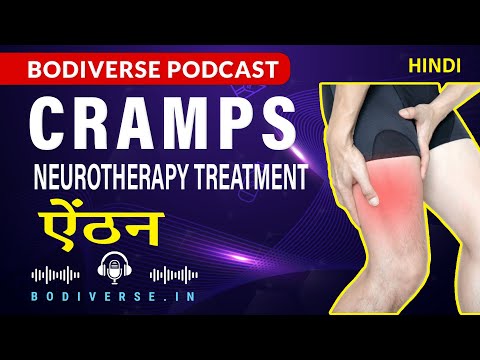
Get Rid of Muscle Cramps: Simple Causes and Effective Prevention मांसपेशियों की ऐंठन से पाएं छुटकारा
A short talk on the common causes of muscle cramps and simple ways to prevent them.
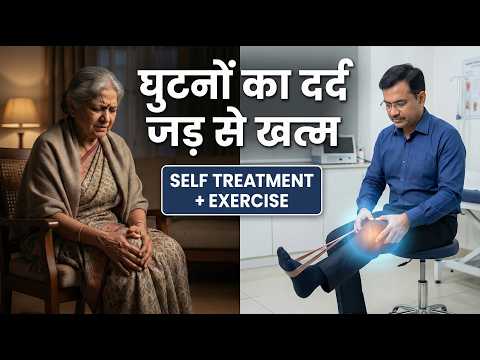
घुटने के दर्द का 100% पक्का इलाज |Treatment & Exercises | Knee Pain Permanent Relief Without Surgery
A home routine for the knees: thumb pressure along the thigh and shin, zig-zag massage above and below the knee, easing the kneecap, and massage behind the knee, then simple exercises such as tapping, a towel roll under the knee and pressing a fist between the knees. It is shared for relief and to strengthen the muscles around the knee.
Test yourself
Research
Strong evidence
A review of delayed-onset muscle soreness found that it begins hours after unaccustomed exercise, peaks at about 24 to 72 hours, and is linked with tiny damage to muscle fibres and the inflammation of repair — not with lactic acid, which clears soon after exercise.
Lactate is not just waste. It moves between cells and organs as a fuel and as a signal: working muscle releases it, and the heart, liver and other muscle fibres take it up to burn or to rebuild sugar.
European experts define sarcopenia — age-related loss of muscle — mainly by low muscle strength, and recommend simple tests such as grip strength and rising five times from a chair to find it early, because it raises the risk of falls, fractures and loss of independence.
This page explains how the body works; it does not diagnose. Neurotherapy (LMNT) works alongside your medical care — keep taking the medicines your doctor prescribed, and see a doctor for any new or severe symptom.
Ready to begin?
Send COURSE for course details, or your name, age and health issue for a consultation.