Knee, Leg and Foot: Neurotherapy (LMNT) for Knee Pain and the Lower Leg
This guide explains how Neurotherapy (LMNT) approaches knee pain: chemical points first to improve the inside of the cells, then physical treatments that free the knee-cap and return the pulled tissue to its place. It also covers the foot treatments for numbness, sprain and gas.
Overview
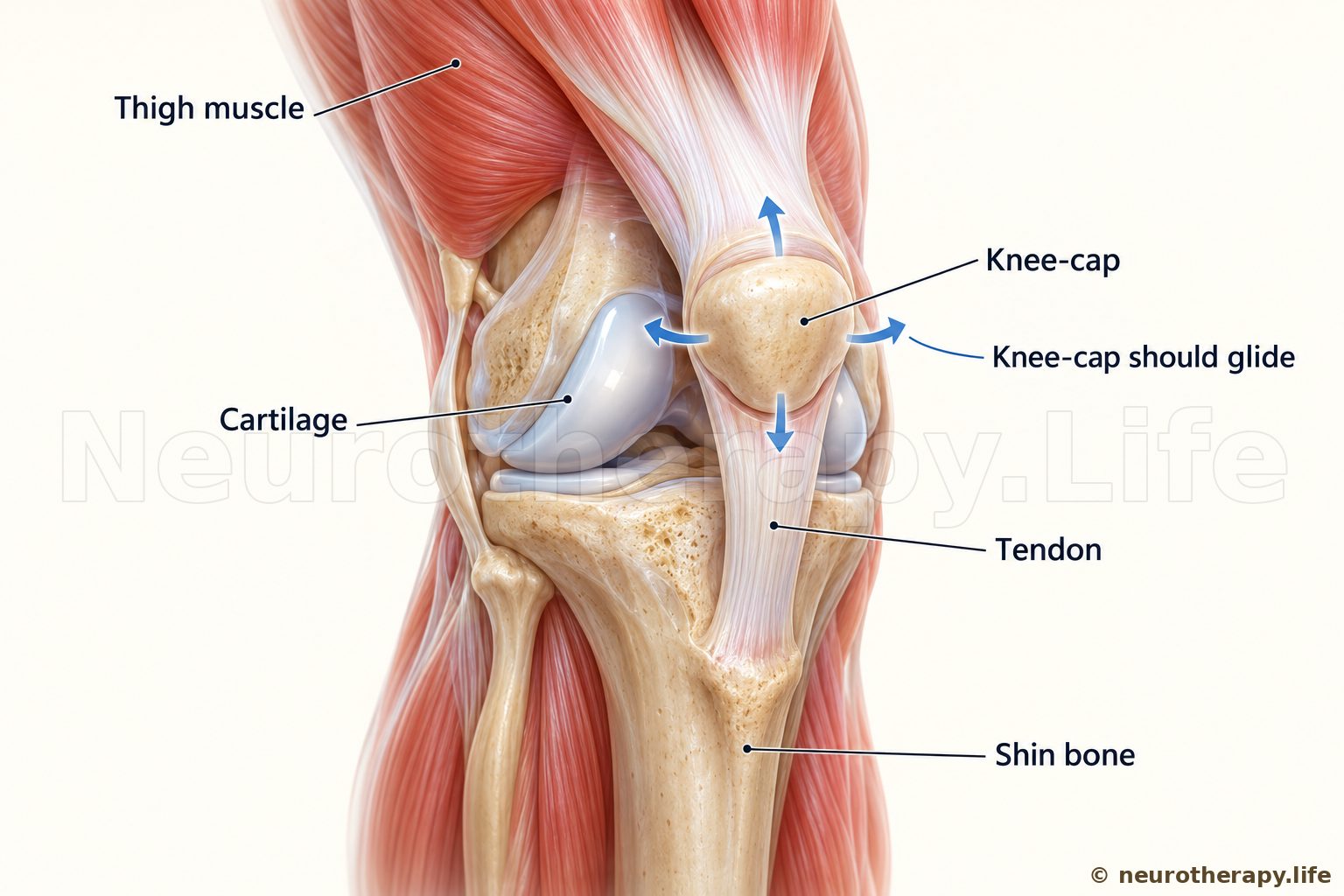
This guide explains how Neurotherapy (LMNT) approaches knee pain: chemical points first to improve the inside of the cells, then physical treatments that free the knee-cap and return the pulled tissue to its place. It also covers the foot treatments for numbness, sprain and gas.
Chemical first, physical after
The knee group opens with an explanation rather than an instruction. First, the right chemical points are given to improve the internal environment of the cells. After that, physical points are chosen so that the tissues above and below the knee-cap, which get pulled during work and become caught at the knee-cap, are returned to their own place.
The chemical points change the conditions the tissue lives in; the physical points change where the tissue sits. A knee in a body that is not digesting well has no raw material to repair itself with. A knee with good raw material can still hurt if a sheet of tissue is caught where it should glide. So the order is part of the treatment.
A teaching case shows the idea. A woman who already had a date for a knee operation came with a coated tongue and hard stools, and the first days were spent on her digestion, not her knee. When her knee was finally examined, the knee-cap did not move at all when pushed gently sideways: not stiff, but stuck. Nobody had tried to move that one small bone before.
Making the knee-cap supple
Two treatments come first, one behind the knee and one in front of it. Back of Knees is given face down: the region behind the knee is softened, and the skin and muscle at the upper and lower borders of the joint are gently drawn outward, so that the muscles behind the knee-cap become soft and supple. It is given on both knees.
Knee Cap Free is given lying face up or seated, with the knee completely loose. The muscles of the thigh and below the knee are kneaded lightly, the sides of the knee are relaxed, and then the knee-cap itself is freed from the muscles beneath it. That is why it is called cap free. The patient must not brace the leg, because a tight thigh muscle clamps the knee-cap into its groove. The exact methods are taught hands-on in the course.
Carrying the tissue back: Giriraj, the calf and Pradeep
Some treatments carry a person's name rather than a place. Giriraj and Pradeep are named after the student or patient in connection with whom they were found; the name is the index, and the method travels with the story of its finding.
Giriraj loosens the muscles above and below the knee by rolling the thigh tissue upward, back toward the groin, the direction it was pulled down from. Calf Muscle Ghisai follows it on the lower leg, using the thumbs and fingertips on the inner and outer calf and along the inner side of the foot. Pradeep works the whole knee region from several sides, with a pillow set at an angle under the bent knee, and ends with gentle weight on the middle of the knee once everything around it has loosened. Every one of these is a putting-back, not a rubbing-away.
For the pain that is left over: JJ Groin and JJ Back
These two are not openers. They are for the patient who, even after the other knee treatments, still has pain at one single point that can be touched with a fingertip. Pain on the inner side of the knee calls for JJ Groin, given face up on the upper front of the thigh. Pain on the outer side calls for JJ Back, given face down on the side of the buttock and the upper outer thigh. Neither touches the knee itself.
Do not confuse them with JJ⁺¹ and JJ⁺² from the low back work. Those are chosen by the spinal level on the card; these two are chosen only by whether the leftover pain sits on the inner or the outer side of the knee.
The foot: BOF, sprain and Big Toe Gas
BOF stands for Bottom of Feet, and the source calls it a wonderful example of Guruji's unique way of thinking: the muscles and nerves are drawn away from the heel, toward the knee. It is given face down and then on each side in turn, and it is used for numbness, pain, burning or any problem from the toes, soles and heel up to the calves. After a sprain, a fourth side, the front of the leg, is added. The source says the relief can be so quick that it is hard to believe, but a patient should judge that for herself.
Big Toe Gas is a press of the therapist's heel on the big toe, used for gas in the stomach. Why a toe for the belly? A strong sensation at one end of the body can change what the gut is doing at the other, through ordinary reflex wiring. The therapist's foot is placed so that it never pinches the skin.
Before any foot touches a knee or a foot
Knee problems is one name for many different things: a worn joint, a torn cartilage, a snapped ligament, a knee-cap that tracks badly, a hip sending its pain down to the knee, and a hot infected joint. So some knees do not enter this group at all, and the checks below come first.
- A hot, swollen, very painful knee with fever needs a doctor today.
- A knee that locks, gives way or followed a twisting injury: a scan answers what is inside it first.
- One calf hot, swollen and tender: possibly a clot; that leg is not rubbed, walked on or moved.
- A replaced knee: no body weight and no jerks on it, ever.
- Diabetes: test whether the feet can feel light touch. Where feeling is reduced, only light hand contact, never body weight.
Key points
- For the knee, chemical points come first to improve the cells; physical points follow to put the tissue back.
- Back of Knees and Knee Cap Free make the knee-cap supple, from behind and from in front.
- Giriraj, Calf Muscle Ghisai and Pradeep return pulled tissue to its place; they put back, not rub away.
- JJ Groin is for leftover pain on the inner knee, JJ Back for the outer knee.
- BOF draws tissue from the heel toward the knee, and the patient is turned onto both sides, not just angled.
- A numb diabetic foot cannot warn of harm, so it gets only light hand contact.
Topics in this guide
Go deeper
Back of Knees
Back of Knees — softening behind the joint
Knee Cap Free
Knee Cap Free — freeing the stuck knee-cap
Giriraj
Giriraj — carrying the thigh back upward
Pradeep
Pradeep — the knee worked from several sides
BOF
BOF — Bottom of Feet
Big Toe Gas
Big Toe Gas — for gas in the stomach
Knee pain
Knee pain
Sprain and injury
Sprain and injury
The Low Back: Treatments for the Back, Hip and Sciatic Leg
The low back group before this one
Uncommon Problems: Neurotherapy (LMNT) Points Found One Patient at a Time
The next group: uncommon problems
Safety: when it is held back
- A hot, swollen, very painful knee with fever: no treatment; see a doctor today. Knee pain
- One calf hot, swollen and tender, especially after surgery, illness, travel or pregnancy: do not rub or move it; send urgently. Thrombosis (blood clots)
- A replaced or resurfaced knee: never body weight and never jerks. Arthritis and joint pain (osteoarthritis)
- Long-standing diabetes: check that the feet can feel. Where they cannot, light hand contact only; treat any blister, ulcer, red patch or hot swollen foot as urgent. Diabetes
- A red, hot, very tender big toe may be gout: it is not stood on. Gout
- JJ Groin ends near the large artery at the top of the thigh: the highest part is kept light, and a pulsing lump there is sent to a doctor. JJ Groin
- Never ATF in alkalosis, never ALTF in acidosis. Children, the elderly and the frail get light treatment. The Child, the Elder and the Frail: Neurotherapy (LMNT) for Delicate Bodies
Guruji says
“First the appropriate chemical points are given, to improve the internal environment of the cells.”
“It is essential to turn the patient onto both sides in turn; merely angling the legs will not give the full result.”
Common questions
My doctor says I need a knee operation. Can Neurotherapy (LMNT) save me from it?
No honest therapist will promise that. The therapy first works on digestion, then frees the knee-cap and loosens the muscles around it, and many people have reported that their pain eases within a few weeks. Keep your surgeon's appointment meanwhile, and decide together with your doctor.
Why press the top of my thigh when the pain is in my knee?
Because the tissue that has tightened around the knee runs all the way up, and it is easier to release from the top than at the sore spot. A pain is often felt at one end of a line and comes from somewhere along it.
Only my right knee hurts. Why treat the left as well?
Back of Knees is written to be given on both knees. Other treatments, such as Giriraj and the calf work, are given only on the side that hurts unless both knees hurt.
Why did you press so gently on my numb feet?
Because a foot with reduced feeling cannot warn you when it is being hurt. For numbness, gentle is the treatment, not a weaker version of it.
Watch
A home routine for the knees: thumb pressure along the thigh and shin, zig-zag massage above and below the knee, easing the kneecap, and massage behind the knee, then simple exercises such as tapping, a towel roll under the knee and pressing a fist between the knees. It is shared for relief and to strengthen the muscles around the knee.

A recorded online class by Dr. Diwakar Shukla on knee pain: the parts of the knee, advice on weight and food (such as keeping away from sour things), and a self-massage and exercise routine, followed by viewers' questions. It is shared as self-care support for knee pain.
Test yourself
Explore more
Organs
Body systems
Diseases
Points
Formulas
Topics
Read more
This page explains what a Neurotherapy (LMNT) treatment is for; it is not a self-treatment guide and does not diagnose. Neurotherapy (LMNT) works alongside your medical care — keep taking the medicines your doctor prescribed.