1A diamond behind your knee
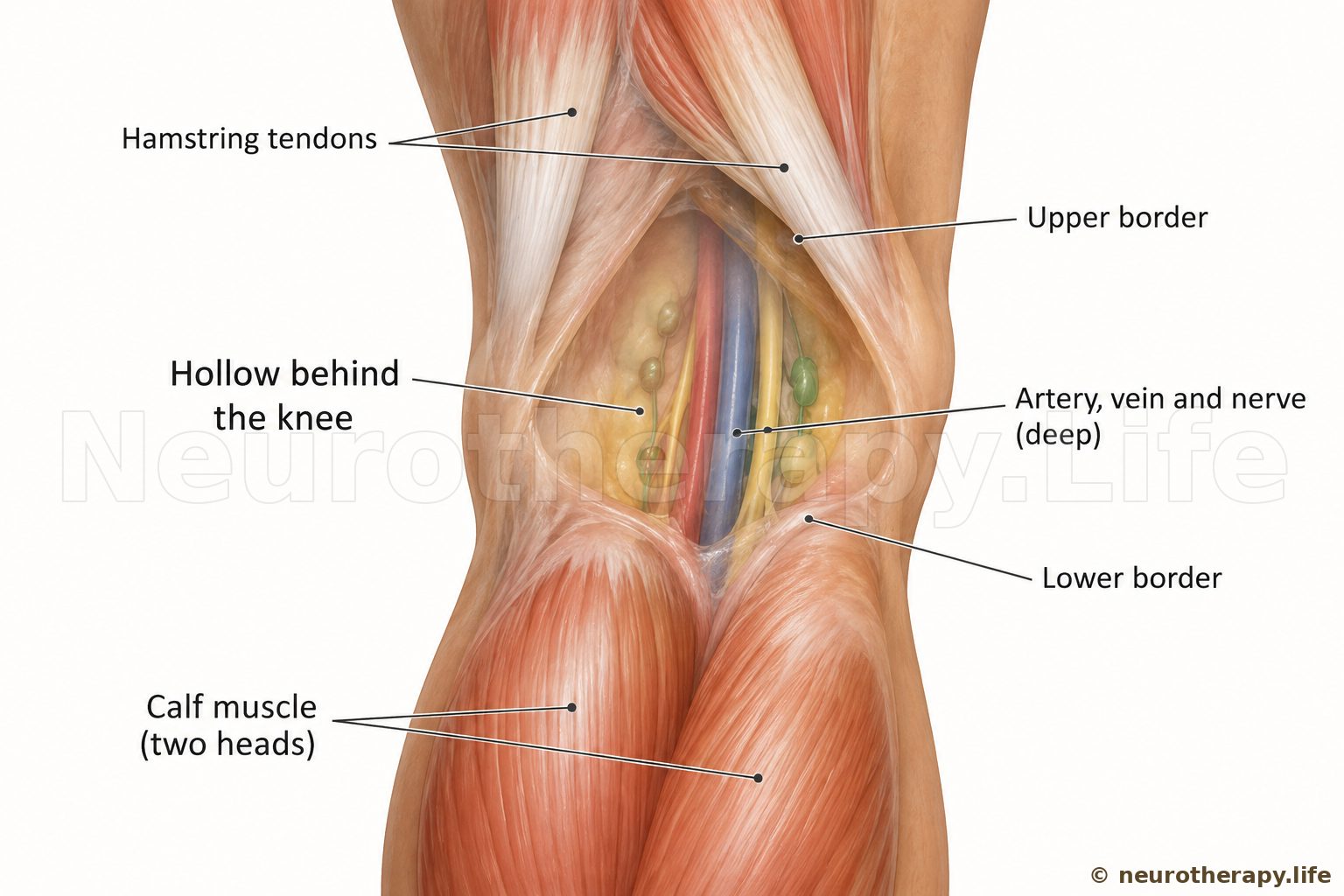
The hollow behind the knee, the popliteal fossa, is diamond-shaped: hamstring tendons form its upper sides and the two heads of the calf muscle its lower sides.
Source: Gray's Anatomy, 41st ed., popliteal fossa.
Also called: Back of knee treatment, घुटने के पीछे का पॉइंट
Back of Knees is the first of the Neurotherapy (LMNT) knee treatments: a gentle rub behind the knee and a light outward drawing of the skin and muscle along its upper and lower borders, given while you lie face down. It softens the back of the knee before the other knee treatments, and is always given to both knees.
Back of Knees is a physical point — a muscle-relaxing treatment named for the place it is given, not for an organ or a chemical. It opens the knee sequence, the set of treatments the therapy gives for pains of the knee.
The teaching explains knee pain this way: the tissues above and below the knee-cap get pulled during work and become caught. First the chemical points are given, to improve the inner environment of the cells; then physical points like this one return the tissues to their own place. Back of Knees softens what lies behind the joint, so the treatments that follow can work on a knee that is already loose.
Its written symbol on a card looks like a vertical stroke with a small circle threaded through it, like the Greek letter φ.
You lie face down with one and a half pillows under the chest — the chest on the upper pillow and the chin on the lower — as in every face-down treatment.
The work is done in the hollow behind the knee, and then along the upper border and the lower border of the knee joint at the back. When one knee is finished, the same is done on the other knee — both knees, always.
How this point is given — the tool, the pressure, the count and the exact movement — is deliberately not described here. A demonstration video for this point is being prepared; until it is on this page, learn the method hands-on from a trained Neurotherapist before giving it. Please do not give any point from a written description alone: a point given in the wrong place or the wrong way can do harm.
The exact technique is taught hands-on in the Neurotherapy (LMNT) course. See the course →
Back of Knees is a muscle-relaxing technique. The teaching is honest that such techniques bring quick relief and comfort, while the lasting change comes from the chemical points given first. Body science agrees that tight hamstrings and calf muscles pull on the knee from behind and add to its stiffness.
The knee treatments are separate treatments, each with its own sides and its own last instruction.
It belongs to the treatments for pains of the knee, given after the chemical points the plan requires.
The teaching closes Back of Knees with a separate instruction to do the other knee as well, with no condition attached. Other knee treatments, like Giriraj, decide the sides differently.
For the border stages the teaching allows the feet or the soles of the palms equally, with light pressure. The rub behind the knee names the soft middle of the sole. Learn it from a trained teacher first.
It is one step of a plan. The teaching gives the chemical points first and the physical points after; relief often comes after a few sessions, while full recovery takes time.
The hollow behind the knee, the popliteal fossa, is diamond-shaped: hamstring tendons form its upper sides and the two heads of the calf muscle its lower sides.
Source: Gray's Anatomy, 41st ed., popliteal fossa.
The main artery of the leg runs deep in that hollow; with the knee slightly bent, a doctor can feel its pulse there.
Source: Gray's Anatomy, 41st ed., popliteal artery.
A soft swelling behind the knee is often a Baker's cyst — joint fluid pushed backward — usually linked with arthritis inside the knee.
Source: Standard orthopaedic description of popliteal (Baker's) cyst.
This page explains what a Neurotherapy (LMNT) treatment is for; it is not a self-treatment guide and does not diagnose. Neurotherapy (LMNT) works alongside your medical care — keep taking the medicines your doctor prescribed.
Send COURSE for course details, or your name, age and health issue for a consultation.