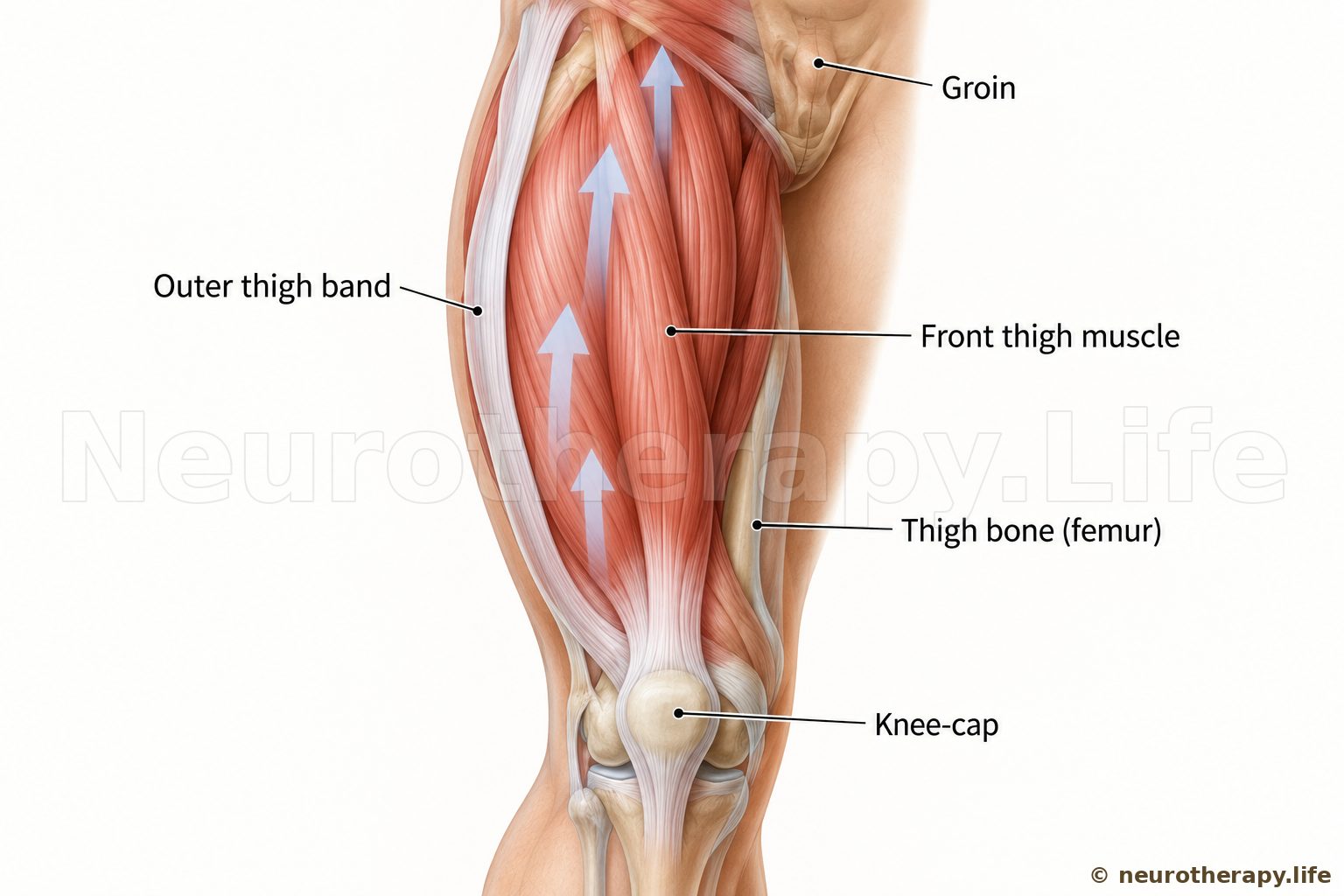
Giriraj is a Neurotherapy (LMNT) knee treatment given on the thigh with the fingers brought together. It carries the thigh muscles back upward, away from the knee, to loosen the muscles above and below a painful knee.
Overview
What is Giriraj?
Giriraj is a physical point — a muscle-relaxing treatment, not a chemical point named for a gland. It belongs to the knee sequence, the set of treatments the therapy gives for pains of the knee.
Its name is a person's name. In this therapy, some treatments are named after the student or patient in whose case the technique was first found — Giriraj and Pradeep among them. The name is a mark of respect, and it tells you nothing about the place, which is why it has to be learnt.
The teaching explains knee pain this way: during work, the tissues above and below the knee-cap get pulled down and caught. Giriraj carries the thigh tissue back upward, the way it was pulled down from. The appendix of uses adds that it also brings down the muscles that have climbed up from the calf — two directions in one treatment.
Giriraj works up the thigh, from near the knee toward the groin, carrying the muscle back upward.
Where it is given
Where is Giriraj given?
PositionLying on the back
Body areaThe thigh, from near the knee up to the groin — seated, or lying on the back with a pillow under the thigh
It can be given with the patient seated, or lying on the back with a pillow under the thigh.
The work runs along the thigh, from near the knee up to the groin, over the front, the inner side and the outer side of the thigh, and ends at the outer side of the thigh. If both knees hurt, both legs are treated; otherwise only the affected side.
How it is given
How is Giriraj given?
How this point is given — the tool, the pressure, the count and the exact movement — is deliberately not described here. A demonstration video for this point is being prepared; until it is on this page, learn the method hands-on from a trained Neurotherapist before giving it. Please do not give any point from a written description alone: a point given in the wrong place or the wrong way can do harm.
Which legBoth if both knees hurt; otherwise the affected side
Kind of pointPhysical (muscle-relaxing)
The exact technique is taught hands-on in the Neurotherapy (LMNT) course. See the course →
What it does
What does Giriraj do?
The stated purpose is to loosen the muscles above and below the knee. The knee teaching is built in two halves: chemical points first, to improve the inner environment of the cells, then physical points like Giriraj to return the tissues to their own place. Body science agrees that tight thigh muscles and the outer thigh band pull on the knee-cap and add to knee pain.
Loosens the thigh muscles above the knee and the tissue below it.
Carries tissue that has been dragged down toward the knee back upward.
Prepares the leg for the calf work and Pradeep that follow in the knee sequence.
Organs it reaches
Knee — The joint the whole knee sequence is built for.
Muscles — The large front thigh muscle and the outer thigh band.
Joints — A joint whose cap glides freely hurts less.
Its family
What comes with Giriraj in the knee sequence?
The knee treatments are separate treatments, each with its own position and its own rule about sides.
Back of Knees — Softens the back of the knee, face down — always both knees.
Knee Cap Free — Frees the knee-cap from the muscles beneath it.
A knee that has locked, gives way, or followed a twisting injury is first checked with a scan or X-ray. Sprain and injury
One calf hot, swollen and tender — after surgery, illness, a long journey or pregnancy — may be a clot: nothing is given on that leg, and the patient sees a doctor the same day. Thrombosis (blood clots)
A replaced or resurfaced knee gets no body-weight pressure and no jerks; the gentle hand treatments of the sequence remain available, given lightly.
Teaching case: the knee that waited for its digestion
A teaching case, put together from several patients: a schoolteacher in her late fifties came with two years of knee pain and a date for knee surgery. Her digestion was worked first, because the knee had to repair itself from what she ate; only then was the knee sequence given, Giriraj among it. She was told plainly that nothing would put cartilage back — only that the knee might hurt less — and her pain eased enough that she did not use the surgery date.
A composite case written to teach the reasoning — not one patient’s file.
Common questions
Why is it called Giriraj?
It carries the name of the person in whose case it was first found. Several treatments in this therapy are named that way, as a mark of respect.
Why does it work on my thigh if my knee hurts?
Because the thigh muscles end in the tendon that holds the knee-cap. When they are tight and pulled down, the cap is pressed and the knee hurts. Loosening them takes load off the knee.
Will both my legs be treated?
Only if both knees hurt. Otherwise Giriraj is given on the affected side only.
Can I have it if I cannot lie down easily?
Yes. Giriraj can also be given seated.
Surprising facts
1The knee-cap sits inside a tendon
The knee-cap is a sesamoid bone — a bone that grows inside a tendon. It sits within the tendon of the big front thigh muscle and acts like a pulley, increasing the muscle's leverage on the shin.
Source: Gray's Anatomy, 41st ed., knee and patella.
2Four muscles, one tendon
The quadriceps is four muscles joined into one tendon at the knee. It is one of the strongest muscle groups in the body and the main one that straightens the knee.
Source: Gray's Anatomy, 41st ed., thigh.
3A long band down the outside
The iliotibial band is a thick strip of tough tissue running from the hip down the outer thigh to just below the knee. A tight band is a common source of pain on the outer side of the knee.
Source: Gray's Anatomy, 41st ed., fascia lata and iliotibial tract.
Test yourself
Research
Emerging evidence
A randomised trial of massage for knee osteoarthritis (wear-and-tear arthritis) found that people who received regular massage for eight weeks had less pain and stiffness and better function than those who waited. It studied Swedish massage, not Neurotherapy (LMNT), but it shows hands-on muscle work can ease a worn knee.
This page explains what a Neurotherapy (LMNT) treatment is for; it is not a self-treatment guide and does not diagnose. Neurotherapy (LMNT) works alongside your medical care — keep taking the medicines your doctor prescribed.
Ready to begin?
Send COURSE for course details, or your name, age and health issue for a consultation.