Your knee is the largest joint in your body: a hinge between the thigh and shin bones, with a kneecap that runs like a rope in a pulley. It carries two to three times your body weight with every step. In LMNT teaching, a painful knee is treated from the inside first — digestion and the body's chemistry — and then the tissues around it are put back in their place.
Overview
What is the knee?
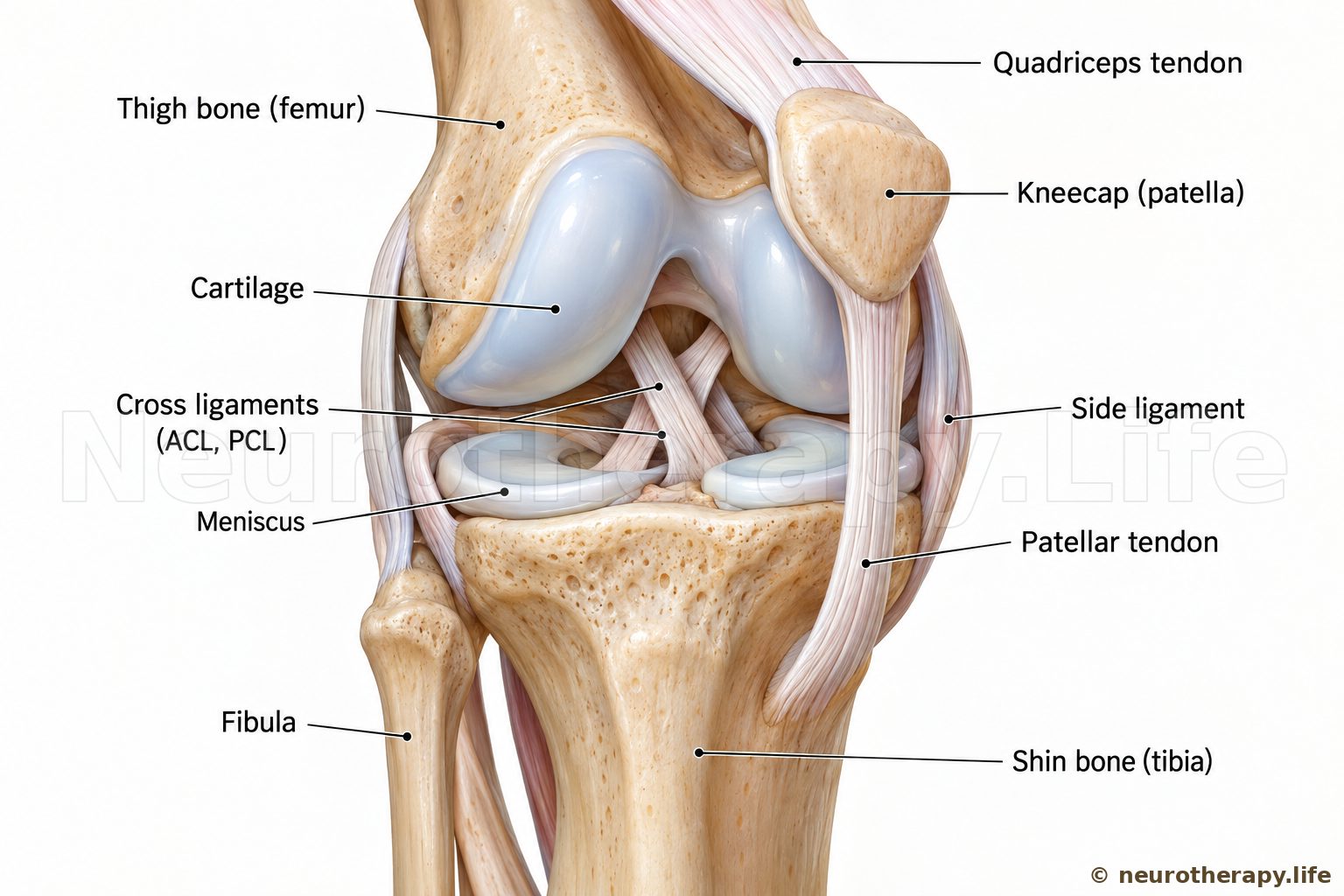
The knee is the joint between your thigh bone (femur) and your shin bone (tibia), with the kneecap (patella) sitting in front. It works mostly like a door hinge, letting the leg bend and straighten, with a little twist when bent.
Inside it, cartilage and two rubbery cushions called menisci soften each step, and four strong ligaments keep the bones from sliding apart. The big thigh muscles in front and behind move it and protect it.
Knee pain is one of the most common complaints of later life — the knee is the joint most often affected by osteoarthritis, the wear of cartilage. It is also the joint most often hurt in sport and falls. Many causes can be helped by exercise, weight control and care, and a few need a doctor quickly.
The knee: three bones, two cushions, four main ligaments — and a kneecap riding in front.
Function
What does the knee do?
The knee has to be strong enough to carry you up stairs and flexible enough to let you sit cross-legged. It does both by combining bone shape, cushions, ligaments and powerful muscles.
Bends and straightens the leg for walking, sitting, squatting and climbing.
Carries body weight — two to three times your weight with each step, more on stairs.
Absorbs shock through its cartilage and menisci.
Locks gently when fully straight, so you can stand for long with little muscle effort.
Gives the thigh muscle extra leverage: the kneecap lifts its tendon away from the joint, like a pulley.
How does the knee work with other organs?
Muscles — The thigh muscles in front straighten the knee and the hamstrings behind bend it; strong muscles take load off the joint.
Joints — The knee is a hinge-type moving joint, built on the same plan as the others but the largest of all.
Low back — Nerves from the low back supply the knee's skin and muscles; a pressed low-back nerve can be felt as knee pain, which is why LMNT links some back and knee points.
Muscular system — The calf muscles also cross the back of the knee and help pump blood back up the leg.
Digestive system — In LMNT teaching the raw material for repair comes from digestion, so a knee in a body that is not digesting is put right from the gut first.
Anatomy
What are the parts of the knee?
The knee is made of three bones, the cartilage and cushions between them, the ligaments that tie them, and the muscles and tendons that move them.
Bones and cartilage
Thigh bone (femur) — Its lower end has two rounded knuckles that roll and glide on the shin bone.
Shin bone (tibia) — Its flat top (the tibial plateau) carries the weight. The thin fibula beside it does not form part of the knee joint itself.
Kneecap (patella) — A flat, triangular bone that grows inside the tendon of the front thigh muscle and glides in a groove on the thigh bone. In Hindi it is often called chakki — a grinding stone.
Articular cartilage — A smooth layer on all three bone surfaces. Under the kneecap it is the thickest cartilage in the body.
Cushions and ligaments
Menisci — Two C-shaped rubbery pads — inner (medial) and outer (lateral) — that deepen the shallow top of the shin bone, spread the load and absorb shock.
Cross ligaments (ACL and PCL) — Two strong cords crossing inside the knee in an X. They stop the shin bone sliding too far forward or backward. The ACL is often torn in sport.
Side ligaments (MCL and LCL) — Bands on the inner and outer sides that stop the knee bending sideways.
Capsule, lining and bursae — A capsule seals the joint and its lining makes a small amount of fluid. Small fluid sacs (bursae) let skin and tendons slide over the kneecap and around the knee.
Muscles and tendons
Quadriceps — The four-part muscle on the front of the thigh that straightens the knee; its tendon holds the kneecap.
Patellar tendon — The thick band from the kneecap down to the front of the shin bone — the spot a doctor taps to test your knee-jerk reflex.
Hamstrings — The muscles at the back of the thigh that bend the knee.
Calf muscles — The larger calf muscle starts just above the knee, so it helps bend the knee as well as point the foot.
Where is the knee located?
The knee sits in the middle of the leg, between the thigh above and the calf and shin below. The kneecap lies just under the skin at the front; the hollow at the back of the knee holds the main artery, vein and nerves of the lower leg.
Nerves from the low back run down to the knee, and pain from the hip is often felt at the knee. This is why a doctor examines the hip and back of a person with knee pain — and why, in LMNT teaching, several knee treatments are given on the thigh, the hip and the back rather than on the knee itself.
In LMNT treatment the therapist's weight hangs from two chairs, and the rule is that the foot steps over the knee joint, not onto it.
From outside you see the rounded kneecap in front, with soft dimples on either side and a firm band — the patellar tendon — running down below it. When you straighten the leg and tighten the thigh, the kneecap lifts slightly.
Inside, the bone ends are capped with smooth, glistening, bluish-white cartilage; the menisci are pale and rubbery, like two crescent moons; the cross ligaments look like shiny white cords.
How big is the knee?
The knee is the largest joint in the body. The adult kneecap is roughly 5 cm across. The cartilage under it can be about 5 mm thick — the thickest in the body — while the cartilage on the rest of the knee is about 2 to 4 mm.
A healthy knee holds only about a teaspoon of joint fluid. Yet it carries about two to three times body weight with each walking step and about three to three-and-a-half times on the stairs.
Conditions and disorders
What conditions and disorders affect the knee?
'Knee pain' is one name for many different problems: a worn joint, a torn cushion or ligament, a kneecap that runs badly, an inflamed or infected joint, or pain sent down from the hip or back.
Wear and pain
Knee painThe commonest joint pain of all, from many causes.
Thrombosis (blood clots)A hot, swollen, tender calf — especially after surgery, illness, a long journey or pregnancy — can be a clot: see a doctor the same day.
Varicose veinsSwollen veins behind the knee and down the calf.
Burning feetBurning or numbness from the soles to the calves.
Muscle crampsNight cramps in the calf, just below the knee.
Cerebral palsy (CP)Children with CP often have tight muscles around the knees; LMNT has a formula that names knee, back and CP together.
What are common signs of a knee problem?
Pain on stairs, rising from a chair or squatting
Stiffness in the morning or after sitting
Swelling, warmth or a feeling of fullness
Creaking or grinding
The knee locking, catching or giving way
Being unable to straighten or bend it fully
A hot, swollen knee with fever, a knee that cannot take weight after an injury, or a hot, swollen calf — see a doctor the same day
What tests check the health of the knee?
Physical examination — Swelling, tenderness, range of movement and ligament tests — and a check of the hip and back.
Standing X-ray — Shows narrowing of the joint space and bony spurs. X-ray changes and pain often do not match.
MRI scan — Shows the menisci, ligaments, cartilage and bone marrow — used after injury or when the knee locks.
Ultrasound — Shows fluid, tendons and a swelling behind the knee; also used to check the calf veins for a clot.
Blood tests — Uric acid, ESR, CRP and RA factor when inflammation, gout or rheumatoid arthritis is suspected.
Joint fluid test — Fluid drawn from a swollen knee is checked for crystals and infection.
How are knee conditions treated?
Exercise and physiotherapy — Strengthening the thigh muscles is the most important single treatment for worn knees.
Weight control — Losing even a little weight clearly reduces the load on the knee.
Medicines — Pain-relief gels and tablets, and medicines for gout or rheumatoid arthritis — prescribed by a doctor.
Injections — A steroid injection can calm a badly inflamed knee for a while.
Supports — A walking stick in the opposite hand, a knee brace, cushioned footwear.
Surgery — Keyhole surgery for some torn menisci or ligaments; a partial or total knee replacement for badly worn knees.
Neurotherapy (LMNT)
LMNT teaching has a group of treatments of its own for knee pain, and it opens with an order: chemical points first, to improve the conditions inside the cells, then physical points, to return the tissues around the kneecap to their own place. The teaching's picture is that tissues pulled down during work get caught at the kneecap, so the physical treatments carry them back — the thigh tissue upward, the calf tissue downward, and the cap freed from the muscles around it. The chemical side is chosen by the kidney points: pain at both Liv° and Mu°, and aching after a climb or a long walk, points to the Lactic Acid formula; pain at Mu° to A. Heparin. Digestion is put right first where it is slow. Several knee treatments are given on the thigh, hip and back, not on the knee itself, and some knees must go to a doctor before any of this. LMNT works alongside a doctor's care, never instead of it.
Points
Back of Knees — Face down: the soft middle of the sole rubs behind the knee 20–25 times, then light strokes draw the skin at the upper and lower borders from the middle outward, 6 times each — on both knees.
Knee Cap Free — With the leg completely loose, the palms knead above and below the knee, then the sides, then circle the four corners of the kneecap to free it from the muscles beneath. The more troublesome knee first.
Giriraj — Fingers bunched together roll the thigh tissue clockwise from near the knee up to the groin along three or four lines — carrying it back the way it was pulled.
Calf Muscle Ghisai (Left) — After Giriraj: thumb tips draw the inner calf down towards the heel, fingertips work the outer calf, and the side of the thumb runs along the inner foot.
Pradeep — Five stages with an angled pillow under the bent knee: one downward jerk of the heels on both sides of the knee, three walks up the thigh, three walks down the calf, and a final stand — left knee first. Pulls the tissues on both sides away from the kneecap.
JJ Groin — Only if one single point of pain is left on the inner side of the knee after the others: lying face up, the front of the thigh is pressed upward at two-inch stations to the hip bone.
JJ Back — The mirror of JJ Groin, for one leftover point on the outer side of the knee: given face down at the side of the buttock and upper thigh.
JJ⁺² — Walks below the knee to the ankle, for knee pain, low back pain and disc trouble at L4–L5–S1. Not on the same day as BOF where there is sole pain.
BOF — Bottom of Feet: tissue caught at the back of the heel is carried towards the knee, in three positions. For numbness, pain or burning from the toes and soles up to the calves.
Liv° — With Mu°, the kidney points checked before any knee plan; they choose the chemical side of the treatment.
(6) Adr — Added for heat and swelling, and with A. Heparin where Mu° hurts. Not given in high blood pressure, septicaemia, HIV or cancer.
For knee pain with pain at both Liv° and Mu°, and aching knees or calves after a climb, a long walk or the gym after a long gap. The teaching explains it with the stairs: we stop on a landing to breathe, because the knees are short of oxygen and lactic acid must be turned back into fuel.
“The patient has to try it for himself and see. Every single thing will not have the same effect on every person.”
— Dr. Lajpatrai Mehra
“Only they know the pain; you do not.”
— Dr. Lajpatrai Mehra
Never do this
A single hot, swollen, very painful knee — especially with fever — needs a doctor the same day, not a session. Infections
A knee that has locked, gives way, or followed a twisting injury, or cannot take weight after an injury: a scan and a doctor first, before any foot is used. Sprain and injury
One calf hot, swollen and tender — after surgery, illness, a long journey or pregnancy — may be a clot. That leg is not rubbed, walked on or moved: see a doctor the same day. Thrombosis (blood clots)
A replaced or resurfaced knee: no body-weight pressure and no jerks, ever. Always tell the therapist about an old knee operation.
Where Pradeep is given for the knee, JJ⁺¹ is not given — it pulls the muscles the opposite way; JJ⁺² may be given. Knee pain with sole pain: BOF that day, not JJ⁺². JJ⁺¹
G. Heparin is never given in heart disease. (6) Adr is not given in high blood pressure, septicaemia, HIV or cancer; some diabetic patients feel unwell after it, so the therapist asks how the day went and writes it down. (6) Adr
The last stations of JJ Groin lie high in the front of the thigh, over the great artery of the leg: press and release only, exactly as taught. JJ Groin
Cancer: if the person has cancer, (10) Pan, Thymus, Pit, Lu + Sh, Rt. Ov / Lt. Ov and (30) Medulla are never given — the therapist changes the plan.
Keep taking the medicines your doctor prescribed. Neurotherapy (LMNT) works alongside your medical care, never instead of it.
Care
How can I keep my knees healthy?
Strong thighs, a healthy weight and kind daily habits protect the knees at any age.
Strengthen the thighs
Simple daily exercises — tightening the thigh with the leg straight, straight-leg raises, rising from a chair — take load off the joint.
Keep a healthy weight
Each kilo lost takes about four kilos of load off the knee with every step.
Keep moving, gently
Walking, cycling and swimming feed the cartilage; long sitting and sudden heavy exercise after a long gap do not.
Mind the bath
LMNT teaching gives, as an observation from experience, that sitting to bathe and pouring hot water first on the knees is one cause of knee pain in old age — begin with the head instead.
Keep sour foods low, and drink water
LMNT teaching asks people with knee pain to keep away from sour things — curd, tamarind, tomato and lemon — to drink more water, and to notice for themselves how the knees feel.
Protect them
Use a stool or chair instead of squatting for long on painful knees, wear cushioned shoes, use a kneeling pad, and hold the rail on stairs.
Common questions
Should I stop walking if my knees hurt?
Usually no. For worn knees, regular gentle walking and thigh-strengthening exercises reduce pain over time. Rest a hot, swollen or freshly injured knee and have it checked.
My X-ray shows a lot of wear but my knee hardly hurts — or the other way round. Why?
X-ray changes and knee pain often do not match. Muscle strength, weight, mood, sleep and the soft tissues all shape how much a knee hurts. Your doctor treats you, not only the picture.
Is it bad to sit cross-legged or squat?
For healthy knees, no. For painful, worn knees, deep bending often increases pain, so use a low stool or chair for daily tasks until the knee is stronger.
Why does the LMNT therapist work on my thigh and back when it is my knee that hurts?
In LMNT teaching, the tissues above and below the kneecap get pulled during work and caught around it, so they are carried back from the thigh and calf. Nerves from the low back also supply the knee. The joint itself is stepped over, not pressed.
Why do my knees ache after climbing or a long walk?
Hard, unaccustomed work tires the muscles around the knee. LMNT teaching explains it through lactic acid and oxygen, and uses the Lactic Acid formula when both kidney points hurt. Build up activity slowly after a long gap.
Can I have Neurotherapy (LMNT) after a knee replacement?
Only with care: LMNT teaching never puts body-weight pressure or a jerk on a replaced knee. Tell your therapist about the operation, and follow your surgeon's and physiotherapist's plan.
What should I ask my doctor or therapist?
What exactly is wrong in my knee — wear, a tear, inflammation, or pain from the hip or back?
Which exercises should I do, how often, and which should I avoid?
How much would losing weight help my knee?
Which signs mean I should come back quickly?
Would a stick, a brace or different shoes help?
(To the therapist) What did the kidney points show, and are any knee treatments barred for me?
Surprising facts
1Each kilo lost is four kilos off the knee
In a study of overweight adults with knee arthritis, every unit of weight lost reduced the load passing through the knee by about four units with each step. Over thousands of steps a day, a small weight loss becomes a very large relief.
Source: Messier SP, Gutekunst DJ, Davis C, DeVita P. Weight loss reduces knee-joint loads in overweight and obese older adults with knee osteoarthritis. Arthritis Rheum 2005;52(7):2026–2032.
2Stairs load the knee three times your weight
Sensors built into knee replacements have measured the forces directly: about two and a half times body weight when walking, and more than three times on the stairs — a little more going down than up.
Source: Kutzner I et al. Loading of the knee joint during activities of daily living measured in vivo in five subjects. J Biomech 2010;43(11):2164–2173.
3The thickest cartilage in your body
The cartilage on the back of the kneecap is the thickest in the body — up to about 5 mm — because the kneecap is pressed hard against the thigh bone every time you bend the knee under load, as in squatting or climbing.
Source: Gray's Anatomy — patellar articular cartilage is the thickest in the body; Eckstein F et al., cartilage thickness by MRI.
4Babies' kneecaps are not yet bone
A newborn's kneecap is soft cartilage and does not show on an X-ray. It usually starts turning to bone between about three and six years of age.
Source: Gray's Anatomy — ossification of the patella begins at about 3–6 years.
5A bone that grew inside a rope
The kneecap is the largest sesamoid bone — a bone that forms inside a tendon. It works like a pulley, lifting the thigh muscle's tendon away from the joint so the muscle straightens the knee with far more leverage. In Hindi it is called chakki, a grinding stone, which describes it well.
Source: Gray's Anatomy — patella as the largest sesamoid bone and its mechanical role; LMNT text 23.1 (chakki).
6X-ray and pain often disagree
When researchers compared knee X-rays with knee pain, they found that many people with painful knees had little on the X-ray, and many with worn-looking knees had little pain. The picture alone does not tell the whole story.
Source: Bedson J, Croft PR. The discordance between clinical and radiographic knee osteoarthritis: a systematic search and summary of the literature. BMC Musculoskelet Disord 2008;9:116.
7The knee locks itself when you stand
In the last few degrees of straightening, the thigh bone rotates slightly on the shin bone and the knee 'screws home' into a locked position. That lets you stand for a long time with very little muscle effort. A small muscle behind the knee unlocks it when you start to bend.
Source: Gray's Anatomy — screw-home mechanism of the knee; popliteus as the 'unlocking' muscle.
8The knee is the world's commonest worn joint
Of all joints, the knee is the one most often affected by osteoarthritis. The World Health Organization counted about 365 million people with knee osteoarthritis in 2019.
Source: World Health Organization, Osteoarthritis fact sheet (2023) — knee most affected, about 365 million (2019); GBD 2021 Osteoarthritis Collaborators, Lancet Rheumatol 2023.
A day in the life of your knees
~2.5×your body weight through each knee with every walking step
>3×your body weight on every stair
1 kg = ~4 kgless load on the knee per step for each kilo lost
~1 tspof joint fluid oiling a healthy knee
Yoga
Staff pose with thigh tightening Daṇḍāsana
Benefits
Wakes up the front thigh muscle, the knee's main protector, without bending the knee.
Safe even for painful knees, and can be done in bed.
How to do it
Sit on the floor with both legs straight in front, hands beside the hips, back tall. Lean against a wall if needed.
Place a small rolled towel under one knee.
Tighten the front of the thigh and press the back of the knee gently down into the towel; the kneecap will lift slightly.
Hold for 5 slow counts, then relax. Repeat 10 times on each leg, two or three times a day.
Take care
Keep breathing — do not hold your breath. Stop if it causes sharp pain. If sitting on the floor is hard, do it lying on your back or sitting on a bed.
One-leg raise Ekapāda Uttānapādāsana
Benefits
Strengthens the front thigh muscle with the knee kept straight and unloaded.
Bending the other knee protects the low back.
How to do it
Lie on your back. Bend one knee with that foot flat on the mat.
Tighten the thigh of the straight leg and point the toes up.
Breathing out, lift the straight leg slowly to the height of the bent knee.
Hold for 3 to 5 seconds, lower slowly. Do 8 to 10 times on each leg.
Take care
Do not lift both legs together, and do not arch the low back. Skip it with a fresh back or hip problem, or in pregnancy, unless your doctor agrees.
Lying hamstring stretch with a strap Supta Pādāṅguṣṭhāsana (with strap)
Benefits
Eases tight hamstrings, which pull on the back of the knee.
Helps the knee straighten fully.
How to do it
Lie on your back, both legs long. Loop a strap or towel around the sole of one foot.
Holding the strap with both hands, raise that leg slowly towards the ceiling, keeping the knee nearly straight.
Stop where you feel a gentle stretch behind the thigh — not behind the knee joint itself.
Breathe slowly for 20 to 30 seconds, lower, and change legs. Do 2 to 3 times each side.
Take care
Never bounce or pull hard. Stop if pain shoots down the leg or you feel pain behind the knee joint. After a knee replacement, follow your physiotherapist's range limits.
Watch
Knee Pain से आज़ादी! घर बैठे सीखें Natural Neurotherapy Treatment | #RogMuktBharat
An explainer on knee pain: how common it is, causes such as osteoarthritis, and how Neurotherapy (LMNT) aims to support the body's own healing, ending with an invitation to a free online workshop. No points are demonstrated.
घुटने का दर्द और न्यूरोथेरेपी KNEE PAIN AND NEUROTHERAPY TREATMENT
A podcast on knee pain: the parts of the knee, common causes and signs, and how Neurotherapy (LMNT) looks at digestion, folic acid, vitamin D and lactic acid in knee pain. No points are demonstrated.
घुटने के दर्द का 100% पक्का इलाज |Treatment & Exercises | Knee Pain Permanent Relief Without Surgery
A home routine for the knees: thumb pressure along the thigh and shin, zig-zag massage above and below the knee, easing the kneecap, and massage behind the knee, then simple exercises such as tapping, a towel roll under the knee and pressing a fist between the knees. It is shared for relief and to strengthen the muscles around the knee.
KNEE PAIN DIWAKAR BHAI
A recorded online class by Dr. Diwakar Shukla on knee pain: the parts of the knee, advice on weight and food (such as keeping away from sour things), and a self-massage and exercise routine, followed by viewers' questions. It is shared as self-care support for knee pain.
FOR BACK PAIN - L1 TO L5, S1 - JJ+1 JJ+2
Shows JJ⁺¹ along the thighs and JJ⁺² just below the knees, given lying down with light jerks and pressure that rises over three rounds. JJ⁺¹ is for nerve trouble near L1–L3 and JJ⁺² for L4–L5–S1 in back pain.
FOR BACK PAIN - L1 TO L5, S1 - JJ+1 JJ+2 SITTING POSITION
Shows JJ⁺¹ along the thighs and JJ⁺² just below the knees with the patient sitting, using light jerks and pressure that rises over three rounds, then a gentle calf massage. JJ⁺¹ is for nerve trouble near L1–L3 and JJ⁺² for L4–L5–S1 in back pain.
Test yourself
Research
Strong evidence
A Cochrane review of 54 trials found that land-based exercise reduces pain and improves physical function in people with knee osteoarthritis, with benefits comparable to common painkillers.
In overweight older adults with knee arthritis, each unit of weight lost reduced the knee's load by about four units with every step — a saving that adds up over the thousands of steps taken each day.
A review of studies found wide disagreement between knee pain and X-ray findings of arthritis: many painful knees look near-normal and many worn-looking knees are not painful.
This page explains how the body works; it does not diagnose. Neurotherapy (LMNT) works alongside your medical care — keep taking the medicines your doctor prescribed, and see a doctor for any new or severe symptom.
Ready to begin?
Send COURSE for course details, or your name, age and health issue for a consultation.