Why the formula is called P. Heparin, and the evidence behind the name
P. Heparin stands for Plasmin Heparin. The name comes from two results seen on patient after patient: clots stopped forming, and old clots seemed to open. It does not claim that heparin was measured in anyone's blood.
Overview
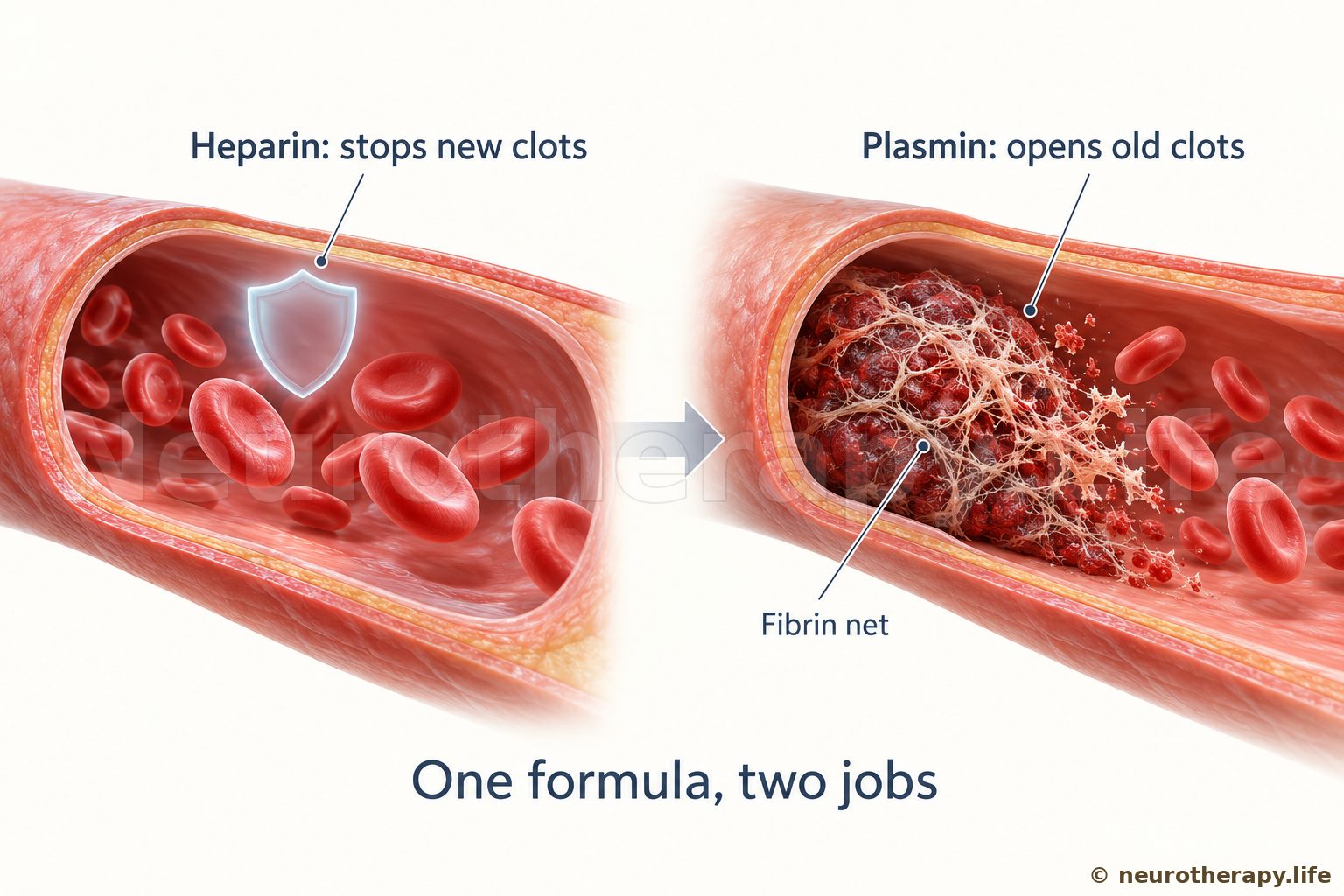
P. Heparin was built in 1994 from the facts of physiology, with two aims held together: unwanted clots should not form, and old clots should also dissolve. Two findings were recorded from it, and those two findings are the whole of the evidence offered for its name.
The first was in women who pass clots during their periods. After one or two treatments, many women reported no clots in the next period. The second was in recent paralysis caused by a blocked vessel. Patients themselves said, in the same hour, that a single treatment had given them more than a quarter of the benefit. That figure is the patient's own estimate, not a measurement.
Heparin stops blood from clotting; plasmin opens an old clot. One treatment was seen doing both, so it was named Plasmin Heparin. The therapy is open that laboratory proof is missing: such tests are costly, and some hospitals do not hand over reports. In their place stand experience, figures and recorded cases.
A teaching case shows the honest scale. A young village woman with sudden weakness of one hand, only days old, received P. Heparin twice a day, and her hand rose fully within a short course; photographs were kept as the record. Recent paralysis tends to respond quickly, while an old one can take a long time.
Key points
- P. Heparin means Plasmin Heparin: one formula, two jobs.
- The name rests on two observed results, not on a blood test.
- Clots in periods often stopped after one or two treatments.
- Recent paralysis responds faster than paralysis of many years.
Go deeper
P. Heparin (plasmin)
The P. Heparin formula page
Paralysis and stroke
Paralysis and stroke
Period problems (irregular, heavy or painful)
Clots and pain in the periods
Thrombosis (blood clots)
Thrombosis: clots in the vessels
How a Formula Is Built: Points, Order and Rests
Why a formula may carry the name of a chemical
The Record That Shows the Truth: The Patient Card in Neurotherapy (LMNT)
Keeping honest records, including photographs
The River: Heparin and the Heparin Formulas
The full guide to the Heparin family
Read the full guide
This topic is part of: The River: Heparin and the Heparin Formulas
Safety: when it is held back
- Sudden weakness or numbness of the face, arm or leg, or sudden trouble speaking, is an emergency. Go to a hospital at once; Neurotherapy (LMNT) comes later, alongside medical care. Paralysis and stroke
- If blood is flowing or there is an open wound, no Heparin treatment is given until the wound heals. P. Heparin (plasmin)
- Neurotherapy (LMNT) works alongside your medical care. Do not stop or change any medicine on your own, especially a blood thinner; ask the doctor who prescribed it.
Watch

Shows the P. Heparin formula: (8) Pan at the top of the thighs, (7) Liv on the thigh and forearm, and (8) Chest Only with the palms on the chest. In the video it is given as the last part of the Angina treatment, to support circulation.
This page explains what a Neurotherapy (LMNT) treatment is for; it is not a self-treatment guide and does not diagnose. Neurotherapy (LMNT) works alongside your medical care — keep taking the medicines your doctor prescribed.