Also called: P. Heparin, Plasmin Heparin, the parent Heparin formula
P. Heparin — Plasmin Heparin — is the parent of Neurotherapy (LMNT)'s Heparin family and its foremost formula for unwanted clots. It is meant both to stop new clots from forming and to help open old ones, it is used for raised diastolic blood pressure, paralysis, heart and kidney disease and clots in the period, and the teaching says it can be given to all patients.
Overview
What is P. Heparin?
Blood is safe while it moves. Slow it, stop it, let it stand, and it begins to set. The Heparin family is Neurotherapy (LMNT)'s answer to that danger: a set of formulas that share one word, Heparin — the name of the body's own substance that keeps blood from clotting.
P. Heparin is the parent. Guruji built it in 1994 from facts of physiology, with two aims held together: that unwanted clots should not form, and that old clots should be dissolved. Nearly every other Heparin formula is this one with something added in front, or one number changed — learn it and you have learned most of the family.
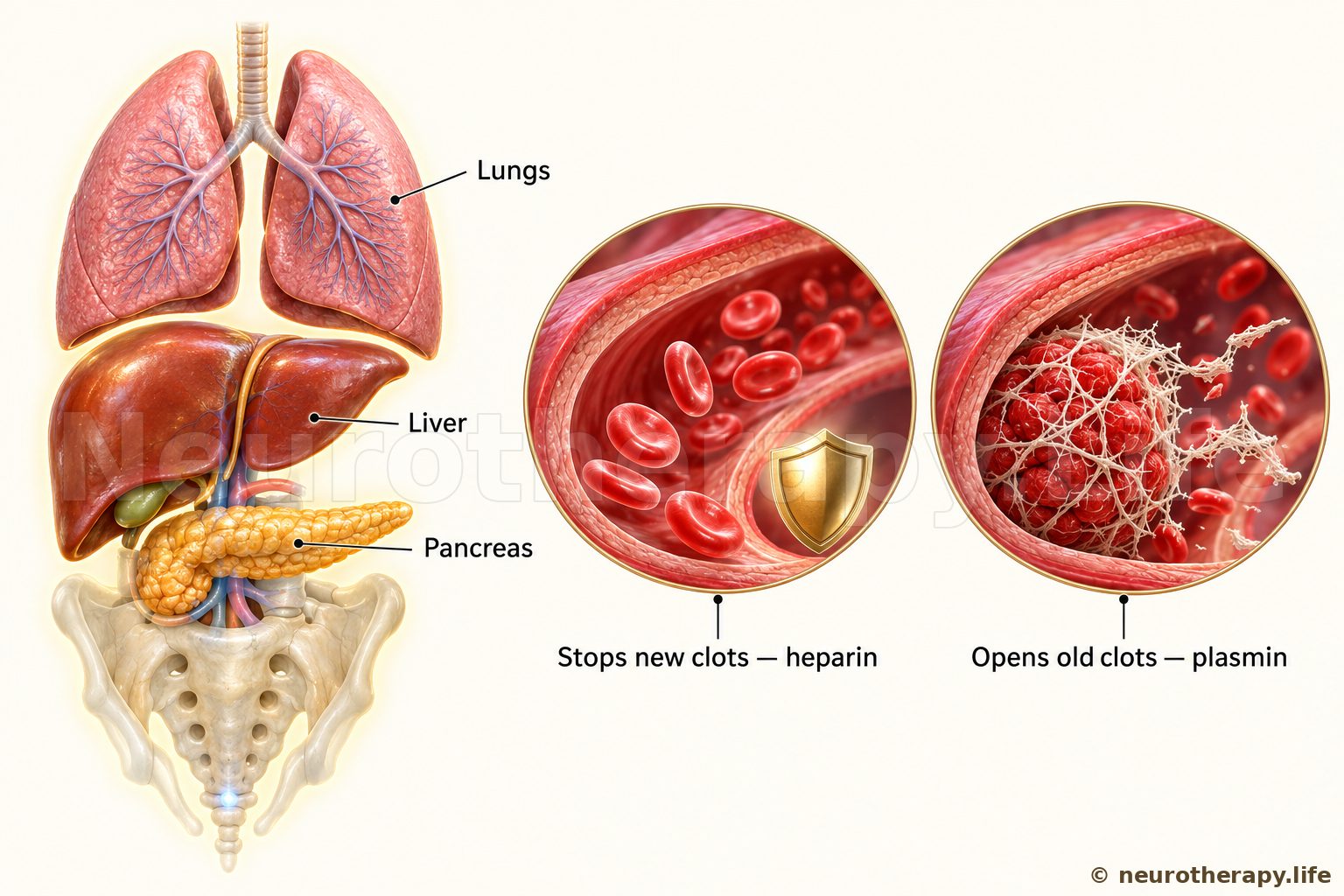
The 'P' stands for plasmin, the body's clot-dissolving enzyme. The formula was named Plasmin Heparin because it was seen doing both jobs — stopping clots that were about to come, as heparin does, and opening clots that had already come, as plasmin does.
P. Heparin works through the pancreas, the liver and the chest. It is named for two jobs: stopping new clots (heparin) and opening old ones (plasmin).
What it is for
What is P. Heparin used for?
To open unwanted clots, and to stop the tendency of clots to form in the future. It is the family's foremost formula for this.
To bring down a raised diastolic blood pressure — the lower of the two numbers.
Clots and pain in the monthly period: the teaching records that after one or two treatments the clots do not come in the next period, and often stay away for years.
Heart disease with blockage: breathlessness is recorded to ease first, and after several months a rise in the heart's pumping (ejection fraction) has been seen.
As the default: if a patient needs the Heparin family and nothing points to a more specific member, P. Heparin is given.
Points it works through
Which points does P. Heparin work through?
(8) Pan (7) Liv (8) Ch. Only — nowadays with (½) Ku – 6 secs at the beginning
Three main points, and nowadays a short hold at the base of the spine at the start, which has been found to bring more benefit. They are listed here as a set, with what each contributes. The exact method is taught hands-on in the Neurotherapy (LMNT) course. This page lists the points of the formula and what each one contributes; it does not describe how any point is given. For the method, watch the demonstration video of each point on its own page and learn hands-on from a trained Neurotherapist. Please do not give a formula from a written description alone.
The half-Ku hold at the very end of the spine, now given at the start of every Heparin formula. It is aimed at the mast cells, which help produce heparin — the 'factory' before the organs.
Chest Only — a very soft glide over the chest towards the shoulders, reaching the lungs, the other great home of heparin.
Position:Face down (prone) for the short hold at the base of the spine, then lying on the back (supine) for the pancreas, liver and chest — one turn in between.
The exact technique is taught hands-on in the Neurotherapy (LMNT) course. See the course →
How it works
How does P. Heparin work?
Two results gave the formula its name. In women who passed clots in their periods, the clots did not come in the next period — a heparin-like result: something was stopped from forming. In heart patients with blockage, breathlessness eased and, over months, the heart's pumping rose — a plasmin-like result: something that had closed was opened.
A careful student asks: the clot already holds plasminogen, so how does anything reach inside it? The teaching's answer is honest about being an estimate: plasminogen turns into plasmin only under a trigger called tPA, so perhaps rousing the pancreas also helps make tPA. Whatever the cause, the teaching records that the formula stops new clots and helps open old ones.
For blood pressure, the reasoning runs through the kidney. If a clot narrows the artery to the kidney, the starved kidney releases renin, which tightens the vessels of the whole body and raises especially the diastolic pressure. Open the narrowing, and the kidney stops 'shouting' — after only a few treatments the diastolic pressure has been seen to fall.
Its family
Which formulas belong to the Heparin family?
Every member is P. Heparin with something put in front of it, added after it, or one number changed. The choice is made from a selection table — and the pain points decide, not the disease name alone.
A. Heparin (acid) — Pain at Mu°, the left kidney point, with signs of acid — knee pain, burning feet, diabetic feet, bamboo spine; also AVN with Mu° pain.
G. Heparin ('glandins) — Pain or clots in the periods, or paralysis from high blood pressure. Not in heart disease.
The gate of the whole family: if blood is flowing, or there is a wound, no Heparin treatment of any kind is given until the wound heals. A bleeding person's life depends on a clot forming. Wound healing
No form of Ku — the hold at the base of the spine — is given during menstruation, and in low blood pressure the therapist checks before giving it. During the four days of the period, treatment is limited to the period's own complaints. Period problems (irregular, heavy or painful)
Pan raises alkali and is normally not given in fits and epilepsy — but inside a Heparin formula it may be given. Pan is never given in schizophrenia, nor in cancer of the pancreas. Epilepsy (fits)
Liv is not given in liver cancer; Chest Only is not given in lung cancer. In any cancer the absolute bars apply: never (10) Pan, Thymus, Pit, Lu + Sh, Rt. Ov. / Lt. Ov. or (30) Medulla. Cancer care: Neurotherapy (LMNT) support
If tingling or numbness runs into the hand during the liver point, the contact is released at once and moved.
Signs of a stroke or heart attack happening now — face drooping, arm weakness, slurred speech, crushing chest pain — are an emergency: call 108/112 at once. Neurotherapy (LMNT) comes afterwards, alongside medical care. Heart attack (myocardial infarction)
If your blood pressure falls after sessions, do not stop your tablets. A normal reading on medicine shows the medicine is working. Ask your own doctor whether the dose should change. Children receive light treatment.
A teaching case
Teaching case: a hand that would not lift
A young woman in a village came with paralysis of the right hand that had come on suddenly a few days earlier. She was given P. Heparin morning and evening, and nothing else is recorded. After a short course her hand rose fully, and photographs were kept. The lesson is the teaching's own: recent paralysis can respond quickly, while an old one takes a good deal of time — so a family is told this on the first day.
A composite case written to teach the reasoning — not one patient’s file.
Common questions
Why is it called P. Heparin?
Because it was seen doing two jobs: stopping clots that were about to form, like heparin, and opening clots that had already formed, like plasmin. So it was named Plasmin Heparin.
Has anyone measured heparin in the blood after this treatment?
No. The teaching is open about this: the name comes from what was seen in patients, not from a laboratory report. Such tests are costly, and reports are not always shared. What stands in their place is recorded experience.
Can a heart or kidney patient have P. Heparin?
Yes. Heart and kidney disease are among its listed uses, and where some Heparin forms are blocked for these patients, P. Heparin is the one named in their place.
Should I stop my blood-pressure tablets if my pressure comes down?
No. Neurotherapy (LMNT) uses no medicine and never tells a patient to stop one. When things have settled, ask your own doctor whether you still need the same dose.
Surprising facts
1Mast cells are heparin's warehouses
Heparin is stored in the granules of mast cells, immune cells that sit along blood vessels and are especially common in the lungs, the liver and the gut lining.
Source: Krystel-Whittemore M, Dileepan KN, Wood JG. Mast Cell: A Multi-Functional Master Cell. Front Immunol. 2016;6:620.
2Plasmin needs a key to switch on
Clots carry plasminogen inside them, but it stays idle until tissue plasminogen activator (tPA), released by the vessel lining, turns it into plasmin. Doctors use man-made tPA to dissolve clots in some strokes.
Source: Chapin JC, Hajjar KA. Fibrinolysis and the control of blood coagulation. Blood Rev. 2015;29(1):17–24.
3A hungry kidney raises blood pressure
When blood flow to a kidney falls — for example from a narrowed renal artery — the kidney releases renin. Through angiotensin, this tightens blood vessels across the body and raises blood pressure.
Source: Guyton & Hall Textbook of Medical Physiology, 14th ed. — the renin–angiotensin system; renovascular hypertension.
4Heparin is named after the liver
It was first found in 1916 in extracts of liver, and named from the Greek 'hepar', liver.
Source: Wardrop D, Keeling D. The story of the discovery of heparin and warfarin. Br J Haematol. 2008;141(6):757–763.
Watch
P HAPARIN FORMULA
Shows the P. Heparin formula: (8) Pan at the top of the thighs, (7) Liv on the thigh and forearm, and (8) Chest Only with the palms on the chest. In the video it is given as the last part of the Angina treatment, to support circulation.
Test yourself
Research
Strong evidence
A review of how plasmin, switched on by tPA, dissolves clots and how this balances clotting — the 'plasmin' half of the formula's name.
This page explains what a Neurotherapy (LMNT) treatment is for; it is not a self-treatment guide and does not diagnose. Neurotherapy (LMNT) works alongside your medical care — keep taking the medicines your doctor prescribed.
Ready to begin?
Send COURSE for course details, or your name, age and health issue for a consultation.