Also called: X. Heparin, X Heparin, Heparin for the tenth cranial nerve
X. Heparin is the member of the Neurotherapy (LMNT) Heparin family made for the digestive system. It puts (10) Medulla, the vagus-nerve treatment, in front of the parent P. Heparin formula, and it is chosen when there is pain at the Pan or Gas point, repeated stomach or digestive trouble, or clots in the digestive system.
Overview
What is the X. Heparin formula?
The Heparin family is built around one parent formula, P. Heparin. It works through the pancreas, the liver and the lungs, and it aims to help the body clear old clots and stop new ones from forming. Every other Heparin formula is that parent with one thing added or changed — and the letter in front of the name tells you what.
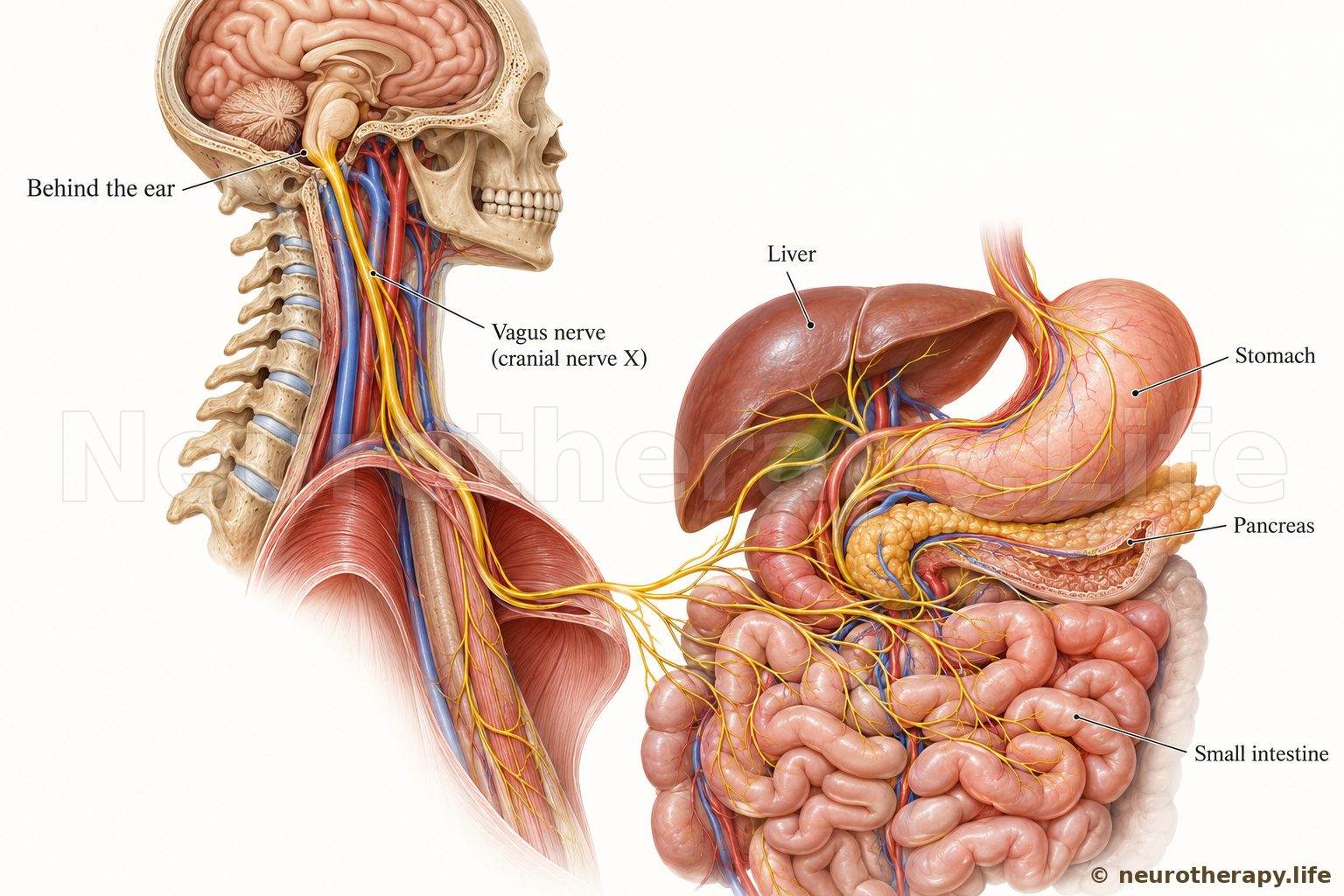
In X. Heparin the letter is a number. X is the Roman numeral for ten, and the vagus is the tenth cranial nerve — one of the twelve pairs of nerves that leave the brain directly. The formula opens with (10) Medulla, the treatment given behind the ears to rouse the vagus, which in Neurotherapy (LMNT) teaching wakes up all the glands of the abdomen.
Put together, the formula has two aims: to rouse the whole digestive system through the vagus, and to remove the blockage that blood clots can cause anywhere along the digestive tract. Nothing is injected or swallowed — 'Heparin' names an effect the formula is held to resemble, not a medicine.
X stands for ten: the vagus, the tenth cranial nerve, reaches the glands of the whole abdomen. X. Heparin uses it to wake the digestive system.
What it is for
What is X. Heparin used for?
To rouse all the glands of the abdomen through the vagus nerve.
To help remove the blockage caused by blood clots anywhere in the digestive system.
For repeated trouble in the stomach or the digestive system, when there is pain at the Pan or Gas point.
It works alongside medical care. A doctor's diagnosis and medicines stay in place.
Points it works through
Which points does X. Heparin work through?
(10) Medulla (8) Pan (7) Liv (8) Ch. Only
X. Heparin is the parent P. Heparin with the vagus treatment added in front. Its points are listed here as a set, with what each one contributes. The exact method is taught hands-on in the Neurotherapy (LMNT) course. This page lists the points of the formula and what each one contributes; it does not describe how any point is given. For the method, watch the demonstration video of each point on its own page and learn hands-on from a trained Neurotherapist. Please do not give a formula from a written description alone.
The vagus treatment, on both sides of the neck behind and below the ears — it rouses every part of the digestive system except the last stretch of the large bowel. In heart patients, the left side only.
The soft chest rub towards the shoulders — for the lungs, the other place where heparin is made.
Position:Seated for (10) Medulla, then lying on the back (supine) for the pancreas, liver and chest points.
The exact technique is taught hands-on in the Neurotherapy (LMNT) course. See the course →
How it works
How does X. Heparin work?
The parent formula follows a simple line of thought. The liver and the lungs are the two places where blood moves very slowly — on purpose, so the liver can clean it and the lungs can exchange gases. Slow blood is blood that could set, so the body makes heparin, its own clot-preventer, right there. Rousing the liver and the lungs is meant to help that natural heparin; rousing the pancreas is meant to help clear the fibrin of old clots.
X. Heparin adds the vagus in front. The vagus nerve carries the brain's 'rest and digest' signals to the stomach, liver, pancreas and intestines. In Neurotherapy (LMNT) teaching, (10) Medulla rouses all the abdominal glands and can raise stomach acid strongly. So this formula is chosen when the findings belong to the stomach: pain at the Pan or Gas point, and digestion that keeps going wrong.
The number is a selector, not a strength. (6) Medulla, (10) Medulla and (30) Medulla head three different Heparin formulas with three different jobs: the brain, the abdomen, and inflammation. Each carries its own list of bars, and none of those lists is a general Medulla rule. The exact method is taught hands-on in the Neurotherapy (LMNT) course.
Its family
Which formulas are related to X. Heparin?
X. Heparin is one of the children of P. Heparin. Its closest relatives are the other two Heparins headed by a Medulla treatment.
P. Heparin (plasmin) — The parent formula — pancreas, liver and chest. The default when nothing else steers the choice.
M. Heparin (medulla) — Headed by (6) Medulla, for the brain: headache, eye disease, paralysis after an infarct.
G. Heparin ('glandins) — Headed by (30) Medulla, for inflammation and the ill effects of medicines. Not in heart disease.
A. Heparin (acid) — The Heparin for the patient who is tender at Mu°, the acid sign.
Multi Heparin — Several Heparins together, for multiple infarcts or calcification.
What it is used for
When is X. Heparin given?
In the Heparin selection table, X. Heparin is the row for repeated trouble in the stomach or digestive system. It is chosen from the patient's findings on the day — above all pain at the Pan or Gas point.
Digestion
Abdominal painRepeated stomach or digestive trouble with pain at the Pan or Gas point
Thrombosis (blood clots)Clots in the blood vessels of the digestive system — always with a doctor's care
Safety: when it is held back
The gate of the whole Heparin family: if blood is flowing, or there is a wound, no Heparin treatment of any kind is given until the wound heals. P. Heparin (plasmin)
Raised stomach acid: (10) Medulla is not given, because it can raise stomach acid strongly. Burning behind the breastbone, sour belching, a known ulcer, or pain worse on an empty stomach — then this is not the formula for today. Acidity (heartburn and acid reflux)
Diabetes: (10) Medulla is barred, so X. Heparin is not given. Diabetes
Cancer: (10) Medulla is not given. In cancer the therapy never gives (10) Pan, Thymus, Pit, Lu+Sh, Rt.Ov/Lt.Ov or (30) Medulla; Liv is not given in liver cancer, Chest Only not in lung cancer, Pan not in cancer of the pancreas. Cancer care: Neurotherapy (LMNT) support
Heart disease: the step is not dropped but changed — (10) Left Medulla only, never both sides. (10) Medulla
'Heparin' is the name of an effect, not a medicine. Nothing is administered. Never tell a doctor 'he was given heparin'. Keep taking every medicine your doctor has prescribed, including blood thinners — only the doctor changes them. Children get light treatment.
Vomiting blood, black tarry stool, sudden severe belly pain or a hard, swollen belly is an emergency: call 108/112 at once. Neurotherapy (LMNT) comes afterwards, alongside medical care.
Common questions
Why is it called X. Heparin?
X is the Roman numeral ten, and the vagus is the tenth cranial nerve. Every other Heparin is named after a substance or a body part; this one is named after a number — the nerve it uses.
Am I being given heparin, the blood-thinning medicine?
No. Nothing is injected or swallowed. The formula is named after heparin because it aims at an effect that resembles it, by working on the organs that make the body's own heparin.
I have diabetes and a poor digestion. Can I have X. Heparin?
No — (10) Medulla is barred in diabetes. But that bar belongs to (10) Medulla only, not to every Medulla. Your therapist will choose another member of the family or another digestive formula.
Why does the therapist ask about heartburn first?
Because the vagus treatment can raise stomach acid. If your trouble is too much acid already, this formula would add to it, so another treatment is chosen that day.
Surprising facts
1The 'wandering' nerve
Vagus is Latin for 'wandering'. It is the longest cranial nerve, travelling from the brainstem through the neck and chest into the abdomen, where it reaches the gut as far as the later part of the large bowel — but not the last stretch.
Source: Gray's Anatomy, 41st ed. — the vagus nerve; parasympathetic supply of the gut.
2Most of the vagus listens
About four out of five fibres in the vagus carry messages up from the organs to the brain, not down. It is the brain's main line for hearing how the gut is doing.
Source: Breit S, et al. Vagus Nerve as Modulator of the Brain–Gut Axis. Front Psychiatry. 2018;9:44.
3Heparin was found in the liver
Heparin was discovered in 1916 by a medical student, Jay McLean, working with extracts of dog liver. Its name comes from the Greek word hepar, liver.
Source: Wardrop D, Keeling D. The story of the discovery of heparin and warfarin. Br J Haematol. 2008;141(6):757–763.
4Your stomach starts before you eat
The sight, smell and thought of food send signals down the vagus that switch on stomach acid before the first bite. This is called the cephalic, or 'head', phase of digestion.
Source: Guyton & Hall Textbook of Medical Physiology, 14th ed. — phases of gastric secretion.
Test yourself
Research
Strong evidence
This major review describes how the brain, mainly through the vagus nerve, controls the movement and the secretions of the stomach and intestines.
This page explains what a Neurotherapy (LMNT) treatment is for; it is not a self-treatment guide and does not diagnose. Neurotherapy (LMNT) works alongside your medical care — keep taking the medicines your doctor prescribed.
Ready to begin?
Send COURSE for course details, or your name, age and health issue for a consultation.