Also called: G. Heparin, G Heparin, Glandin Heparin
G. Heparin is a member of Neurotherapy (LMNT)'s Heparin family of formulas. The 'G' stands for prostaglandins, the body's local messengers of inflammation. It is used for high systolic blood pressure, paralysis that followed high blood pressure, painful periods with clots, and a hot, red, swollen knee — and it is never given in heart disease.
Overview
What is G. Heparin?
In Neurotherapy (LMNT), the Heparin formulas are a family built on the body's own clot-dissolving and blood-flow chemistry. The parent formula, P. Heparin, can be given to all patients. Each other member adds one step in front of the parent that steers it towards a particular target.
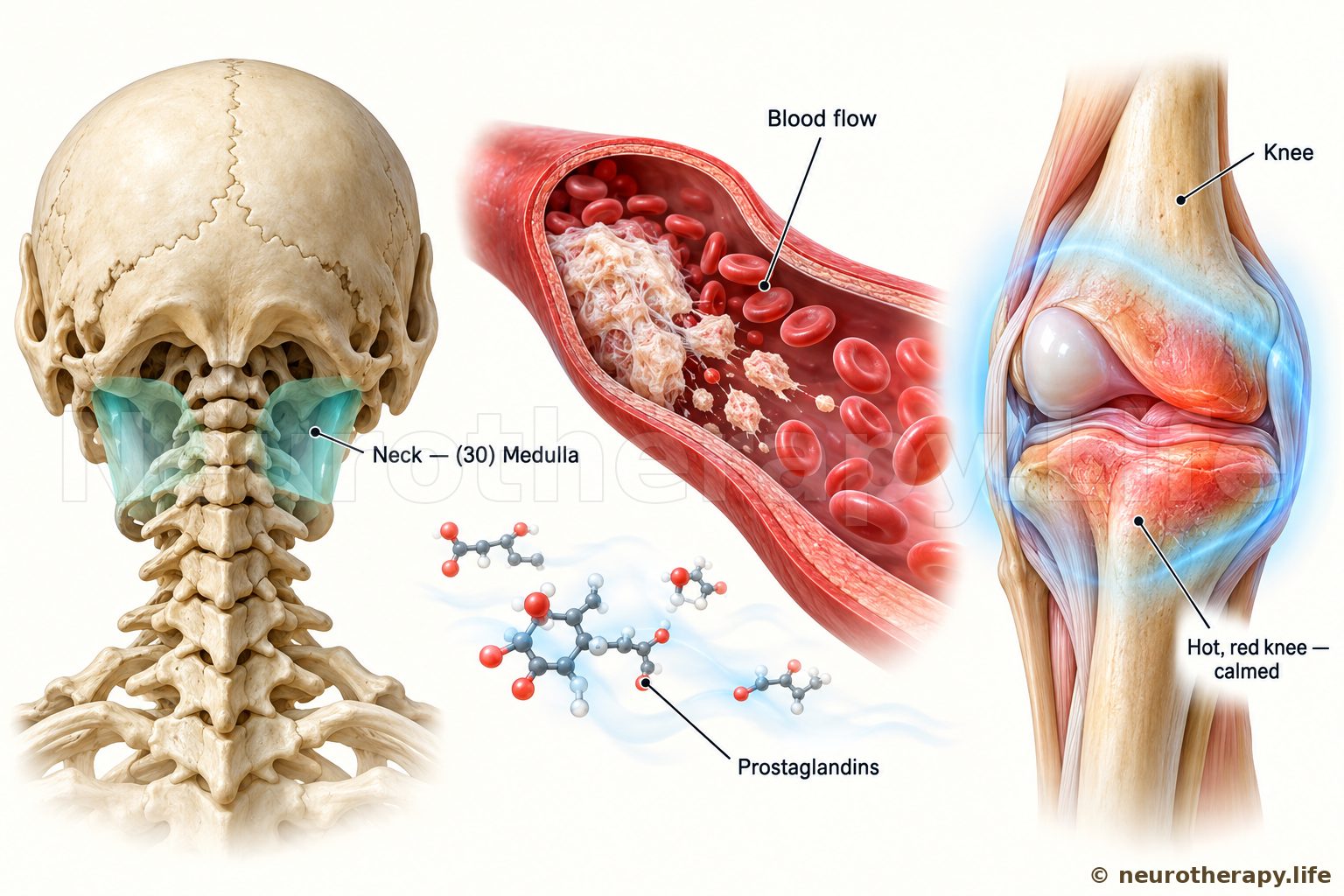
In G. Heparin, that step is (30) Medulla, given at the neck. The teaching says this form of Medulla rouses the prostaglandins — the 'glandins' in the name — and through them corrects the ill effects of medicines, or trouble that has come from inflammation anywhere in the body.
Three Heparins open with Medulla, each in a different named form, and each is a different formula: M. Heparin with (6) Medulla for the brain, X. Heparin with (10) Medulla for the vagus nerve, and G. Heparin with (30) Medulla for the prostaglandins.
G. Heparin adds (30) Medulla, linked with the prostaglandins, to the parent Heparin formula for blood flow.
What it is for
What is G. Heparin used for?
To help reduce high systolic (upper) blood pressure. The parent P. Heparin is linked with the diastolic (lower) reading; G. Heparin with the systolic.
For paralysis that came because of high blood pressure, where the teaching records considerable benefit.
For painful periods with clots — the teaching records that pain and clots eased from the very next cycle.
For a knee that is hot, red and swollen when there is no pain at the Mu° point — the heat and swelling were reported to settle within one or two treatments.
In autoimmune conditions such as multiple sclerosis, and for the ill effects of medicines — always alongside the specialist's care.
Points it works through
Which points does G. Heparin work through?
(30) Medulla (8) Pan (7) Liv (8) Ch. Only
G. Heparin is (30) Medulla followed by the parent Heparin formula. The points are listed here as a set, with what each contributes. The exact method is taught hands-on in the Neurotherapy (LMNT) course. This page lists the points of the formula and what each one contributes; it does not describe how any point is given. For the method, watch the demonstration video of each point on its own page and learn hands-on from a trained Neurotherapist. Please do not give a formula from a written description alone.
The chest point, given lightly on the chest — it closes the parent Heparin.
Position:Seated for (30) Medulla; lying on the back (supine) for the rest.
The exact technique is taught hands-on in the Neurotherapy (LMNT) course. See the course →
How it works
How does G. Heparin work?
Prostaglandins are small messenger chemicals made in almost every tissue. Body science shows they take part in inflammation, pain, the tone of blood vessels, blood clotting and the contractions of the womb. The teaching's idea is that by rousing them through (30) Medulla and mixing that effect into the Heparin formula, inflammation and its after-effects can be helped.
The knee shows how a finding chooses the formula. Two patients may both say 'my knee is killing me'. If the knee is painful and the Mu° point is tender, with signs such as constipation and dry skin, A. Heparin is chosen. If the knee is hot, red and swollen and Mu° is not painful, G. Heparin is chosen. The fingers decide, not the X-ray.
The bar travels with the step. (30) Medulla is not given in heart disease, so neither is any formula that contains it. That bar belongs to (30) Medulla alone — it does not spread to other forms of Medulla.
Its family
Which formulas are related to G. Heparin?
G. Heparin is one of a large family that shares one parent sequence.
P. Heparin (plasmin) — The parent — may be given to all patients; linked with the diastolic reading. Given in place of G. Heparin in heart disease.
A. Heparin (acid) — The knee's other choice — when Mu° is painful and the acidosis signs are present.
J. Heparin (joints) — For night cramps and weakness; also a substitute for G. Heparin in heart disease.
M. Heparin (medulla) — Headed by (6) Medulla, for headache and diseases of the brain, eye and nose.
Knee painA hot, red, swollen knee with no pain at Mu°
InflammationTrouble that has come through inflammation in any part of the body
Multiple sclerosis (MS)Named as an autoimmune disease it is used in, alongside the neurologist's care
Safety: when it is held back
Never given in heart disease. (30) Medulla is barred in heart disease, and the bar passes to every formula that contains it. In heart patients, J. Heparin or P. Heparin is given in its place. Heart
(30) Medulla is also not given in low blood pressure or in infections. (30) Medulla
No Heparin formula is given while a wound is still open. Wound healing
A single hot, swollen, very painful knee — especially with fever — needs a doctor the same day to rule out infection in the joint. How to tell a patient to see a doctor
Sudden weakness of one side, a drooping face or slurred speech is a stroke emergency: call 108/112 at once. Paralysis and stroke
Never stop blood pressure or blood-thinning medicines because of this formula. Pan is not given in fits or seizures, nor in schizophrenia. Pan
Keep taking the medicines your doctor prescribed. Neurotherapy (LMNT) works alongside your medical care, never instead of it.
Common questions
Is any heparin injected?
No. Nothing is injected or swallowed. 'Heparin' is the name of this family of touch formulas, which the teaching links with the body's own blood-flow chemistry.
I have heart disease and high blood pressure. Can I have G. Heparin?
No. G. Heparin is never given in heart disease. Your therapist will choose another member of the family, such as P. Heparin or J. Heparin.
What are prostaglandins?
Small messenger chemicals made in almost every tissue. They help control inflammation, pain, blood vessel tone, clotting and the contractions of the womb during a period.
How does the therapist choose between A. Heparin and G. Heparin for my knee?
By pressing the Mu° point beside the navel. Painful Mu° with signs of acidosis points to A. Heparin; a hot, red, swollen knee with no pain at Mu° points to G. Heparin.
Surprising facts
1Period pain is largely a prostaglandin story
The lining of the womb releases prostaglandins at the start of a period. They make the womb squeeze hard, which is a main cause of period cramps.
Source: Ricciotti E, FitzGerald GA. Prostaglandins and inflammation. Arterioscler Thromb Vasc Biol. 2011;31(5):986–1000.
2Aspirin works by blocking prostaglandins
Aspirin and similar painkillers block the enzyme that makes prostaglandins. This discovery earned a Nobel Prize in 1982.
Source: Vane JR. Inhibition of prostaglandin synthesis as a mechanism of action for aspirin-like drugs. Nature New Biology. 1971;231:232–235.
3Heparin was found in the liver
The natural anticoagulant heparin was discovered in 1916 by a medical student, and named after the Greek word for liver, where it was first extracted.
Source: Wardrop D, Keeling D. The story of the discovery of heparin and warfarin. Br J Haematol. 2008;141(6):757–763.
Test yourself
Research
Strong evidence
This review explains how prostaglandins are made, how they drive and later help resolve inflammation, and their roles in blood vessels, pain and the womb — the body science behind the 'glandins' in this formula's name.
This page explains what a Neurotherapy (LMNT) treatment is for; it is not a self-treatment guide and does not diagnose. Neurotherapy (LMNT) works alongside your medical care — keep taking the medicines your doctor prescribed.
Ready to begin?
Send COURSE for course details, or your name, age and health issue for a consultation.