The uterus, or womb, is a pear-sized muscle low in a woman's pelvis. Every month it builds a fresh lining and, if no pregnancy begins, sheds it as the period — without leaving a scar. In pregnancy it grows about fifteen times heavier to hold a baby, then shrinks back in about six weeks.
Overview
What is the uterus?
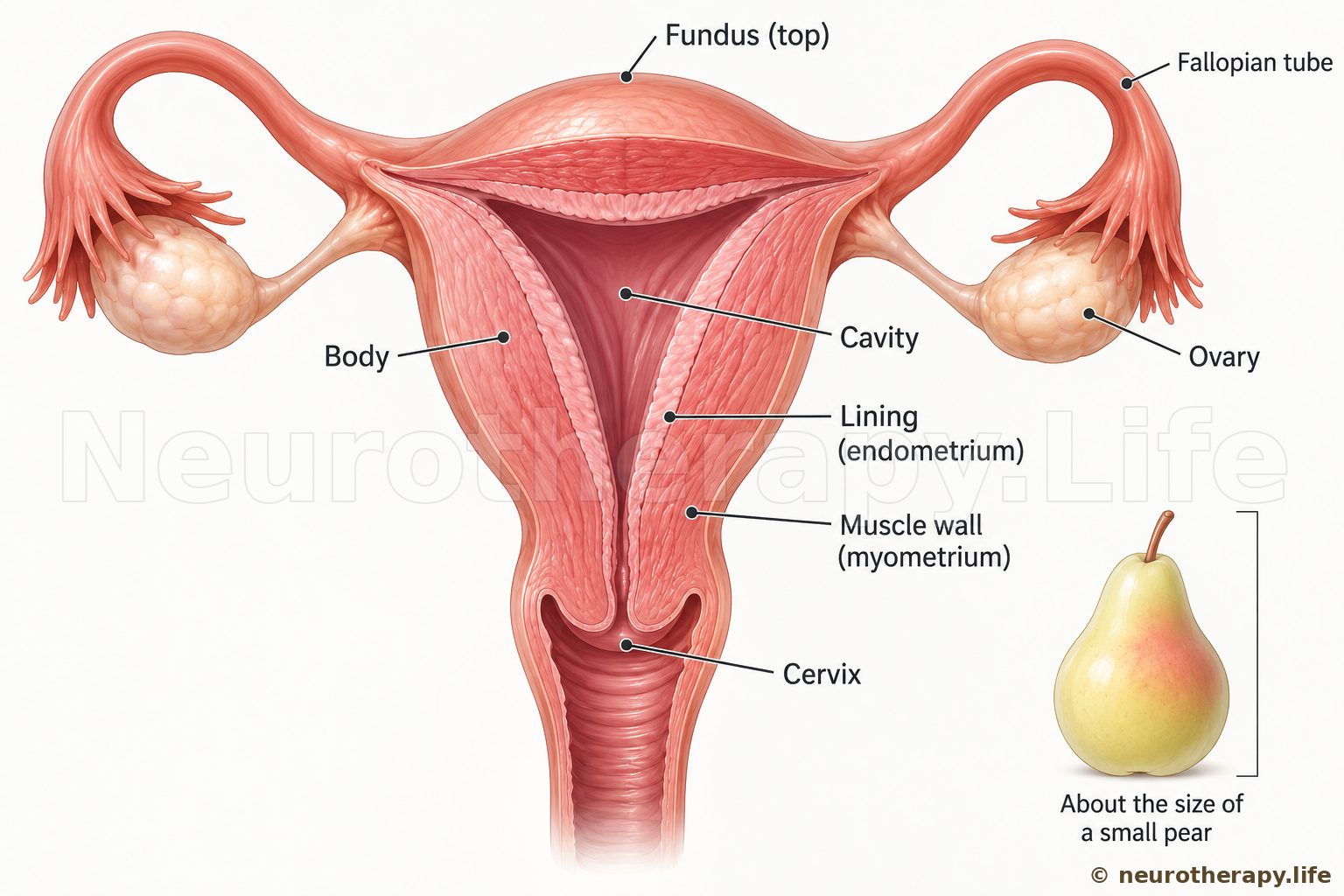
The uterus is a hollow, muscular organ shaped like an upside-down pear. It sits in the middle of the pelvis, between the bladder in front and the rectum behind. Its narrow lower end, the cervix, opens into the birth canal (vagina); at its upper corners the two fallopian tubes join it.
Its job is to receive a fertilised egg, shelter and feed a baby for about nine months, and then push it out at birth. When there is no pregnancy, the uterus sheds its lining every month — the period.
Uterus problems are very common: heavy or painful periods, fibroids, and a womb that slips down from its place. Most can be managed well once they are named and checked. Cancer of the cervix, one of the commonest cancers in Indian women, can be largely prevented by the HPV vaccine and regular screening.
The uterus: a thick muscle wall around a small cavity lined with the endometrium, the lining that is rebuilt every month.
Function
What does the uterus do?
The uterus is a home that rebuilds itself every month, a nursery for nine months, and one of the strongest pushing muscles in the body at birth. The ovaries' hormones tell it what to do and when.
Builds a thick, blood-rich lining every month, ready for a fertilised egg.
Sheds that lining as the period when no pregnancy begins.
Holds, protects and feeds a growing baby through the placenta for about 40 weeks.
Contracts powerfully in labour to push the baby out, then clamps down to control bleeding.
The cervix acts as a gate — mostly closed, softening only around ovulation and in labour.
The period (about days 1–5)
Progesterone has fallen, so the old lining breaks down and leaves as the period, usually over 2 to 7 days.
Rebuilding
Rising oestrogen from the ovary makes the lining grow thick again, from about 1 mm to around 1 cm.
Ripening
After ovulation, progesterone makes the lining soft, rich in glands and full of nourishment.
Pregnancy or a new period
If a fertilised egg settles, the lining is kept and the placenta forms. If not, progesterone falls about 14 days after ovulation and the cycle begins again.
How does the uterus work with other organs?
Ovaries — Their oestrogen builds the lining and their progesterone ripens it; when progesterone falls, the period starts.
Pituitary gland — Makes oxytocin, which drives labour contractions and the let-down of breast milk.
Bladder — Sits just in front of the uterus; a heavy or slipped womb often presses on it.
Intestines — The rectum lies just behind; constipation and straining add to the load on the pelvic floor.
Blood — Every period uses blood; heavy periods drain iron, and pregnancy raises blood volume by about half.
Low back — Uterus trouble is often felt low in the back, over the sacrum.
Anatomy
What are the parts of the uterus?
The uterus has three regions, three layers in its wall, and a set of supports that hold it in place.
Regions
Fundus — The rounded top, above where the tubes join. In pregnancy, doctors measure its height to follow the baby's growth.
Body (corpus) — The main part, around a small, flat, triangle-shaped cavity.
Cervix — The narrow neck, about 2.5–3 cm long, with a small canal that opens into the birth canal. Its glands make mucus that changes through the cycle.
Fallopian tubes — Two tubes, about 10 cm long, joining the upper corners; the egg and sperm usually meet in them.
Layers of the wall
Endometrium — The soft inner lining that thickens, ripens and is shed each month. Its deepest layer stays behind and regrows the rest.
Myometrium — The thick middle wall of smooth muscle that contracts in periods and in labour. Fibroids grow from this layer.
Perimetrium — The thin, smooth outer covering.
What holds it up
The uterus is held not by one strong rope but by a web of ligaments and, most of all, by the muscles of the pelvic floor underneath.
Pelvic floor muscles — A hammock of muscle across the bottom of the pelvis that carries the bladder, uterus and rectum.
Uterosacral and cardinal ligaments — Tough bands that tie the cervix back to the sacrum and out to the pelvic walls.
Round and broad ligaments — Softer supports that keep the uterus tipped forward and carry its blood vessels.
Where is the uterus located?
The uterus sits in the middle of the pelvis, low in the belly, behind the pubic bone. The bladder lies in front of and below it, and the rectum lies behind it. In most women it is tipped forward, resting over the bladder; in about one woman in five it is tipped backward — a normal variation.
In LMNT, the point for the uterus is WD, on the midline just below the navel, between the navel and the pubic bone. Behind it lie the dome of the bladder when full — one reason the patient passes urine before a session — the top of the uterus, and loops of bowel. In pregnancy the uterus rises out of the pelvis and, by the end, reaches up under the ribs.
A uterus that is not pregnant is a firm, pinkish, pear-shaped organ, flattened from front to back. Its wall is thick muscle — well over a centimetre — and the cavity inside is only a narrow slit shaped like a triangle, with the two tubes at its upper corners and the cervix at its tip.
On ultrasound, the lining shows as a bright stripe down the middle that is thin just after a period and thick before the next one.
How big is the uterus?
In an adult woman who is not pregnant, the uterus is about 7.5 cm long, 5 cm wide and 2.5 cm thick — about the size of a small pear or a closed fist — and weighs roughly 40–80 grams, a little more in women who have had children.
By the end of pregnancy it weighs about 1,100 grams and holds about 5 litres. After the menopause it becomes smaller again.
Conditions and disorders
What conditions and disorders affect the uterus?
Uterus problems include heavy, painful or irregular periods; fibroids and polyps; endometriosis and adenomyosis, where lining-like tissue grows in the wrong place; a womb that slips down (prolapse); infections; and cancers of the cervix and the lining. Heavy bleeding and any bleeding after the menopause always need a doctor's check.
Low back painPain low in the back over the sacrum can come from the uterus as well as from the spine.
What are common signs of a uterus problem?
Periods that soak a pad within an hour, last more than 7 days, or pass large clots
Period pain that stops you working, or pain that is getting worse year by year
Bleeding between periods, after intercourse, or any bleeding after the menopause
A dragging heaviness low in the belly, or a feeling that something is coming down, worse by evening
Leaking urine on coughing or lifting, or difficulty emptying the bladder
Discharge that is coloured, bad-smelling or blood-stained
Tiredness, pale skin and breathlessness from heavy periods
What tests check the uterus?
Pelvic ultrasound (sonography) — Shows the size of the uterus, the thickness of the lining, fibroids, polyps and a prolapse.
Haemoglobin and iron tests — A cheap, quick way to see what heavy periods have taken from the blood.
Pap smear and HPV test — Cells from the cervix are checked for early changes, years before any cancer could form.
Pelvic examination — A doctor's examination is how the grade of a prolapse is judged — it cannot be felt by the patient herself.
Hysteroscopy and endometrial biopsy — A thin camera looks inside the uterus, and a small sample of the lining may be taken — for example after bleeding past the menopause.
Pregnancy test — The first test for any missed period or unexpected bleeding in a woman who could be pregnant.
How are uterus conditions treated?
Iron and diet — To rebuild blood lost in heavy periods, as a doctor advises.
Medicines for heavy or painful periods — Anti-inflammatory pain relief that blocks prostaglandins, medicines that reduce bleeding, and hormone treatments including a hormone-releasing coil.
Pelvic floor training and pessary — Supervised pelvic floor exercises improve mild prolapse; a soft ring (pessary) can support the womb.
Surgery — Removing fibroids or polyps, repairing a prolapse, or, when needed, removing the uterus (hysterectomy).
Prevention of cervical cancer — HPV vaccination and regular screening prevent most cervical cancers; early changes are easy to treat.
Care in pregnancy and birth — Regular antenatal check-ups and a skilled birth attendant for every delivery.
Neurotherapy (LMNT)
In LMNT, the uterus is reached through WD, the point on the midline below the navel. WD is never pressed on the belly: it is given on both forearms, from elbow to wrist, and the teaching uses it to increase the flow of blood in the uterus — in prolapse, control of urine, menstrual pain and infertility. LMNT reads a woman's cycle as a finding: heavy or long flow as a chief sign of acidosis, very scanty flow as a sign of alkalosis. A descended womb is classed with piles and prolapse of the rectum as one family of loose muscle, and tender Mu° goes with it. The rules that come with the uterus are among the strictest in the therapy: the four days, the heparin bar in heavy flow, the pregnancy bars, and the question 'do you want a child — now or later?' before Ton 'P'.
Points
WD — The uterus point (also the prostate point in men). Given on both forearms; for blood flow in the uterus, prolapse, control of urine, menstrual pain and infertility. Not given in cancer or in the teenage years.
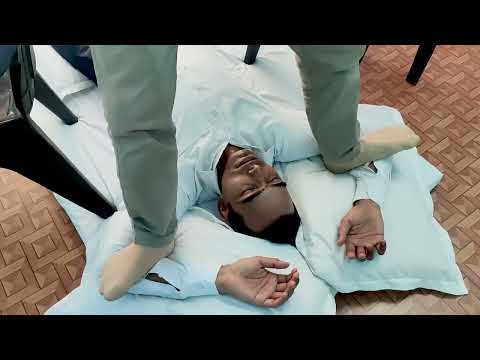
P point — The prolapse point: the heel on the middle of the thigh with one upward jerk, left thigh first. Given only when sonography shows the prolapse — and (6) WD must follow immediately, on the same line of the card, because a muscle loosened and left loose is worse than before.
Triangle for Piles — Three upward jerks on the sacrum. The teaching says it strengthens the pelvic muscles and tightens the sphincters of the bladder, uterus and back passage — named for prolapse of the uterus and for excessive menstrual bleeding. Not for those who pass little urine.
(2) S4 – S5 — Given at almost the same place as the Triangle but in the opposite direction: it relaxes those sphincters and is used to increase a scanty flow. Not for those who pass too much urine.
(4) Para — For heavy menstrual flow — the teaching says such women benefit immediately. If there are cramps too, the 1,25 DCC formula is added. Never alone in osteoporosis.
(30) Medulla — The prostaglandin treatment. Prostaglandins make the uterus contract; the teaching says (30) Medulla reduces menstrual pain. Not given to heart patients.
Raman — The peritoneum treatment, called 'excellent for problems of the uterus'.
Ton 'P' — Described as unmatched for setting a prolapsed uterus back in place — but refused to any woman who still wishes to bear children, because it may perhaps affect conception. It is not proven to prevent pregnancy either, so it is never to be called a contraceptive.
Mu° — Pain at Mu° is found in prolapse of the uterus, prolapse of the rectum and hernia — the teaching's sign of the acid side.
(8) Pan (6) WD (8) Ch. Only (20) Round Arrow — named for all problems of the uterus, white discharge and pain below the navel. Where pain below the navel is severe and there is no diabetes or autoimmune disorder, the last two steps are replaced by (8) Thymus + Chest.
For giddiness when blood pressure has fallen suddenly after a very heavy period — once the bleeding has stopped. (2) Para is not given in that situation.
“This matter is to be publicised as widely as possible: that the cord should not be cut until the child itself has cried properly for some time.”
— Dr. Lajpatrai Mehra
“Whether or not the patient gets immediate benefit from our treatment, let no harm reach him through our carelessness — attend to this.”
— Dr. Lajpatrai Mehra
“This is a matter of experience.”
— Dr. Lajpatrai Mehra
Never do this
See a doctor the same day — and keep treating alongside — for bleeding after the menopause (any amount), bleeding in pregnancy, soaking a pad every hour or passing very large clots, bleeding with faintness or a racing heart, and bleeding between periods or after intercourse. How to tell a patient to see a doctor
Never apply pressure to a pregnant woman's abdomen, and never push down on the top of the womb, at any stage, for any reason. A labouring woman belongs with someone skilled in delivering babies. Pregnancy care
P point is a jerk and cannot be graded: it is not given in pregnancy or the weeks after birth, after recent pelvic, belly or hip surgery, in fragile bones, or to anyone on blood-thinning medicine. It is given only on sonography evidence, and always followed at once by (6) WD. P point
In prolapse of the uterus, Gas Only and (10) Medulla are never given. Gas Only
The four days: no treatment for other problems during the period — only for flow that is very heavy, will not stop or is very scanty, or for pain and clots. While the flow is heavy, no Heparin formula of any kind, and no Ku during the period. Neurotherapy (LMNT) during periods: the four-day pause and its exceptions
WD, Rt. Ov. and Lt. Ov. are not given in the teenage years. Ton 'P' is not given to a woman who wants a child, now or later — ask her plainly before it is written on a card. Ton 'P'
The cord teaching is about not hurrying to cut the cord — never about waiting when a newborn is not breathing. A baby who is not breathing needs help to breathe within the first minute: dry, warm, rub the back, and a trained person starts breathing support.
Cancer: if the person has cancer, (10) Pan, Thymus, Pit, Lu + Sh, Rt. Ov / Lt. Ov and (30) Medulla are never given — the therapist changes the plan. WD is not given in cancer either. Cancer care: Neurotherapy (LMNT) support
Keep taking the medicines your doctor prescribed and keep every scan and appointment with your gynaecologist — whether a womb has gone back into place is decided by an examination, not by how it feels. Neurotherapy (LMNT) works alongside your medical care, never instead of it.
Care
How can I keep my uterus healthy?
Much of the uterus's health is about the muscles that hold it, the blood it loses, and the checks that catch problems early.
Lukewarm milk in heavy flow
LMNT's rule: during heavy bleeding drink at least ¾ litre of milk a day, lukewarm and never hot — hotter milk, the teaching says, can increase the bleeding. At night soak one dried date (khārak / chhuhārā) in a cup of milk in the fridge; in the morning boil them together, eat the date and drink the milk.
Iron with something sour
If your periods are heavy, get a haemoglobin test. Eat dal, greens and millets with lemon, tomato or āmlā in the same meal, which helps the iron to be absorbed — and take iron tablets a little apart from milk.
Look after the pelvic floor
Treat constipation, get a chronic cough seen, and lift with the knees bent and the load close to the body. These three loads push the womb down every day.
Screening and HPV vaccine
Have cervical screening as your doctor advises, and ask about the HPV vaccine for daughters aged 9–14.
Rest in the four days
LMNT pauses other treatments for the four days of the period; the old household order, too, kept those days for rest rather than heavy work.
Sit and sleep straight
Guruji's daily rule: women and girls should not sit or sleep with one leg over the other, because of the one-sided pull on the uterus and ovaries; everyone should sleep with straight legs. This is a habit for the future — it does not mean an old problem was caused by how you sat.
Common questions
How much bleeding is 'too much'?
Signs of heavy bleeding are soaking a pad or cloth every hour or two, needing to change at night, passing clots larger than a coin, bleeding for more than 7 days, or feeling tired and breathless. If this is you, see a doctor and ask for a haemoglobin test.
Do all fibroids need an operation?
No. Fibroids are very common and most cause no trouble at all. Treatment depends on their size, place and symptoms — heavy bleeding, pressure, or difficulty conceiving. Many are simply watched with a scan.
My doctor says my womb has slipped and needs an operation. Can Neurotherapy (LMNT) fix it instead?
Please do not cancel anything. LMNT has treatments for a descended womb and many women feel real relief from the dragging and heaviness, especially when constipation, coughing and lifting are also corrected. But whether the womb has gone back is decided by your doctor's examination, not by how it feels. Take any change back to your doctor.
Is a tilted (retroverted) uterus a problem?
Usually not. About one woman in five has a uterus that tips backward. It is a normal variation and on its own does not stop pregnancy.
Why are some treatments stopped during my period?
In LMNT, no treatment for other problems is given during the four days of the period. And while the flow is heavy, no Heparin formula is given, because heparin keeps blood from clotting and the flow would increase. You should still come if the flow is very heavy, will not stop, is very scanty, or comes with pain or clots.
What should the family tell the nurse about the baby's cord?
Guruji's teaching asks that the cord not be cut until the baby has cried properly, and not until the blood in the cord has stopped moving. Modern guidelines agree in part: the WHO recommends waiting at least a minute before clamping a healthy baby's cord. But if the baby is not breathing, the team must help it breathe at once — that comes first.
What should I ask my doctor or therapist?
What is my haemoglobin, and do I need iron?
Where exactly is my fibroid, how big is it, and when should it be scanned again?
What grade is my prolapse, and would pelvic floor training or a pessary help?
Am I due for a Pap smear or HPV test?
Which bleeding should send me to hospital straight away?
(To the therapist) Is P point right for me, is (6) WD written straight after it, and which points are left out because I am pregnant, bleeding heavily, or want a child?
Surprising facts
1It grows about 15 times heavier in pregnancy
A non-pregnant uterus weighs about 70 grams and holds about 10 millilitres. By full term it weighs about 1,100 grams and holds about 5 litres — some 500 times more — mostly by stretching and enlarging the muscle cells it already has.
Source: Williams Obstetrics — uterine growth in pregnancy (about 70 g to about 1,100 g; volume about 10 mL to about 5 L).
2Then it shrinks back in about six weeks
After birth the uterus contracts hard and shrinks, week by week, almost back to its old size within about six weeks. Breastfeeding helps: it releases oxytocin, which makes the womb contract — that is why many mothers feel cramps while feeding in the first days. Guruji's teaching makes the same point.
Source: Williams Obstetrics — puerperal involution; NHS, 'Your body after the birth' (afterpains with breastfeeding). LMNT: sec. 40.11.
3It rebuilds its lining every month — without a scar
Every period, the upper part of the lining is shed and then regrown from the deep layer that stays behind. Over a lifetime this happens some 400 times, and a healthy uterus heals each time without scarring — something few other tissues in the body can do.
Source: Critchley HOD et al., 'Physiology of the endometrium and regulation of menstruation', Physiological Reviews 2020;100:1149–1179.
4Period cramps and labour pains share a chemical
The lining makes prostaglandins, which make the muscle of the uterus squeeze. Too much of them causes period cramps — which is why anti-inflammatory painkillers that block prostaglandins help. The same family of chemicals helps drive labour. LMNT's (30) Medulla is called the prostaglandin treatment for this reason.
Source: ACOG FAQ 'Dysmenorrhea: painful periods'; Guyton & Hall — parturition. LMNT: sec. 40.9, 40.4.
5One woman in five has a womb that tips backward
Most wombs tip forward over the bladder, but about one in five tips backward towards the spine. It is a normal variation, not a disease, and on its own it does not stop pregnancy.
Source: Cleveland Clinic, 'Retroverted uterus' (about 1 in 5 people with a uterus).
6By 50, most women have had fibroids
An ultrasound study found fibroids by age 50 in about 70% of white women and over 80% of black women — most of them never causing any symptoms. A fibroid on a report is common; what matters is its size, its place, and whether it causes trouble.
Source: Baird DD et al., American Journal of Obstetrics and Gynecology 2003;188:100–107.
7The cervix is a gate that changes with the cycle
For most of the month the cervix makes thick mucus that blocks sperm and germs. Around ovulation, rising oestrogen turns it thin, clear and stretchy, like raw egg white, so sperm can swim through. In pregnancy it seals itself with a thick plug.
Source: Guyton & Hall, Medical Physiology — female hormones and cervical mucus; NHS, 'Fertility awareness'.
8Science now agrees: don't rush to cut the cord
Guruji taught that the cord should not be cut until the baby has cried and the blood in the cord has stopped moving. The WHO now recommends waiting at least one minute before clamping a healthy baby's cord, because the extra blood from the placenta raises the baby's iron stores for months. If a baby is not breathing, helping it breathe comes first.
Source: WHO, 'Guideline: Delayed umbilical cord clamping for improved maternal and infant health and nutrition outcomes' (2014); McDonald SJ et al., Cochrane Database Syst Rev 2013. LMNT: sec. 40.11.
A month in the life of your uterus
21–35 daysthe usual length of an adult cycle
2–7 daysof bleeding in a usual period
~1 mm → ~1 cmthe lining, from just after a period to before the next
~30–40 mLaverage blood lost in a period (over 80 mL is heavy)
~400periods in a lifetime, each healed without a scar
Strengthens the muscle hammock that holds up the womb, bladder and bowel.
Supervised pelvic floor training has been shown to ease the symptoms of mild prolapse and leaking urine.
Can be done anywhere — sitting, standing or lying down.
How to do it
Sit upright with your feet flat and your thighs, buttocks and belly relaxed.
Squeeze and lift the muscles you would use to stop passing wind and urine at the same time.
Hold for up to 5–10 seconds while breathing normally, then let go completely and rest for the same time.
Do up to 10 of these, three times a day. Add 10 quick squeezes and releases.
Take care
Do not practise it while passing urine. Never hold your breath or push down. If you have a prolapse, ask for a women's health physiotherapist to check you are doing it correctly.
Mārjārī — the cat and cow stretch Mārjāryāsana
Benefits
Gently moves the low back and pelvis, which often ache before and during a period.
Takes the weight of the belly off the pelvic floor while the body is on all fours.
How to do it
Come onto hands and knees, wrists under shoulders, knees under hips.
Breathe out and slowly round the back, tucking the chin and tail.
Breathe in and gently let the belly drop and the chest open, without forcing the low back.
Move slowly with the breath, 6–10 times.
Take care
Keep the movement small if you have back pain; use a folded blanket under the knees. Safe for most people, including in pregnancy if your doctor agrees — but avoid deep dipping of the back in pregnancy.
Śavāsana — resting on the side or back Śavāsana
Benefits
A few minutes of complete rest eases the tension that makes period pain feel worse.
The roll under the knees lets the low back and belly relax fully.
How to do it
Lie on your back with a thin pillow under the head and a rolled blanket under the knees.
Rest the arms a little away from the body, palms up; close your eyes.
Breathe slowly and let the belly rise and fall softly.
After 5–10 minutes, turn onto your side and get up slowly using your hands.
Take care
After about the fifth month of pregnancy, do not lie flat on your back for long — lie on your left side with a pillow between the knees instead.
Watch
Treatment for Pain Due to Fibroid in Uterus | LMNT Neurotherapy
A demonstration, in Hindi, for period pain where a fibroid is present: (30) Medulla, then (3) WD on both forearms, and Thymus + Chest.
A fibroid must be followed by a doctor. (30) Medulla is not given to heart patients; Thymus + Chest is not given in pregnancy, diabetes, heart, kidney or autoimmune disease; WD is not given in cancer.
NEW GENES FORMULA - LMNT Neurotherapy
A step-by-step demonstration, in Hindi, of the New Genes formula: (8) Pan at the thigh–hip crease, (6) WD on both forearms, (8) Ch. Only and the Round Arrow, with the patient's position and how each count is kept.
LOW BP DUE TO HEADY BLEEDING DURING PERIODS
A demonstration of the Angiotensin No. 2 formula — (7) Liv, (7) Mu° and (6) Lu + Sh — for low blood pressure that comes on suddenly after very heavy bleeding in a period.
The video suggests using the formula at the moment of fainting. In LMNT teaching, a person who is still bleeding, cold, pale or fainting is taken to hospital first; this formula is for after the bleeding has been stopped. Lu + Sh is not given in cancer.
Test yourself
Research
Strong evidence
Pooling randomised trials of healthy full-term babies, this review found that waiting to clamp the cord gave babies higher haemoglobin soon after birth and better iron stores months later, without raising the mother's risk of heavy bleeding.
In a large trial of women with pelvic organ prolapse, one-to-one pelvic floor muscle training with a physiotherapist over 16 weeks reduced prolapse symptoms more than advice alone.
Screening randomly chosen women aged 35–49 by ultrasound showed that fibroids are far more common than symptoms suggest: by age 50 most women had had them.
This page explains how the body works; it does not diagnose. Neurotherapy (LMNT) works alongside your medical care — keep taking the medicines your doctor prescribed, and see a doctor for any new or severe symptom.
Ready to begin?
Send COURSE for course details, or your name, age and health issue for a consultation.