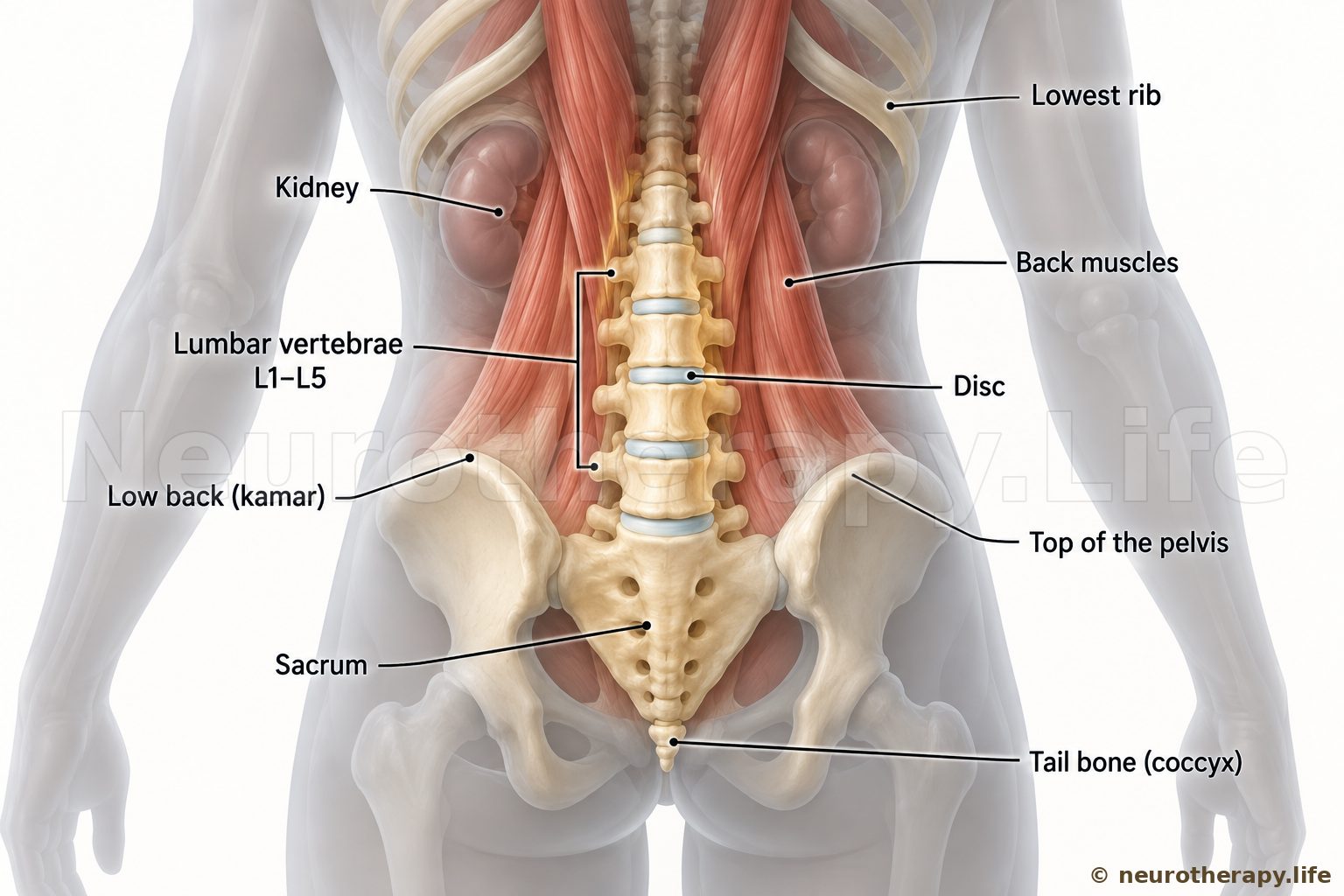
Your low back — kamar (कमर) — is the band between your lowest ribs and the top of your buttocks. Five large vertebrae, the cushions between them, strong muscles and the nerves to your legs all meet here, carrying the weight of your whole upper body. It is the commonest place for pain in the world, yet most back pain gets better — and a few warning signs mean seeing a doctor today.
Overview
What is the low back?
Doctors call it the lumbar region. When people in India say kamar (कमर), they usually mean the whole band between the lowest rib and the top of the buttock — front, back and sides together. At its centre is the lumbar spine: five large vertebrae (L1 to L5) resting on the sacrum, the triangle-shaped bone at the back of the pelvis.
The low back carries the weight of the head, arms and trunk down to the pelvis and legs, lets you bend and twist, and protects the bundle of nerves that runs to your legs, bladder and bowel. Deep muscles on all sides hold it steady like the ropes around a tent pole.
Low back pain is the leading cause of disability worldwide — about 619 million people had it in 2020. Most of it has no single named cause, and an ordinary bout usually eases a great deal within weeks. A small number of backs, though, carry warning signs that need a doctor the same day.
The low back: five big vertebrae on the sacrum, wrapped in muscle, with the kidneys just in front.
Function
What does the low back do?
The low back is both a pillar and a hinge. It must be strong enough to carry the upper body and flexible enough to let you bend, lift and turn — and it has to protect the nerves passing through it while it moves.
Carries the weight of the head, arms and trunk down to the pelvis and legs.
Lets you bend forward and back, lean to the sides and twist.
Absorbs shock: the discs cushion each step and jump.
Protects the nerve roots that run to the legs, bladder, bowel and sexual organs.
Anchors the big muscles of the back, belly, hips and thighs.
How does the low back work with other organs?
Spine — The low back is the lowest and heaviest-loaded moving part of the spine.
Spinal cord — The cord itself ends near L1–L2; below that, its nerve roots run down through the low back as a bundle.
Muscles — Deep and surface muscles hold the low back steady; most ordinary back pain is muscle and posture.
Kidneys — The kidneys lie just in front of the upper low back muscles; kidney pain is felt in the flank, between the last rib and the hip bone.
Bowel — Hard constipation and straining load the low back; nerves from the lowest levels control the bowel.
Bladder — Nerves leaving the lowest part of the spine control the bladder — which is why new bladder trouble with back pain is urgent.
Knee — The same nerves run on to the thighs and calves, and weak or tight hip and thigh muscles change the load on both back and knee.
Bones, cushions, nerves and muscles, all bound together by strong ligaments and a broad sheet of fascia.
Bones and joints
Lumbar vertebrae (L1–L5) — The five largest movable vertebrae in the spine, with thick, kidney-shaped bodies built to bear weight.
Facet joints — Small paired joints at the back of each vertebra that guide and limit movement.
Sacrum — Five vertebrae fused into one triangle, wedged between the two hip bones.
Sacroiliac joints — Where the sacrum meets the pelvis on each side; they move only a little.
Tail bone (coccyx) — A few small fused bones at the very end of the spine; it can be bruised by a hard fall onto the seat.
Discs
Cushions between the vertebrae that let the spine bend and absorb shock.
Soft centre (nucleus pulposus) — A jelly-like core, mostly water, that spreads load evenly.
Tough rings (annulus fibrosus) — Layers of criss-crossed fibres around the centre, like the layers of an onion.
Bulge and slipped disc — With age or strain the rings can weaken, the disc can bulge, and sometimes the centre pushes out and presses on a nerve root.
Nerves
The end of the spinal cord — In adults the spinal cord ends at about the L1–L2 level.
Cauda equina — Below that, the nerve roots hang down like a horse's tail — which is what the Latin name means.
Nerve roots L1–S5 — One pair leaves at each level, each owning its own strip of skin and muscles in the leg.
Sciatic nerve — The largest nerve in the body, formed from the lowest two lumbar and first three sacral roots; it runs down the back of the leg.
Muscles and fascia
Long back muscles (erector spinae) — Two thick columns beside the spine that hold you upright and straighten you from a bend.
Multifidus — Short, deep muscles linking one vertebra to the next; they steady each level.
Quadratus lumborum — A deep square muscle from the last rib to the top of the pelvis, often tender in one-sided back pain.
Psoas — A long muscle from the front of the lumbar vertebrae to the thigh bone; it bends the hip.
Belly wall and buttocks — The deep belly muscles and the buttock muscles complete the living corset around the low back.
Thoracolumbar fascia — A broad, tough sheet across the low back that links the back muscles with the belly wall and the big back muscle that reaches the arm.
Where is the low back?
The low back runs from the lowest ribs down to the top of the pelvis at the back, and continues into the sacrum between the buttocks. The kidneys sit just in front of its upper part, the right one a little lower than the left because the liver sits above it. In front of the spine lie the great blood vessels, the intestines and, deep in the pelvis, the bladder and the uterus or prostate.
LMNT teaching uses the navel as a landmark: the L3 vertebra lies straight behind it. (Standard anatomy places the navel at about the level of the disc between L3 and L4.) The same flank, between the last rib and the rim of the hip bone, holds two key LMNT examination points: Mu° on the left and Liv° on the right.
From the side, the low back curves gently inward — the lumbar curve. From behind, a shallow groove runs down the middle over the bony knobs of the vertebrae, with a firm ridge of muscle on each side.
Just above the buttocks many people have two small dimples. They mark the sacroiliac joints, where the spine meets the pelvis. The lumbar vertebrae themselves are chunky and short, much bigger than the neck vertebrae, because they carry more weight.
How big is the low back?
The lumbar vertebrae are the largest movable bones of the spine, and the discs between them are the thickest — about a centimetre or a little more. The sciatic nerve that forms here is about as thick as a little finger where it leaves the pelvis, roughly 2 cm wide.
The load is large too. Measurements inside a living disc found the pressure in relaxed standing to be about five times that of lying down, and lifting 20 kg with a rounded back to be more than four times that of standing.
Conditions and disorders
What conditions and disorders affect the low back?
Most low back pain is 'non-specific' — it comes from the muscles, joints, ligaments and discs without one clear cause, and it usually improves. Some pain comes from a trapped nerve, some from the bones, and some is felt in the back but starts in an organ in front of it.
Ordinary back pain
Low back painAching and stiffness from the muscles, joints and discs — the commonest kind, and usually the kind that mends.
Ache or stiffness across the low back, often worse in the morning or after sitting
Pain on bending, lifting or turning in bed
Muscle spasm, or the waist pulled to one side
Pain spreading into the buttock or down the back of the leg
Tingling, numbness or weakness in the leg or foot
Emergency signs: numbness in the saddle area, new trouble passing or holding urine or stool, or weakness in both legs
What tests check the low back?
History and examination — How the pain started, what eases it, the warning-sign questions, and tests of movement, reflexes, strength and feeling in the legs. For most backs this is all that is needed at first.
Straight-leg raise — Raising the straight leg while lying down stretches the sciatic nerve; pain down the leg suggests a pressed root.
X-ray — Shows fractures, slipped vertebrae and changes of ankylosing spondylitis, but not discs or nerves.
MRI — Shows discs, nerves and soft tissue; used for warning signs or severe nerve pain that is not settling. Bulges are also common in backs that do not hurt.
Blood and urine tests — Look for infection, inflammation or a kidney cause.
Bone density scan (DEXA) — Checks for thin bones, especially after the menopause or a fracture from a small fall.
How is low back pain treated?
Stay active — Keeping up gentle daily activity helps more than bed rest. Reassurance that most backs improve is part of the treatment.
Exercise and physiotherapy — Guided exercise to strengthen and loosen the back, hips and belly is the main long-term treatment.
Heat and short-term pain relief — Warmth, and anti-inflammatory medicines for a short time if a doctor agrees.
Hands-on therapy and psychological support — Hands-on treatment as part of an exercise plan, and help with fear, stress and sleep for long-lasting pain.
Injections and surgery — For severe nerve pain that does not settle, and as an emergency when the nerves to the bladder and bowel are pressed.
Treating the cause — Fractures, infections, kidney stones, osteoporosis and ankylosing spondylitis each have their own medical treatment.
Neurotherapy (LMNT)
LMNT teaching starts with a word. Ask an Indian patient where it hurts and you hear kamar (कमर) — which may mean the spine, the flank, the hip or the rim of the pelvis. So the therapist's first job is to turn a region into a place: 'Show me with one finger. Now show me with your whole palm.' Where the finger lands is usually a joint; where the palm lands is usually muscle. The group of treatments for the region carries a modest heading — 'some treatments to correct problems of the low back' — and it sits inside a plan built the ordinary way, from the navel findings, the acid–alkali direction, the digestion and the history. Before any hand touches a back, four questions are asked about the saddle area, the bladder and bowel, cancer and night pain, and fever, falls or new weakness; any 'yes' ends the session and sends the patient to a doctor that day. The teaching is honest that most backs get better whatever is done. The same flank holds the Mu° and Liv° points, which are compared with each other, never measured alone. Face-down treatments are given with 1½ pillows under the chest, and the therapist's weight hangs from two chairs, so the pressure can be taken back in an instant. This works alongside medical care, never instead of it.
Points
L5–S1 Ghisai — The opening treatment: three different actions with three counts — the L1–S1 band rubbed 20–25 times, a one-way oblique stroke 12 times each side, and an L-shaped lengthening 3 times. Given for sciatica and all pains of the back, especially lumbar spondylosis.
(6) L3, 4, 5 — Starting above the L3 vertebra, straight behind the navel, the soft inner sole draws the back muscles out towards the side, six times at each place; the teaching says it gives considerable relief.
Blood Supply to Sides — The same outward sweep at the side of the hip, 6 to 12 times, to relax the muscles around the hip.
JJ⁺¹ — For L1–L2–L3: closely spaced steps from the waist to the knee in three rounds of rising pressure — never on the knee joint. For pain in the middle of the back and slip disc at L1–L3.
JJ⁺² — For L4–L5–S1: the same, below the knee to the heel, with a pillow under the calf. For knee pain, low back pain and slip disc at L4–S1.
L4 Fracture — Given face up on the inner calves, because the L4 nerves go there — for a known L4 fracture or slip that is under medical care.
L5 Fracture — The mirror: given face down on the outer calves, where the L5 nerves go.
Sciatica Point — Both big toes press lightly beside L5, then the heel travels from hip to heel on the painful leg only.
Sciatica Setting — Given with the hands on the foot, the heel held still while the toes are bent against each other; the teaching calls it very useful for disc bulge.
Bindu Point — One foot anchors the hip while the other draws from L5 to the opposite shoulder; for pain in both the upper and lower back.
Fracture Point — 'T' pumps the heels at S5, then 1-2-3 walks down the back of the raised thigh without a pause; a relative must lift the legs.
Mu° — The left flank point between the last rib and the hip bone; in the back pain chart it is the left kidney pain point.
Liv° — The same place on the right, compared with Mu° to read the body's direction.
Tail Bone Pain — For injury to the end of the spine from a fall on the stairs or a heavy sit-down.
“Whether or not the patient gets immediate benefit from our treatment, let no harm reach him through our carelessness — attend to this.”
— Dr. Lajpatrai Mehra
“This is exactly how it should be. And this itself is the secret of Neurotherapy (LMNT)'s success.”
— Dr. Lajpatrai Mehra — on why two people with one disease may need two different treatments
“I am yet to understand the human body. My knowledge is hardly the tip of the iceberg. Neurotherapy (LMNT) is just in its infancy. There is a long way to go.”
— Dr. Lajpatrai Mehra
Never do this
Emergency: numbness in the saddle area (the seat, inner thighs or around the back passage), new trouble starting or holding urine or stool, or weakness or pain in both legs — go to hospital today. The nerves at the base of the spine may be crushed, and what is lost by waiting is not recovered. Low back pain: warning signs that mean see a doctor today
New back pain in anyone who has ever been treated for cancer, pain that wakes you at night, or pain that goes round the body like a band needs a doctor and a scan before any treatment. Cancer care: Neurotherapy (LMNT) support
After a fall, a sudden severe pain that began at one moment, or back pain in a woman past the menopause, a frail elder or anyone on long-term steroids: a possible fracture is an X-ray and a doctor's question before any foot is used. Lumbar fracture (L4 / L5)
Constant, severe back pain with fever, sweats or shaking, a recent injection into the back, or tuberculosis in the body or household — hospital, the same day. Infections
A hot, swollen, tender leg — especially after surgery, a long journey or pregnancy — may be a clot. It is not rubbed, walked on or treated; it is sent. Thrombosis (blood clots)
(6) L3, 4, 5 is not given if there is a fracture in any bone between L1 and S1. (6) L3, 4, 5
JJ⁺¹ is not given to a person with knee pain (Pradip is given instead; JJ⁺² may be given). JJ⁺² is not given on the same day as BOF when the soles also hurt. Nothing is ever given on the knee joint itself. JJ⁺¹
The Sciatica point is given on the painful leg only. Pain down both legs means the saddle and bladder questions come first. Sciatica Point
Pressing Mu° and Liv° at the flank: light contact only in the elderly, the very thin, anyone with fragile bones and anyone who has broken a bone after a small fall — the lowest rib floats free and breaks easily. Mu°
Cancer: if the person has cancer, (10) Pan, Thymus, Pit, Lu + Sh, Rt. Ov / Lt. Ov and (30) Medulla are never given — the therapist changes the plan.
Keep taking the medicines your doctor prescribed, and tell your therapist about blood thinners and steroid tablets. Neurotherapy (LMNT) works alongside your medical care, never instead of it.
Care
How can I keep my low back healthy?
A back that moves, a belly and hips that are strong, and habits that share the load evenly — these protect the low back more than any belt.
Keep moving
Walk every day. During a bout of back pain, keep up gentle activity rather than lying in bed.
Lift close and bend the knees
Hold the load close to your body, bend at the hips and knees, and avoid lifting with a rounded back or twisting while you lift.
Break up sitting
Stand and move every 30 minutes; sit well back in the chair with the low back supported.
Share the load between both sides
Change the shoulder you carry a bag on and the hip you carry a child on. Guruji's teaching notes that most people lean to one side for hours every day.
Sleep supported
On your back, put a pillow under the knees; on your side, put one between the knees. Get up by rolling onto your side first.
Avoid straining at stool
Drink enough water and eat fibre so that you do not strain. Hard constipation loads the low back and pelvic floor.
Stop tobacco and watch your weight
Smoking and a high body weight are among the main risk factors for low back pain worldwide.
Common questions
Should I rest in bed when my back hurts?
Usually no. A day of easing off is fine, but long bed rest slows recovery. Gentle walking and normal activity, within what the pain allows, help the back mend faster.
My MRI shows a disc bulge. Is that what is causing my pain?
Not necessarily. Bulges are found in about a third of 20-year-olds and most 80-year-olds who have no back pain at all. A doctor matches the scan with your symptoms and examination. LMNT teaching makes the same point: a reported bulge changed nothing in the plan until the questions changed.
When do I need a scan?
Most ordinary back pain does not need one. A scan is needed for warning signs — numbness in the saddle area, bladder or bowel changes, weakness, a past cancer, fever, or a fall — and for severe leg pain that is not settling after several weeks.
Is my back pain coming from my kidneys?
Sometimes, but not usually. Kidney pain sits in the flank, between the last rib and the hip bone, often with fever, burning urine or blood in the urine, and it does not change much with movement. Most back pain is muscle and posture. LMNT teaching checks the Mu° and Liv° points in this very place — as a comparison, not a diagnosis.
Why does the therapist ask about my bladder, cancer and fever every time?
Because a few back problems are emergencies that look like ordinary back pain. The four questions take under a minute. LMNT teaching asks them before every session on a back — and a 'yes' means the session stops and you see a doctor that day. You are not being sent away; you come back once you have been seen.
Is it safe for a therapist to press my back with the feet?
In LMNT the therapist's weight hangs from two chairs, so the pressure can be made as light as needed and taken off at once. It is not used where a fracture, fragile bones or warning signs are suspected. Say 'stop' at any moment and the therapist stops.
What should I ask my doctor or therapist?
Is this ordinary back pain, or is there a sign that needs tests?
Which symptoms mean I should go to hospital the same day?
Do I need a scan now, or only if things change?
Which exercises should I do, and which movements should I avoid for now?
Should my bones be checked for thinning?
(To the therapist) Which points are you giving, which are blocked for me, and will you ask the four warning questions each time?
Surprising facts
1There is no spinal cord in your low back
The spinal cord stops growing before the spine does, so in adults it ends at about the level of the first or second lumbar vertebra. Below that, the canal holds only a bundle of nerve roots hanging down like a horse's tail — the cauda equina. That is why pressure on this bundle shows up as numbness in the seat and trouble with the bladder.
Source: Gray's Anatomy (42nd ed.) — the conus medullaris ends at about L1–L2 in adults; cauda equina.
2Lifting with a round back can multiply the pressure in a disc
A pressure sensor placed inside a healthy volunteer's lumbar disc read about 0.1 megapascals lying down, about 0.5 standing, about 1.1 bending forward, and about 2.3 when lifting 20 kg with a rounded back. Lifting the same weight close to the body with bent knees roughly halved it.
Source: Wilke HJ et al., Spine 1999;24(8):755–762 (in vivo intradiscal pressure, one volunteer).
3You are taller in the morning
While you sleep, the discs soak up water and swell a little. During the day, standing and sitting squeeze some of it out. Most people are about 1 to 2 cm shorter by evening than when they got up — and most of that loss happens in the first hour after rising.
About 619 million people had low back pain in 2020, and the number is expected to reach about 843 million by 2050. It causes more years lived with disability than any other condition on earth.
Source: GBD 2021 Low Back Pain Collaborators, Lancet Rheumatol 2023;5(6):e316–e329.
5The body's biggest nerve starts here
Five nerve roots — the last two of the low back and the first three of the sacrum — join to form the sciatic nerve. Where it leaves the pelvis it is about as thick as a little finger, the largest nerve in the body. It runs down the back of the thigh, which is why a pressed root in the back is so often felt in the leg and foot.
Source: Gray's Anatomy (42nd ed.) — sciatic nerve (L4–S3), about 2 cm wide at its origin.
6Scans of pain-free backs are full of 'findings'
When researchers pooled scans of people with no back pain, disc bulges were found in about 30% of 20-year-olds and 84% of 80-year-olds, and disc wear in 37% of 20-year-olds and 96% of 80-year-olds. Many such findings are part of normal ageing, like grey hair.
Source: Brinjikji W et al., AJNR Am J Neuroradiol 2015;36(4):811–816.
7Your right kidney sits lower than your left
The liver takes up so much room on the right that it pushes the right kidney a little lower than the left. LMNT's own back-pain chart notes the same thing: the right kidney lies about half a vertebra lower because of the liver above it.
Source: Gray's Anatomy (42nd ed.) — relations of the kidneys. LMNT back-pain chart: db section 6.6, Table 4.
8Those two dimples mark a joint
The two small dimples many people have just above the buttocks lie over the sacroiliac joints, where the spine is wedged into the pelvis. They are made by a short ligament that ties the skin to a bony point beneath.
Source: Gray's Anatomy (42nd ed.) — surface anatomy of the back (dimples over the posterior superior iliac spines, at the level of the sacroiliac joints).
Your discs through the day
5lumbar vertebrae carrying the upper body
~0.1MPa disc pressure lying down — the lowest of the day
~0.5MPa standing relaxed — about five times lying
~2.3MPa lifting 20 kg with a rounded back
1–2 cmheight lost between morning and evening
4warning questions asked before every LMNT session on a back
Yoga
Makarāsana — the crocodile rest Makarāsana
Benefits
A restful position for many people with low back pain.
Belly breathing in this pose gently moves the low back with each breath.
A good starting point before the cobra.
How to do it
Lie on your front on a mat, legs a little apart, toes pointing out.
Fold your arms and rest your forehead on your hands.
Close your eyes and breathe slowly into the belly, feeling it press gently into the mat.
Stay for 2 to 5 minutes.
To come out, bring the hands under the shoulders, roll to one side and get up slowly.
Take care
Not in pregnancy. If lying on the front increases your back or leg pain, put a thin pillow under the belly or choose another position. Anyone who cannot lie face down can rest on the side with a pillow between the knees.
Bhujaṅgāsana — the gentle cobra Bhujaṅgāsana
Benefits
Gently arches the low back and strengthens the back muscles.
Counters long hours of sitting bent forward.
Opens the chest for easier breathing.
How to do it
Lie on your front, legs together, forehead on the mat.
Place the forearms on the mat with the elbows under the shoulders.
Breathing in, lift the head and chest a little, keeping the hips down.
Hold for 3 to 5 easy breaths, shoulders relaxed.
Lower slowly and rest in Makarāsana. Repeat 3 to 5 times.
Take care
Stop if pain spreads into the leg or grows worse. Avoid in pregnancy, after recent abdominal or spine surgery, with a hernia, and in severe acute back pain. People with narrowing of the spinal canal may find backward bending uncomfortable — ask your doctor.
One knee to the chest Ardha Pavanamuktāsana
Benefits
Gently stretches the low back and the buttock muscles.
One leg at a time is kinder to a sore back than both together.
Also helps to release trapped gas.
How to do it
Lie on your back with both legs straight, or with the other knee bent if that is easier.
Bend the right knee and hold it with both hands just below the knee.
Breathing out, draw the knee gently towards the chest, keeping the head on the mat.
Hold for 20 to 30 seconds of easy breathing.
Release slowly and repeat with the left leg, 2 or 3 times each.
Take care
Skip it if you have thin bones (osteoporosis) or a recent spinal fracture, in later pregnancy, or soon after abdominal surgery. Do not lift the head towards the knee.
Watch
L5 S1 GHISAI
A demo of L5–S1 ghisai in its three parts, given face down with the front of the foot over the lowest part of the back and the buttocks, followed by the Fracture point with the legs raised on pillows. It is used for relief in low back pain.
FOR BACK PAIN - L1 TO L5, S1 - JJ+1 JJ+2
Shows JJ⁺¹ along the thighs and JJ⁺² just below the knees, given lying down with light jerks and pressure that rises over three rounds. JJ⁺¹ is for nerve trouble near L1–L3 and JJ⁺² for L4–L5–S1 in back pain.
FOR BACK PAIN - L1 TO L5, S1 - JJ+1 JJ+2 SITTING POSITION
Shows JJ⁺¹ along the thighs and JJ⁺² just below the knees with the patient sitting, using light jerks and pressure that rises over three rounds, then a gentle calf massage. JJ⁺¹ is for nerve trouble near L1–L3 and JJ⁺² for L4–L5–S1 in back pain.
L4 FRACTURE
A practical demonstration of the L4 Fracture point: the patient lies face down with pillows under the thighs and knees, heels turned inward, and the therapist, steadying their weight on two chairs, presses the inner calf muscles with the heel in three rounds of rising pressure, asking the patient how much they can bear, then gently massages the ankle area.
The demonstrator uses small jerks and says the spinal bead "sets at once" — that is his own remark, not a promise. In LMNT teaching this point is given only after a doctor has checked the fracture, the pressure stays on the calf muscle, never on the spine or a bone, and only as much as the patient can bear.
L5 FRACTURE
A practical demonstration of the L5 Fracture point: the patient lies face down with pillows under the thigh and knees, and the therapist presses along the calf muscles from just below the knee towards the ankle in three rounds of rising pressure, keeping off the knee and bone and checking the patient's comfort, then finishes by rubbing the heel and the top of the foot.
The demonstration uses small jerks. In LMNT teaching this point is given only after a doctor has checked the fracture, with the pressure on the calf muscle, never on the spine or a bone, and only as much as the patient can bear.
Test yourself
Research
Strong evidence
The Global Burden of Disease study estimated that about 619 million people had low back pain in 2020, making it the leading cause of disability worldwide, and projected about 843 million cases by 2050. Work-related factors, smoking and high body weight were among the risk factors counted.
A pooled review of spine scans in over 3,000 people without back pain found disc bulges in about 30% at age 20 rising to 84% at 80, and disc wear in 37% at 20 rising to 96% at 80. Scan findings must be read alongside symptoms.
A pressure sensor placed inside a lumbar disc of one healthy volunteer showed how daily postures change the load: lowest lying down, about five times higher standing, and highest when lifting with a rounded back. Holding the load close with bent knees roughly halved it. It is a single-person study, but it is still the classic measurement.
This page explains how the body works; it does not diagnose. Neurotherapy (LMNT) works alongside your medical care — keep taking the medicines your doctor prescribed, and see a doctor for any new or severe symptom.
Ready to begin?
Send COURSE for course details, or your name, age and health issue for a consultation.