1The body's biggest nerve
The sciatic nerve is the largest and longest nerve in the body, about as wide as a thumb or finger where it leaves the pelvis, and it runs all the way to the foot.
Source: Gray's Anatomy, 41st ed., Sciatic nerve.
Also called: Sciatica, Sciatic point, गृध्रसी, सायटिका पॉइंट
The Sciatica Point is a face-down Neurotherapy (LMNT) treatment for sciatica — a sharp, pricking pain that runs from the waist down the leg. It begins with a light touch beside the lowest bone of the low back and then follows the course of the sciatic nerve down the painful leg only.
Sciatica is the name for a sharp, pricking pain that runs from the waist toward the leg. It may come and go, or stay for hours. Some people have it in one leg only; others feel burning or pain in both legs. The Sciatica Point is the Neurotherapy (LMNT) treatment written for this pain.
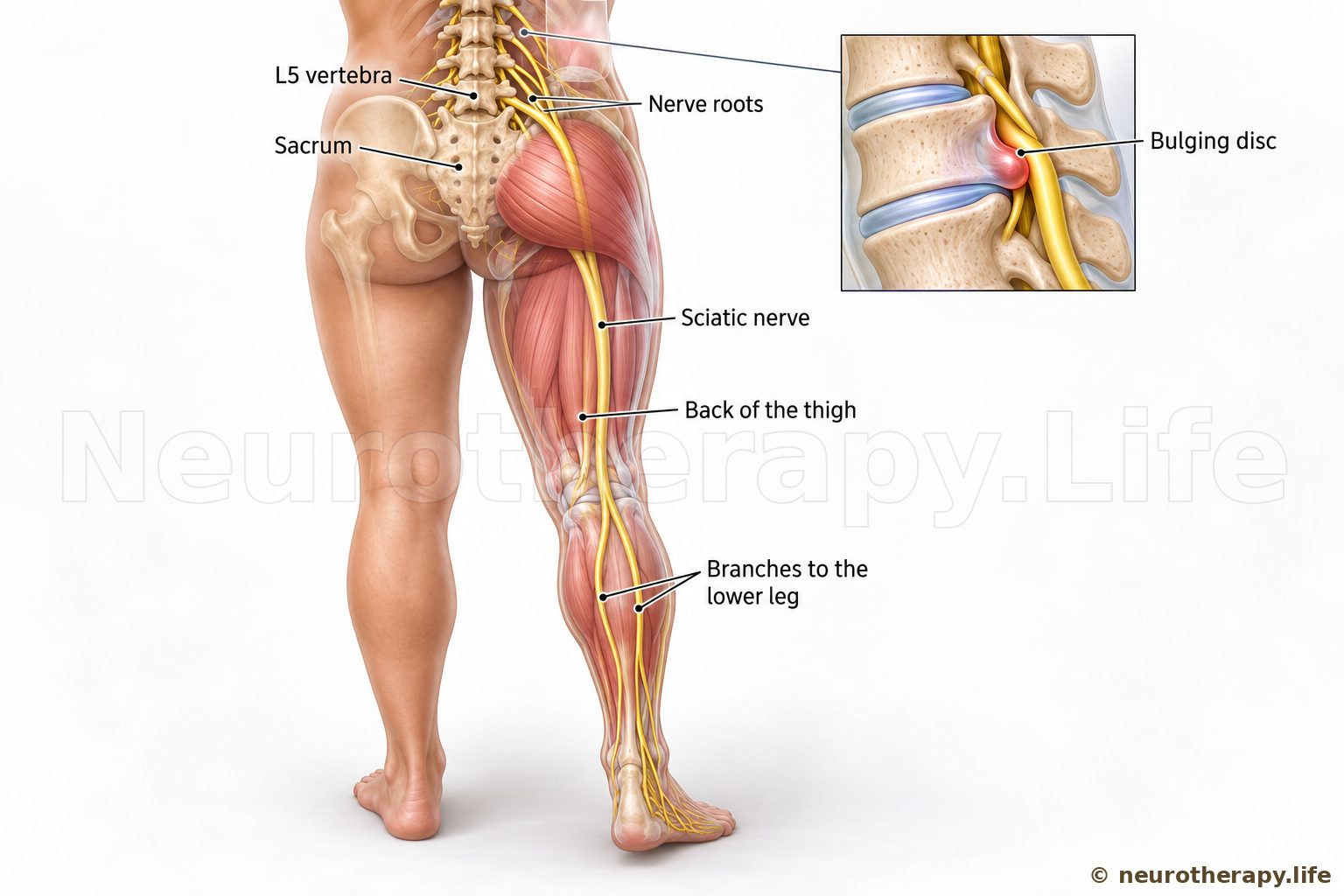
The sciatic nerve is the largest nerve in the body — about as thick as a little finger where it leaves the pelvis. It is made of five nerve roots from the lowest part of the back and the sacrum, which join into one flat band and run down the middle of the back of the thigh.
The trouble usually starts at the top, where a nerve root squeezes past a bulging disc on its way out of the spine. So the treatment has two parts: a light touch at the bottom of the low back, near that root, and then a descent along the course of the nerve down the leg that hurts.
You lie face down with one and a half pillows under the chest, head straight. The therapist stands beside you and takes their weight on two chairs.
It starts on both sides of the L5 vertebra — the lowest bone of the low back, just above the sacrum. It then follows the back of the painful leg, from the hip down to the heel. Only the leg with the problem is treated; drawings may show both legs, but the instruction is the painful leg.
How this point is given — the tool, the pressure, the count and the exact movement — is deliberately not described here. A demonstration video for this point is being prepared; until it is on this page, learn the method hands-on from a trained Neurotherapist before giving it. Please do not give any point from a written description alone: a point given in the wrong place or the wrong way can do harm.
The exact technique is taught hands-on in the Neurotherapy (LMNT) course. See the course →
The Sciatica Point is written for sciatic pain. The heel's route from hip to heel follows the real course of the sciatic nerve almost exactly, and the light touch at L5 sits over the level where the trouble usually begins. No pressure from outside can open a squeezed root; what patients have reported is easing of the pain and stiffness along the leg.
The Sciatica Point belongs to the low-back group, given face down on the same patient.
It is used inside a full plan for the low back, built from the navel findings, digestion and history — not as the whole answer on its own.
“This is useful for those who get a sharp, pricking pain running from the waist toward the leg, which sometimes goes away and sometimes stays for hours.”
Because the instruction says to treat the leg whose sciatic nerve has the problem. Pictures may show both legs only because a drawing has to show something.
First your therapist must ask about numbness in the seat and about passing urine and motion. If any of those are present, you need a hospital today. If they are clear, each leg is treated as a separate decision.
No outside pressure can push a disc back or free a squeezed root. Most sciatica eases over weeks; the Sciatica Point is used to support that with less pain and stiffness, alongside your doctor's care.
The start at the low back is light. The heel on the leg should feel firm but bearable; the method is chosen by what your leg tolerates. Say so at once if the pain shoots.
The sciatic nerve is the largest and longest nerve in the body, about as wide as a thumb or finger where it leaves the pelvis, and it runs all the way to the foot.
Source: Gray's Anatomy, 41st ed., Sciatic nerve.
Most people with sciatica from a disc improve within weeks to a few months without surgery.
Source: NICE guideline NG59, Low back pain and sciatica in over 16s, 2016 (updated 2020).
Classical Ayurveda called sciatica gṛdhrasī, from gṛdhra, the vulture — after the dragging, lurching walk it causes. The old physicians described the same course down the leg that the nerve follows.
Source: Charaka Samhita, Chikitsa Sthana 28 (Vatavyadhi).
This page explains what a Neurotherapy (LMNT) treatment is for; it is not a self-treatment guide and does not diagnose. Neurotherapy (LMNT) works alongside your medical care — keep taking the medicines your doctor prescribed.
Send COURSE for course details, or your name, age and health issue for a consultation.