Low back pain: warning signs that mean see a doctor today
Most low back pain gets better. A small number of backs carry warning signs that have nothing to do with how bad the pain is, and these need a doctor the same day, not a treatment.
Overview
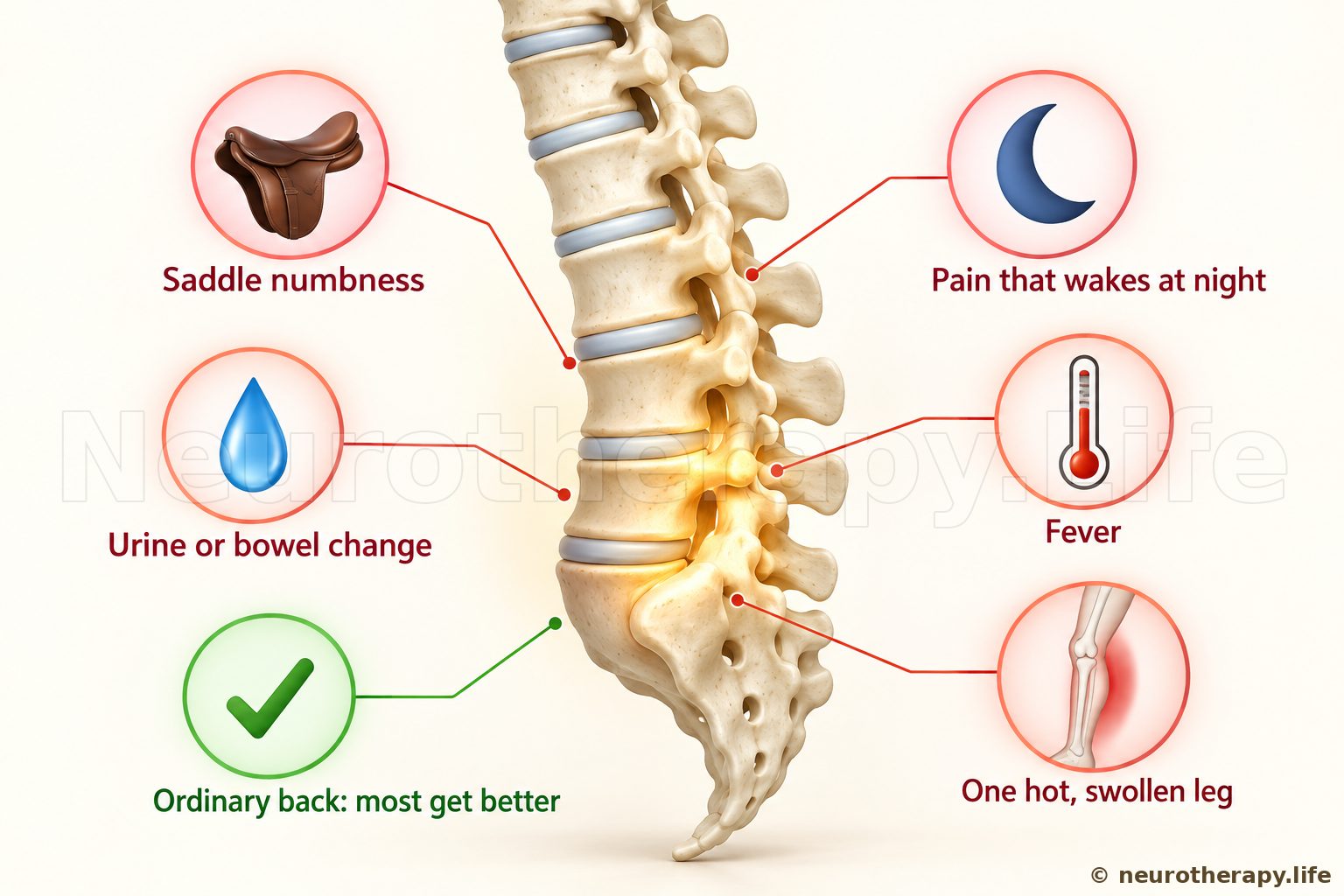
Start with the good news: most low backs get better. Most back pain has no single cause that anyone can name, and an ordinary sudden back pain usually settles a great deal within weeks. That also means any treatment given to it can look excellent, which is worth knowing honestly.
A few backs are different, and the difference lies in a handful of findings, not in the strength of the pain. Numbness in the saddle area, a new change in passing or holding urine or motion, or weakness or shooting pain in both legs can mean the nerve bundle at the base of the spine is being crushed. This is called cauda equina, and it is a same-day emergency.
Back pain in anyone who has ever had cancer, pain that wakes a person from sleep, or pain running round the body like a band may mean spread to the bone. A fall or sudden pain in someone with brittle bones may be a broken vertebra. Constant back pain with fever may be infection in the spine. Weight falling off without trying must always be checked.
That is why a careful therapist asks four short questions before touching any back. If any answer is yes, the session stops. The patient is told plainly and calmly to see a doctor today, and a written note goes with them. Their care is not ended; treatment can follow once a doctor has looked.
Key points
- Most low back pain gets better; ordinary backs are the commonest thing in the clinic.
- Warning signs are about specific findings, not about how bad the pain is.
- Saddle numbness or a new bladder or bowel change means hospital today.
- If any warning sign is present, no gentle points are given in the meantime.
- Sending a patient to a doctor is not the end of their Neurotherapy (LMNT) care.
Go deeper
Low back pain
Low back pain and how it is approached
Sciatica
Pain running down one leg
Lumbar fracture (L4 / L5)
A broken bone in the low back
Osteoporosis
Brittle bones that break easily
Thrombosis (blood clots)
Blood clots in the legs
Cancer care: Neurotherapy (LMNT) support
Neurotherapy (LMNT) support in cancer, and its limits
When the Hand Must Stop: Blocked Points and Safety in Neurotherapy (LMNT)
When the hand must stop
The Low Back: Treatments for the Back, Hip and Sciatic Leg
The full guide to the low back
Read the full guide
This topic is part of: The Low Back: Treatments for the Back, Hip and Sciatic Leg
Safety: when it is held back
- Saddle numbness, new trouble passing or holding urine or motion, or weakness or shooting pain in both legs: hospital today. Do not treat, not even one session to see.
- Back pain with any past cancer, pain that wakes from sleep, band-like pain, or new weakness or change in walking: see a doctor the same day. No pressure, no stretching, no load on the spine. Cancer care: Neurotherapy (LMNT) support
- A fall or sudden dated pain, past menopause, frailty, long-term steroids or a past easy fracture: an X-ray first. No jerks and no body weight on the spine until it is known. Osteoporosis
- Severe constant spinal pain with fever, a recent injection into the back, or tuberculosis in the household: hospital. No spinal work at all. Infections
- One leg that is hot, swollen and tender — especially after surgery, a long illness, a long journey or pregnancy — may hide a clot. That leg is not rubbed or worked on; it is sent to a doctor urgently. Thrombosis (blood clots)
- Weight falling off without trying is never called the treatment working. It is investigated before treatment.
This page explains what a Neurotherapy (LMNT) treatment is for; it is not a self-treatment guide and does not diagnose. Neurotherapy (LMNT) works alongside your medical care — keep taking the medicines your doctor prescribed.