The Low Back: Treatments for the Back, Hip and Sciatic Leg
This guide covers the Neurotherapy (LMNT) treatments given at the waist and below it: for low back pain, sciatica, numbness and weakness in the legs. It also explains the few warning signs that mean a back must go to a doctor the same day.
Overview
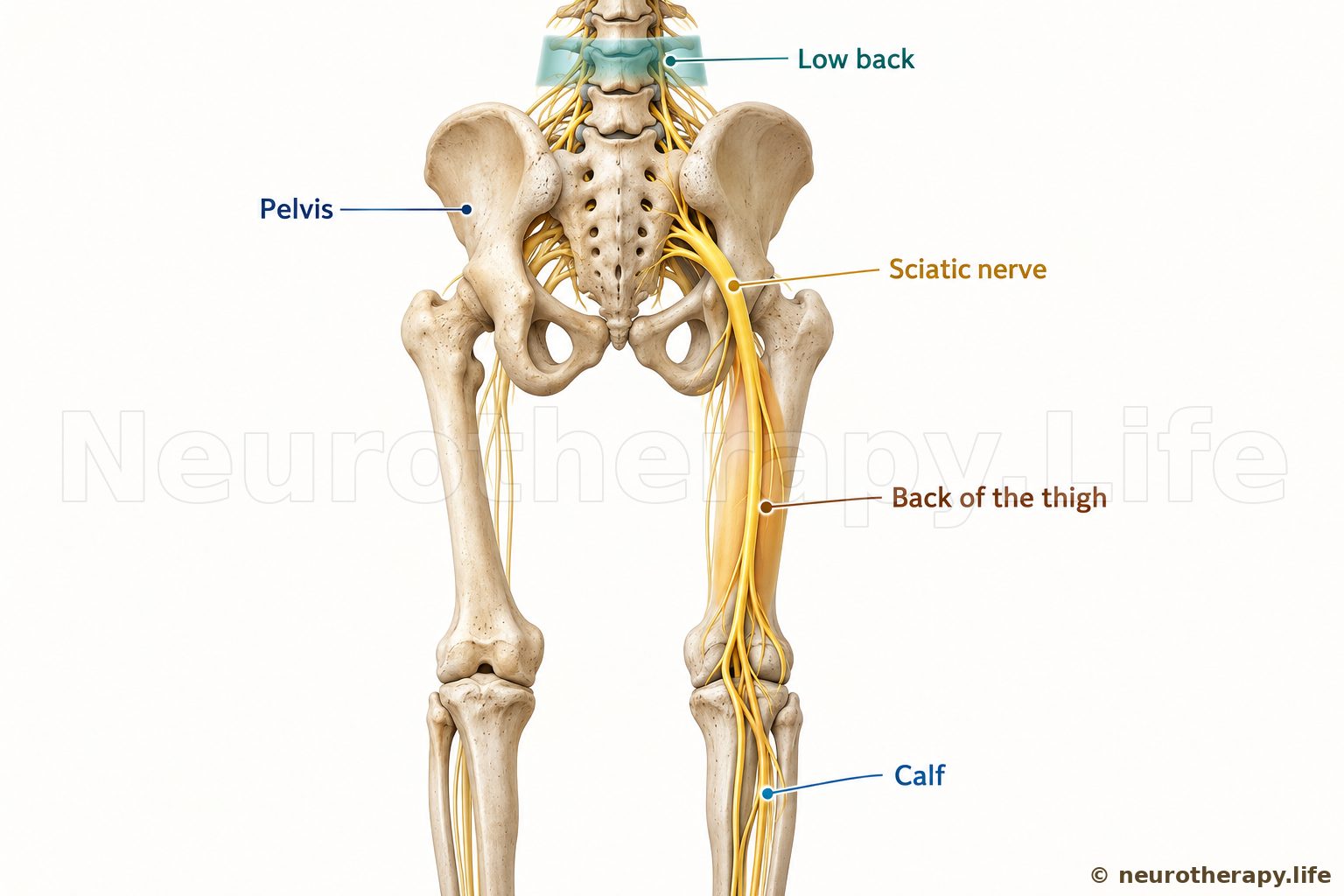
This guide covers the Neurotherapy (LMNT) treatments given at the waist and below it: for low back pain, sciatica, numbness and weakness in the legs. It also explains the few warning signs that mean a back must go to a doctor the same day.
Some treatments for the low back — not the whole answer
The heading this group carries is modest on purpose: some treatments to correct problems of the low back. Not the treatments. The group does not claim to be the whole answer, nor that the trouble began in the back. These treatments sit inside a plan built the usual way: from the navel findings, the digestion and the patient's history.
When an Indian patient says 'kamar dard', the word कमर can mean the spine, the flank, the hip or the rim of the pelvis. So the therapist first turns a region into a place, by asking the patient to show it with one finger, and then with the whole palm. Most of the treatments here are given face down, with the same pillow arrangement as the rest of the back work. A few are given face up or seated, so the position is always read before the method.
Working the low back itself
L5–S1 Ghisai is the opening treatment, given over the lowest part of the back with the therapist's weight carried on two chairs. It is given in separate stages, and each stage is a different action: one softens a long band of muscle, one moves the tissue outward from the lowest bone, and one lengthens the low back muscles upward and out toward the side of the waist. It is not one rub repeated.
Blood Supply to Sides is a sweep with the soft inner part of the sole at the side of the hip, from the side outward, given to relax the muscles around the hip. (6) L3, 4, 5 uses the same sweep at another place: it starts from the bone that lies exactly behind the navel, and draws the back muscles toward the side, which gives the patient considerable relief. Bindu Point is a long diagonal slide from the lowest back bone toward the opposite shoulder, used to relax the muscles of the whole back when both the upper and the lower back hurt.
Following the nerve down the leg
Each nerve root from the spine owns a strip of skin and muscle, called a dermatome (derma means skin, tome means slice). Stacked together, these strips map the leg in long ribbons. That is why a problem at one level of the low back can show itself in one part of the leg, and why several points here choose the part of the leg by the spinal level written on the card.
JJ⁺¹ is for the upper levels of the low back and is worked on the thigh; JJ⁺² is for the lower levels and is worked on the calf. Both are often given seated, with the pressure rising gently over the rounds, so that anything that would hurt shows itself while the load is still light. L4 Fracture and L5 Fracture are a mirrored pair: L4 is given face up on the inner calf, L5 face down on the outer calf. They are only for a fracture that a doctor has already found and is looking after.
The Fracture Point joins two treatments given one after the other without a pause: one over the sacrum, and one down the back of the raised thigh. A relative or helper must lift the legs. The patient should never hold them up alone, because a leg holding itself up is braced tight, and the treatment then lands on a tense rope instead of a soft muscle.
Sciatica, numbness and weak legs
Sciatica is a sharp, pricking pain running from the waist toward the leg, which sometimes goes and sometimes stays for hours. The Sciatica Point starts with a light touch beside the lowest back bone and then travels down the leg that hurts, from the hip to the heel. Sciatica Setting is the one treatment in the group given entirely with the hands, on the foot: the heel is held still and the toes are worked against each other until every toe has been reached. The source calls it very useful for disc bulge.
Blood Supply to Legs is a gentle sweep down the back of each thigh, the one treatment where the therapist faces the patient's heels; it is called an excellent treatment for polio and for weakness in the legs. Pelvic is given with one leg resting out to the side on pillows, and is used for numbness, pain or burning in the leg. It is the only held pressure in this group, with a firm upper limit, and it is shortened at once if the patient cannot bear it. Bending Forward and Standing Point are given together, seated or lying with the knees bent, for pain in the low back or calves on bending forward, and for knee pain. The exact methods are taught hands-on in the course.
The back that gets better, and the back that must go today
Most low backs get better. Most back pain has no cause anyone can name, scans of painless backs are full of worrying-looking findings, and an ordinary new back pain settles a great deal within weeks. That is good news, and it is also a warning to the therapist: any treatment given to an ordinary new back will look excellent.
A small number of backs are not ordinary, and the difference has nothing to do with how bad the pain is. These signs are not reasons to treat more gently. They are reasons to stop the session today and send the patient to a doctor, with a note of what was found.
- Numbness in the seat or between the legs, new trouble passing or holding urine or motion, or pain or weakness in both legs: hospital the same day.
- Back pain in anyone who has ever had cancer, pain that wakes them at night, or a band of pain around the body: see a doctor the same day.
- A fall, a sudden severe pain, thin bones or long steroid use: an X-ray first, before any weight or jerk on the spine.
- Constant severe back pain with fever: hospital.
- One leg hot, swollen and tender: possibly a clot; that leg is not touched, and the patient is sent urgently.
- Weight falling off without trying is never 'the treatment working'.
Key points
- The low back treatments are 'some treatments', set inside a plan built from the navel, digestion and history.
- L5–S1 Ghisai is given in separate stages, and each stage is a different action, not a repeat.
- Dermatomes explain why the spinal level on the card decides which part of the leg is worked.
- The Sciatica Point is given on the leg that hurts; pain in both legs means the warning questions come first.
- Pelvic is the only held pressure in the group, with a firm upper limit that is shortened if needed.
- Most backs get better; a few warning signs mean stopping today and sending the patient to a doctor.
Topics in this guide
Go deeper
L5–S1 Ghisai
L5–S1 Ghisai — the opening low back treatment
Sciatica Point
Sciatica Point — for the leg that hurts
Sciatica Setting
Sciatica Setting — the hands-only treatment on the foot
JJ⁺¹
JJ⁺¹ — the thigh, for the upper low back levels
Fracture Point
Fracture Point — the sacrum and the raised thigh
Pelvic
Pelvic — for numbness, pain or burning in the leg
Sciatica
Sciatica in plain words
Low back pain
Low back pain
Face Down: Treatments Given on the Back and Spine
The face-down group above the waist
Knee, Leg and Foot: Neurotherapy (LMNT) for Knee Pain and the Lower Leg
The next group: knee, leg and foot
Safety: when it is held back
- Saddle numbness, new trouble with urine or motion, or pain or weakness in both legs: stop and send to hospital the same day. Low back pain
- Any past cancer with new back pain, night pain or a new weakness: no pressure on the spine; see a doctor the same day. Cancer care: Neurotherapy (LMNT) support
- L4 Fracture and L5 Fracture are only for a fracture already diagnosed and managed by a doctor. A suspected fracture is an X-ray question first. Lumbar fracture (L4 / L5)
- Thin bones or long steroid use: no jerks and no body weight on the spine until a doctor has checked. Osteoporosis
- One leg hot, swollen and tender: do not rub or move it; send urgently. Thrombosis (blood clots)
- In the Fracture Point, a helper lifts the legs; the patient never holds them up alone. Fracture Point
- Never ATF in alkalosis, never ALTF in acidosis. Children, the elderly and the frail get light treatment. The Child, the Elder and the Frail: Neurotherapy (LMNT) for Delicate Bodies
Guruji says
“Some treatments to correct problems of the low back.”
“Both of these are based on dermatome charts. The nerves of L1, 2, 3 go from the thigh to the knee, while the nerves of L4 and L5 go to both sides of the calves.”
Common questions
Why do you press my back when the pain is in my foot?
Because the nerve that reports pain in your foot begins in your back. Think of a long wire: it may be pinched near the top, but the message arrives labelled 'foot'. So the therapist works at both ends.
My scan shows a disc bulge. Does that mean my back will never get better?
No. Disc bulges are found in many people whose backs do not hurt at all, and most backs get better. What usually decides how it goes is whether you keep moving and what provokes the pain in your day, not the scan alone.
I can lift my own legs. Why must my son do it?
It is not about strength. A leg holding itself up has all its muscles pulled tight, and this treatment exists to loosen exactly those muscles. Let someone else do the lifting while you rest.
For two days I have had trouble starting my urine. Is that the treatment loosening things?
Tell your therapist at once. This is not something to treat around; the session stops and you should see a doctor today, not tomorrow. It is not being sent away for good: you come back once a doctor has seen you.
Watch

A demo of L5–S1 ghisai in its three parts, given face down with the front of the foot over the lowest part of the back and the buttocks, followed by the Fracture point with the legs raised on pillows. It is used for relief in low back pain.

Shows JJ⁺¹ along the thighs and JJ⁺² just below the knees, given lying down with light jerks and pressure that rises over three rounds. JJ⁺¹ is for nerve trouble near L1–L3 and JJ⁺² for L4–L5–S1 in back pain.

A practical demonstration of the L5 Fracture point: the patient lies face down with pillows under the thigh and knees, and the therapist presses along the calf muscles from just below the knee towards the ankle in three rounds of rising pressure, keeping off the knee and bone and checking the patient's comfort, then finishes by rubbing the heel and the top of the foot.
The demonstration uses small jerks. In LMNT teaching this point is given only after a doctor has checked the fracture, with the pressure on the calf muscle, never on the spine or a bone, and only as much as the patient can bear.
Test yourself
Research
- Strong evidence
A systematic review of 33 studies covering more than 3,000 people with no back pain. Disc wear and disc bulges were very common and rose with age: disc wear was seen in about a third of 20-year-olds and almost all 80-year-olds. The authors concluded that many such scan findings are part of normal ageing, not a cause of pain.
Explore more
Organs
Body systems
Diseases
Points
Topics
Read more
This page explains what a Neurotherapy (LMNT) treatment is for; it is not a self-treatment guide and does not diagnose. Neurotherapy (LMNT) works alongside your medical care — keep taking the medicines your doctor prescribed.