1A quarter of your bones
Each foot has 26 bones, so your two feet hold about a quarter of all the bones in your body.
Source: Gray's Anatomy, 41st ed., Bones of the foot.
Also called: Standing, स्टैंडिंग पॉइंट
The Standing Point is a Neurotherapy (LMNT) treatment given on the top of the foot, at the knuckle line where each toe begins, followed by a light stroke of the sole. It is given straight after Bending forward, and both are useful in low back pain and knee pain.
The Standing Point is the second half of a pair. It always follows Bending forward, a cupped-palm treatment down the back of the calf. Both are written as useful in low back pain and in knee pain, and they are given one after the other.
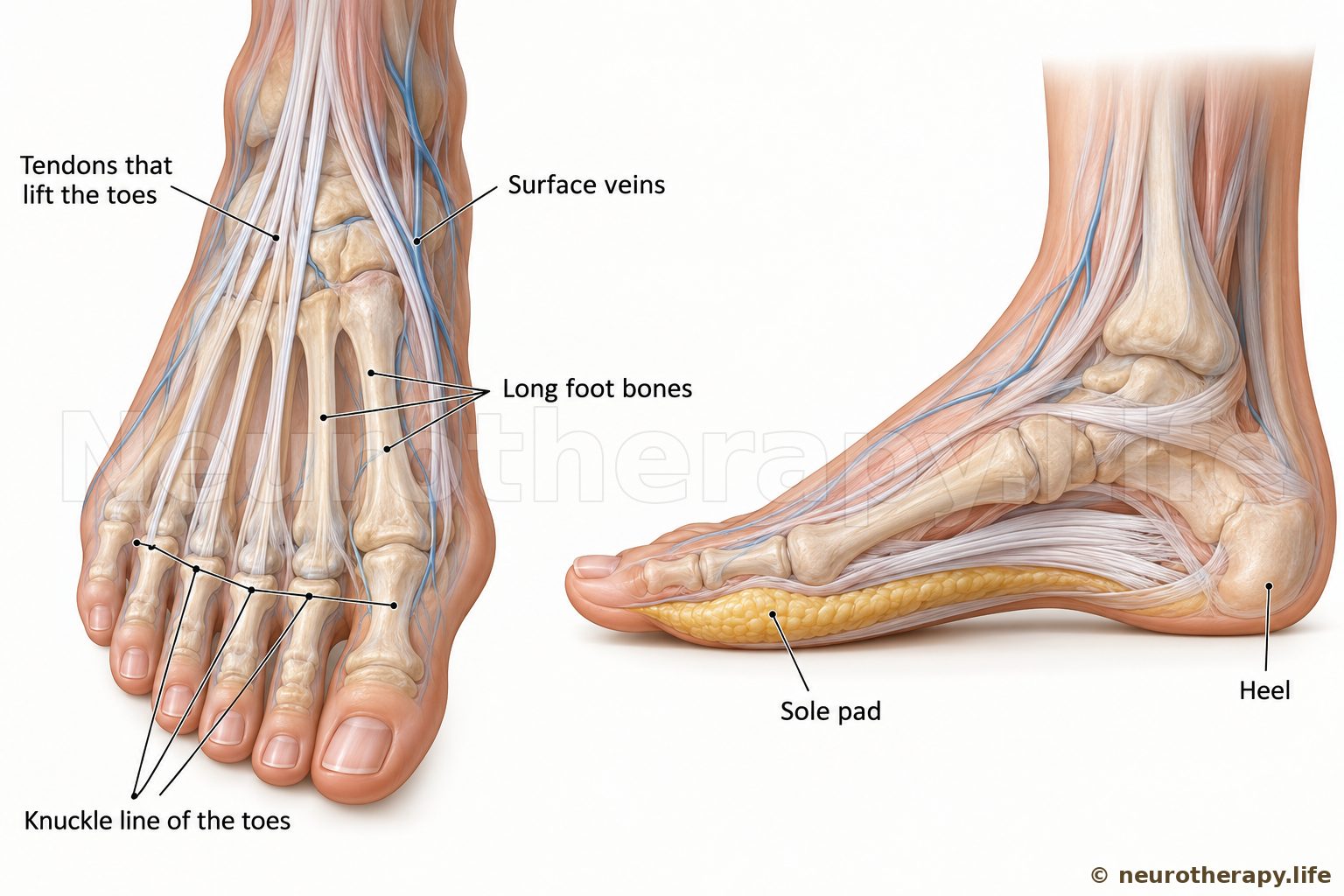
It works on the top of the foot, at the knuckle line — the five joints where the long bones of the foot meet the toes — from the big toe to the little toe. It then finishes with a light stroke of the sole of the foot from heel to toes.
The top of the foot is the thinnest tissue a therapist ever works on: skin, the tendons that lift the toes, visible veins and bone, with no muscle padding. That is why the action here is a gentle press and release, never a rub or a heavy weight.
You stay exactly as you were for Bending forward: either seated on a chair, or lying on your back with knees bent, both heels near the buttocks, knees pointing up and a little apart. This position flattens the hollow of the low back and lets the calf go slack.
The therapist stands in front of you. The area is the top of each foot along the line where the toes begin, and then the sole from heel to toes.
How this point is given — the tool, the pressure, the count and the exact movement — is deliberately not described here. A demonstration video for this point is being prepared; until it is on this page, learn the method hands-on from a trained Neurotherapist before giving it. Please do not give any point from a written description alone: a point given in the wrong place or the wrong way can do harm.
The exact technique is taught hands-on in the Neurotherapy (LMNT) course. See the course →
The teaching says the Standing Point, given with Bending forward, is useful in both low back pain and knee pain. The position itself relaxes the low back; the foot work completes a treatment that runs from the calf to the toes. How work at the foot helps the back and knee is the therapy's own experience.
The Standing Point is half of a pair, and sits in the low-back group.
It is given with Bending forward, as part of a plan for the back or the knee.
The source does not explain the name. It may refer to the therapist, who stands in front of you to give it, but that is not stated.
The Standing Point completes Bending forward, which runs from behind the knee to the toes. The knees-bent position also relaxes the low back while the foot is worked.
It is written to be given one after the other with Bending forward, in the same position.
Each foot has 26 bones, so your two feet hold about a quarter of all the bones in your body.
Source: Gray's Anatomy, 41st ed., Bones of the foot.
Lying with hips and knees bent and feet flat reduces the inward curve of the low back — the 'hook-lying' position often used to ease low back strain.
Source: Kisner C, Colby LA. Therapeutic Exercise: Foundations and Techniques, 7th ed.
Knee osteoarthritis is one of the leading causes of pain and disability in older adults worldwide.
Source: World Health Organization, Osteoarthritis fact sheet, 2023.
This page explains what a Neurotherapy (LMNT) treatment is for; it is not a self-treatment guide and does not diagnose. Neurotherapy (LMNT) works alongside your medical care — keep taking the medicines your doctor prescribed.
Send COURSE for course details, or your name, age and health issue for a consultation.