Treatments for the low back (kamar): what they offer and how they are used
Neurotherapy (LMNT) has a group of treatments for the low back. They are some of the answers, not the whole answer, and they sit inside a full plan built from the navel findings, digestion and history.
Overview
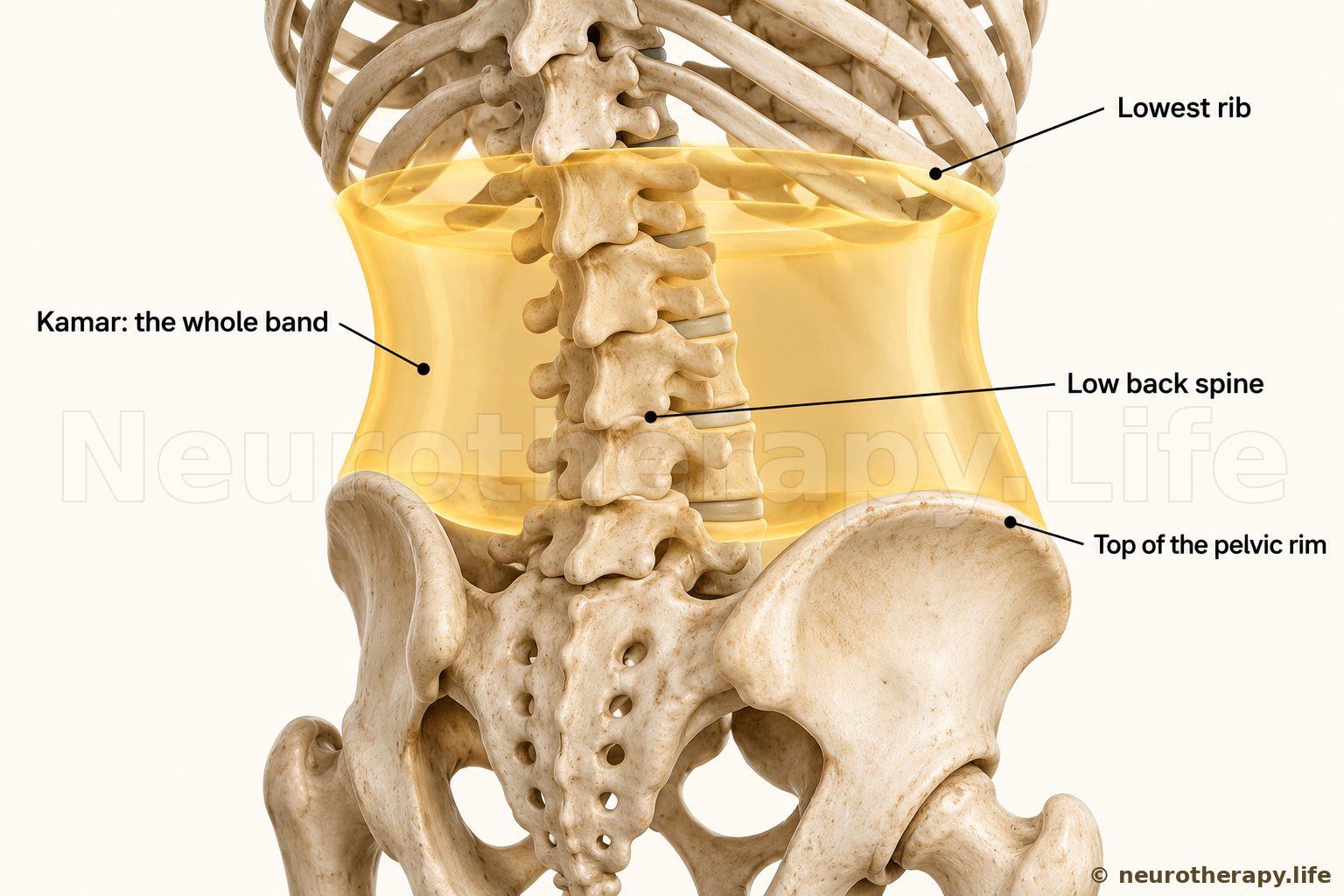
The heading of this group is modest on purpose: some treatments to correct problems of the low back. They do not claim to be the whole answer, or that the trouble began in the low back. They are given inside a full plan built the usual way, from the navel findings, digestion and the patient's history.
"Kamar dard" is not one place. For most Indian patients, kamar is the whole band between the lowest rib and the top of the buttock, front, back and sides. So the therapist's first job is to find where. The patient is asked to show it with one finger, then with the whole palm. A finger usually lands on a joint; a palm usually lands on muscle.
Most of these treatments are given face down, with one and a half pillows under the chest and the head straight. Some are not: L4 Fracture is given lying on the back, and JJ⁺¹, JJ⁺², Bending forward and Standing point may be given seated or lying straight. When the feet are used, the therapist's weight hangs from two chairs, so the pressure can be taken back in an instant.
The older Indian view agrees on one point: soften the area first. Ayurveda names kati, the waist and hips, as a place where disturbed vata settles, bringing stiffness and catching pain that is worse in the cold. Its answer is warmth held still. This group, too, begins with a slow, broad, soft stroke before any firm work. The exact methods are taught hands-on in the course.
Key points
- These are some treatments for the low back, used inside a full plan.
- Kamar is a region, not a spot; the therapist first finds the exact place.
- Most are given face down, but not all: always check the position first.
- The chairs control how much of the therapist's weight reaches the patient.
- The area is softened before any firm work begins.
Go deeper
L5–S1 Ghisai
The three-stage treatment for the lowest back joint
Fracture Point
Fracture point for the low back
JJ⁺¹
JJ⁺¹, chosen by the upper levels of the low back
JJ⁺²
JJ⁺², chosen by the lower levels of the low back
Sciatica Point
For pain running from the waist down the leg
Pelvic
A held treatment at the hip for the leg
Low back pain
Low back pain and how it is approached
The Low Back: Treatments for the Back, Hip and Sciatic Leg
The full guide to the low back
Read the full guide
This topic is part of: The Low Back: Treatments for the Back, Hip and Sciatic Leg
Safety: when it is held back
- Before any low back treatment, the therapist asks about the warning signs that need a doctor the same day. Low back pain: warning signs that mean see a doctor today
- Neurotherapy (LMNT) works alongside your medical care. Do not stop or change any medicine on your own.
Watch

A demo of L5–S1 ghisai in its three parts, given face down with the front of the foot over the lowest part of the back and the buttocks, followed by the Fracture point with the legs raised on pillows. It is used for relief in low back pain.

Shows JJ⁺¹ along the thighs and JJ⁺² just below the knees, given lying down with light jerks and pressure that rises over three rounds. JJ⁺¹ is for nerve trouble near L1–L3 and JJ⁺² for L4–L5–S1 in back pain.
This page explains what a Neurotherapy (LMNT) treatment is for; it is not a self-treatment guide and does not diagnose. Neurotherapy (LMNT) works alongside your medical care — keep taking the medicines your doctor prescribed.