1Five bones fused into one
The sacrum begins life as five separate vertebrae, which fuse into a single triangular bone by early adulthood. It forms the back wall of the pelvis.
Source: Standard human anatomy of the sacrum (S1–S5 fusion).
Also called: Fracture point, 'T' + 1-2-3, T 123, फ्रैक्चर पॉइंट
Fracture Point is a Neurotherapy (LMNT) treatment for the low back, given face down. It joins two parts without a pause — 'T', worked with the heels at the side of the sacrum, and 1-2-3, a walk down the back of the thigh while a helper holds the legs raised. Its stated purpose is to loosen the muscles of the thighs; despite its name, it is not a treatment for a broken bone.
Fracture Point belongs to a group the teaching heads, modestly, 'some treatments to correct problems of the low back' — not the whole answer to a back, but procedures that sit inside a plan built from the navel findings, digestion and history.
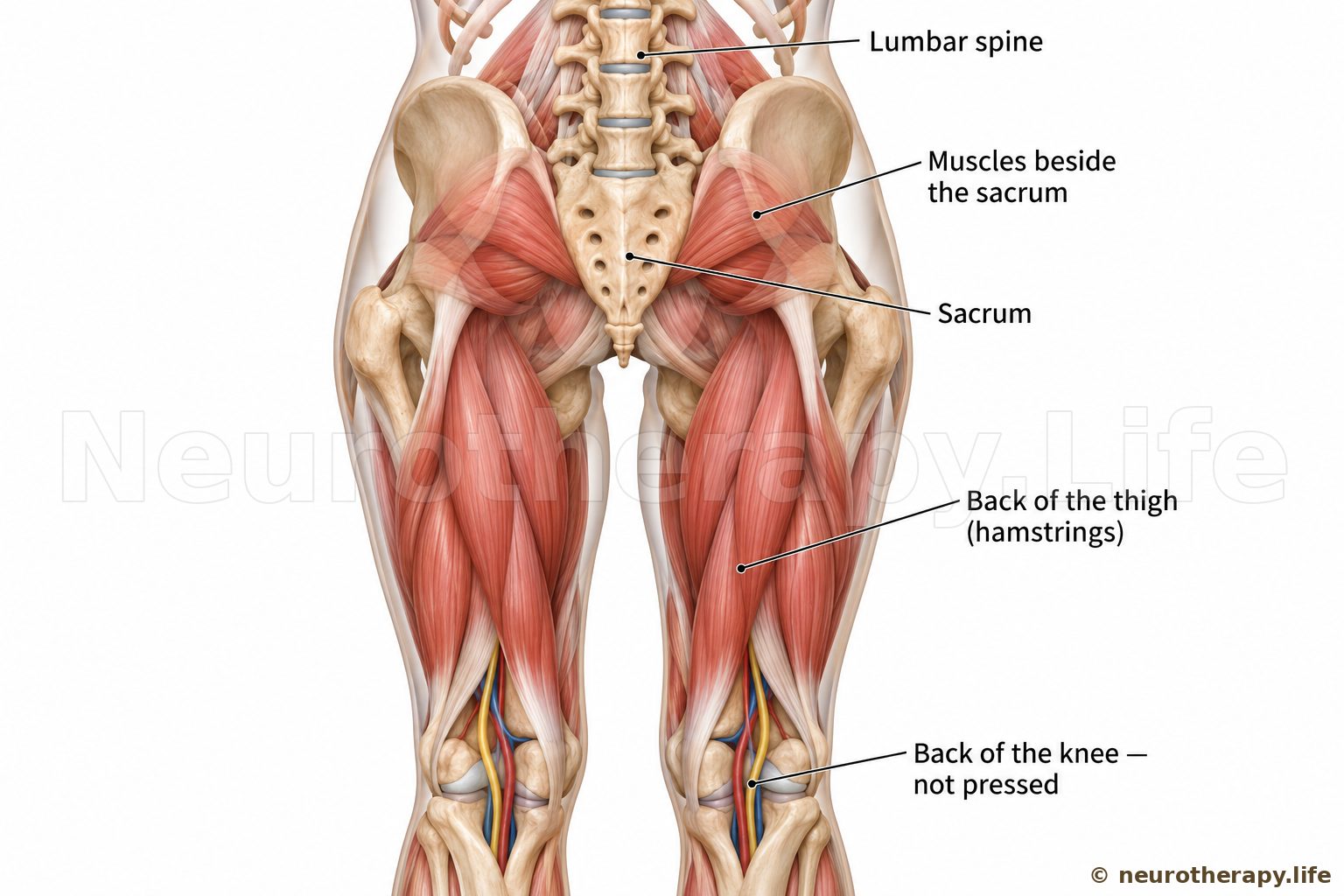
It is two treatments with two names, two symbols and two areas, given one after the other without stopping. The first, called 'T', works the muscles at the side of the sacrum — the flat, triangular bone at the base of the spine. The second, called 1-2-3, works down the back of the thigh. Here the numbers 1, 2, 3 are not vertebrae: they only mark near the hip, the middle of the thigh, and near the knee.
The name must be handled plainly. The treatment is called Fracture Point, but its own stated purpose is loosening the muscles of the thighs. A broken vertebra is an X-ray question and a doctor's question, and that question is asked before a foot goes near the back.
You lie face down with the face-down arrangement this therapy uses for all prone work: pillows under the chest, the chin resting on the lower pillow, and the head kept straight, never turned.
'T' is given at the side of the sacrum, at the base of the spine. For 1-2-3, a relative or helper — never you — raises your legs and holds them up, and the work runs down the back of the thigh from the hip to near the knee. The knee joint itself is never stepped on.
How this point is given — the tool, the pressure, the count and the exact movement — is deliberately not described here. Watch the demonstration video on this page, and learn the method hands-on from a trained Neurotherapist before giving it. Please do not give any point from a written description alone: a point given in the wrong place or the wrong way can do harm.
The exact technique is taught hands-on in the Neurotherapy (LMNT) course. See the course →
The teaching states its purpose in its own words, and it is a modest one.
Members of the same low-back group, and two with similar names but different jobs.
Chosen inside a low-back plan, after the red-flag questions have been asked.
“Whether or not the patient gets immediate benefit from our treatment, let no harm reach him through our carelessness — attend to this.”
A teaching case, put together from busy camps: a mill fitter with years of back pain had the 'T' given properly, but his helper had stepped out, and the therapist asked him to lift his own legs a little. The willing patient lifted and held them, the thigh muscles under the foot turned hard, and the treatment did not help. The lesson is the instruction itself: arrange the helper before beginning, and never ask the patient to hold his own legs up.
A composite case written to teach the reasoning — not one patient’s file.Because that is the treatment's name. Its stated purpose is to loosen the muscles of the thighs, not to treat a broken bone.
Because for the second half someone else must hold your legs up. If you hold them yourself, the treatment works less and may even increase the pain.
Never. The walk stops near the knee, not on it.
The sacrum begins life as five separate vertebrae, which fuse into a single triangular bone by early adulthood. It forms the back wall of the pelvis.
Source: Standard human anatomy of the sacrum (S1–S5 fusion).
A limb held up by its owner is contracting along its whole length. Only when someone else supports it can the muscle go slack — the basic idea behind passive stretching.
Source: Basic muscle physiology (active contraction versus passive support).
Behind the knee, the main artery, vein and the two branches of the sciatic nerve lie close under the skin with no muscle covering them — one of the few places on the leg with nothing to take a load.
Source: Standard anatomy of the popliteal fossa.


A demo of L5–S1 ghisai in its three parts, given face down with the front of the foot over the lowest part of the back and the buttocks, followed by the Fracture point with the legs raised on pillows. It is used for relief in low back pain.

This page explains what a Neurotherapy (LMNT) treatment is for; it is not a self-treatment guide and does not diagnose. Neurotherapy (LMNT) works alongside your medical care — keep taking the medicines your doctor prescribed.
Send COURSE for course details, or your name, age and health issue for a consultation.