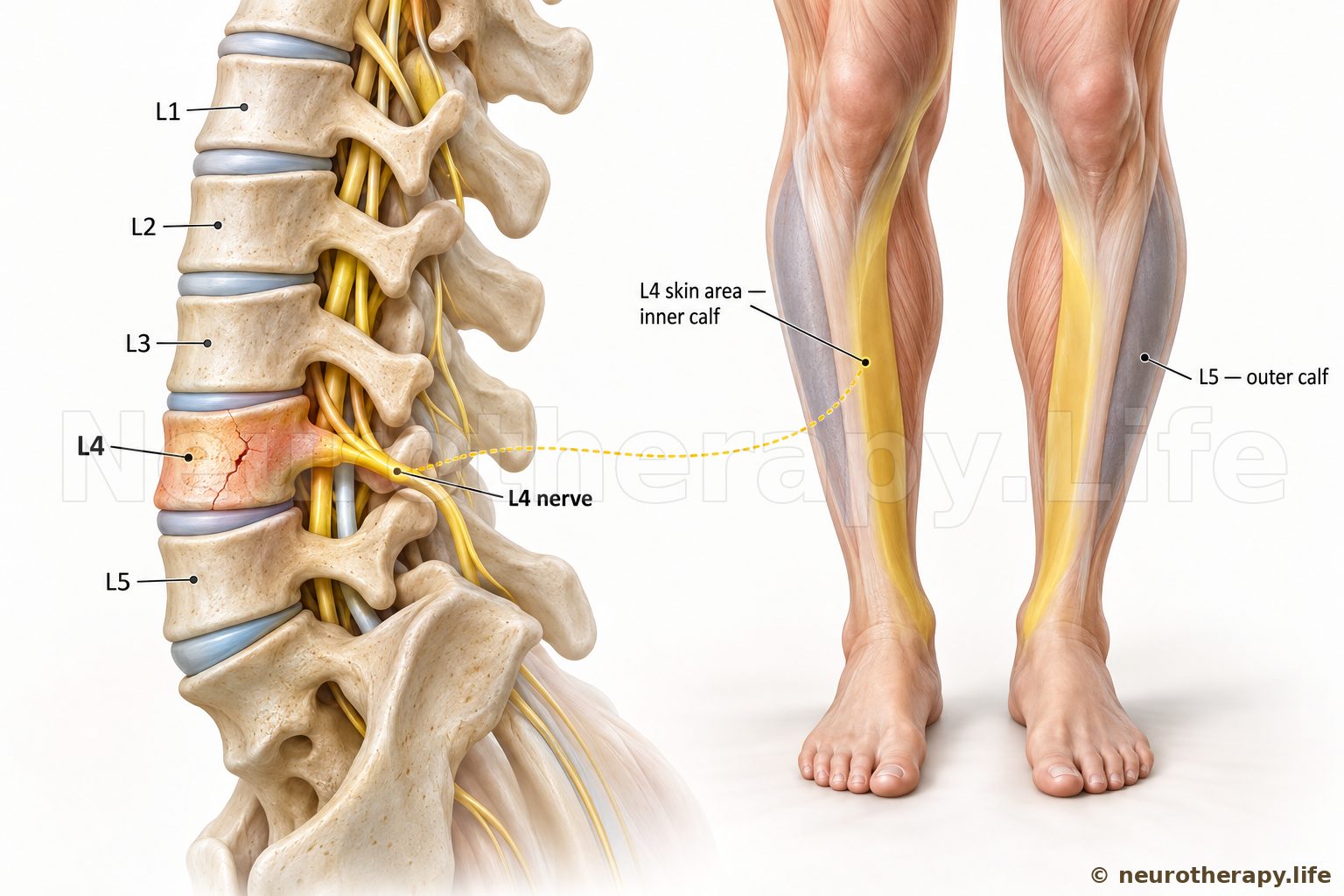
Also called: L4 fracture point, L4 फ़्रैक्चर पॉइंट
L4 Fracture is the Neurotherapy (LMNT) treatment given when the fourth lumbar bone (L4) has broken or slipped. It is given on the inner side of both calves — the skin area served by the L4 nerves — never on the broken spine itself, and only once a doctor knows about the fracture and is looking after it.
Overview
What is the L4 Fracture point?
L4 is the fourth of the five bones of the low back. A fracture is a break or crack in a bone. The L4 Fracture point is LMNT's treatment for a broken or slipped L4 — and the surprising part is that it is not given on the back at all.
It is based on dermatome charts. A dermatome is the patch of skin served by the nerve of one level of the spine. The nerves of L4 go to the inner side of the calves, so LMNT works there, stretching the L4 nerves so that the broken vertebra gradually sets.
It has a mirror twin. L5 Fracture is given on the outer side of the calves. 'L4 inner, L5 outer' is the sentence that keeps the two apart.
The L4 nerves serve the inner calf — so the L4 Fracture point is given there, not on the broken spine.
Where it is given
Where is it given?
PositionLying on the back
Body areaThe inner side of both calves, from below the knee toward the heel
The teaching gives it laid face up — सीधा लिटाकर — on the inner side of both calves, from just below the knee down toward the heel, at many places along the muscle.
The position line matters: a leg lying the wrong way presents the wrong side of the calf. L5 Fracture, its twin, is given face down on the outer calf. Read the position before the method, every time.
How it is given
How is it given?
How this point is given — the tool, the pressure, the count and the exact movement — is deliberately not described here. A demonstration video for this point is being prepared; until it is on this page, learn the method hands-on from a trained Neurotherapist before giving it. Please do not give any point from a written description alone: a point given in the wrong place or the wrong way can do harm.
The number written before a point's name is not a strength setting. Each numbered form is a separate named treatment with its own method and timing, taught hands-on in the course.
Side of the calfInner — for L4
Never onThe broken spine, the knee or the shin bone
The exact technique is taught hands-on in the Neurotherapy (LMNT) course. See the course →
What it does
What does it do?
LMNT reasons from the dermatome: by working where the L4 nerves end, it stretches those nerves, and the broken or slipped vertebra or disc slowly comes back to its correct place. The teaching says such patients get relief. These are the therapy's own clinical observations; the bone itself heals by the body's own repair, which needs stillness and a doctor's care.
Given for a fractured or slipped L4 vertebra or disc.
Works through the inner calf, the skin area of the L4 nerves.
Keeps the hands and feet away from the broken spine.
Spinal cord — Source of the nerve roots that leave at L4.
Its family
Which points are related?
It belongs to the low-back group, and its closest partner is its mirror twin.
L5 Fracture — The mirror twin — face down, outer calf, for L5.
(6) L3, 4, 5 — The low-back sweep withheld whenever there is a fracture from L1 to S1.
JJ⁺² — Uses the same dermatome idea for L4–S1, at the knee.
Fracture Point — Another low-back treatment of the same group.
What it is used for
What is it used for?
It is given only to someone whose fracture is already known about and being looked after by a doctor. Neurotherapy (LMNT) works alongside medical care.
Low back painA slipped L4 vertebra or disc, inside a plan built from the findings.
Bones
OsteoporosisWhere thin bones were behind the fracture, alongside the osteoporosis care.
Safety: when it is held back
A suspected fracture is an X-ray and a doctor's question first. After a fall or a sudden, dated severe pain — especially past menopause, in the frail or on long-term steroids — no jerks and no body weight on the spine until it is known. How to tell a patient to see a doctor
Never press on the broken spine. Where there is a fracture anywhere from L1 to S1, (6) L3, 4, 5 is never given. (6) L3, 4, 5
The work stays on calf muscle — never on the knee or the shin bone — and only as much as the patient says they can bear.
A hot, swollen, tender calf may be a clot: that leg is not rubbed or pressed, and goes to a doctor urgently. Thrombosis (blood clots)
Back pain with a past cancer is sent to a doctor. In cancer, never (10) Pan, Thymus, Pit, Lu + Sh, Rt. Ov / Lt. Ov or (30) Medulla. Cancer care: Neurotherapy (LMNT) support
Because the L4 nerves reach the inner calf. LMNT works where the nerve ends and keeps all pressure off the broken bone.
Can I have it straight after a fall?
No. First an X-ray and a doctor. This point is for a fracture that is already known and being looked after.
Do I still wear my brace and see my doctor?
Yes. Follow your orthopaedic doctor's advice on rest, brace, medicines and physiotherapy. Neurotherapy (LMNT) works alongside it.
What is the difference from L5 Fracture?
Everything is mirrored: L4 is given face up on the inner calf; L5 face down on the outer calf.
Surprising facts
1Skin maps of the spine
Each spinal nerve serves its own strip of skin, called a dermatome; the L4 strip covers the front of the knee and runs down the inner leg to the inner ankle.
The spinal cord itself ends around the L1–L2 level in adults; below that, the nerve roots for L4 and L5 hang down like a horse's tail — the cauda equina.
Source: Gray's Anatomy, 41st ed.
3Silent fractures
Many vertebral fractures from thin bones are never diagnosed, because they cause little or no pain at the time.
Source: International Osteoporosis Foundation; Cooper C, et al. Journal of Bone and Mineral Research. 1992;7(2):221–227.
Test yourself
Research
Strong evidence
A reference review of dermatomes — the strips of skin each spinal nerve serves — with the L4 and L5 areas of the leg. It explains the map this point is built on; it does not test Neurotherapy (LMNT).
This page explains what a Neurotherapy (LMNT) treatment is for; it is not a self-treatment guide and does not diagnose. Neurotherapy (LMNT) works alongside your medical care — keep taking the medicines your doctor prescribed.
Ready to begin?
Send COURSE for course details, or your name, age and health issue for a consultation.