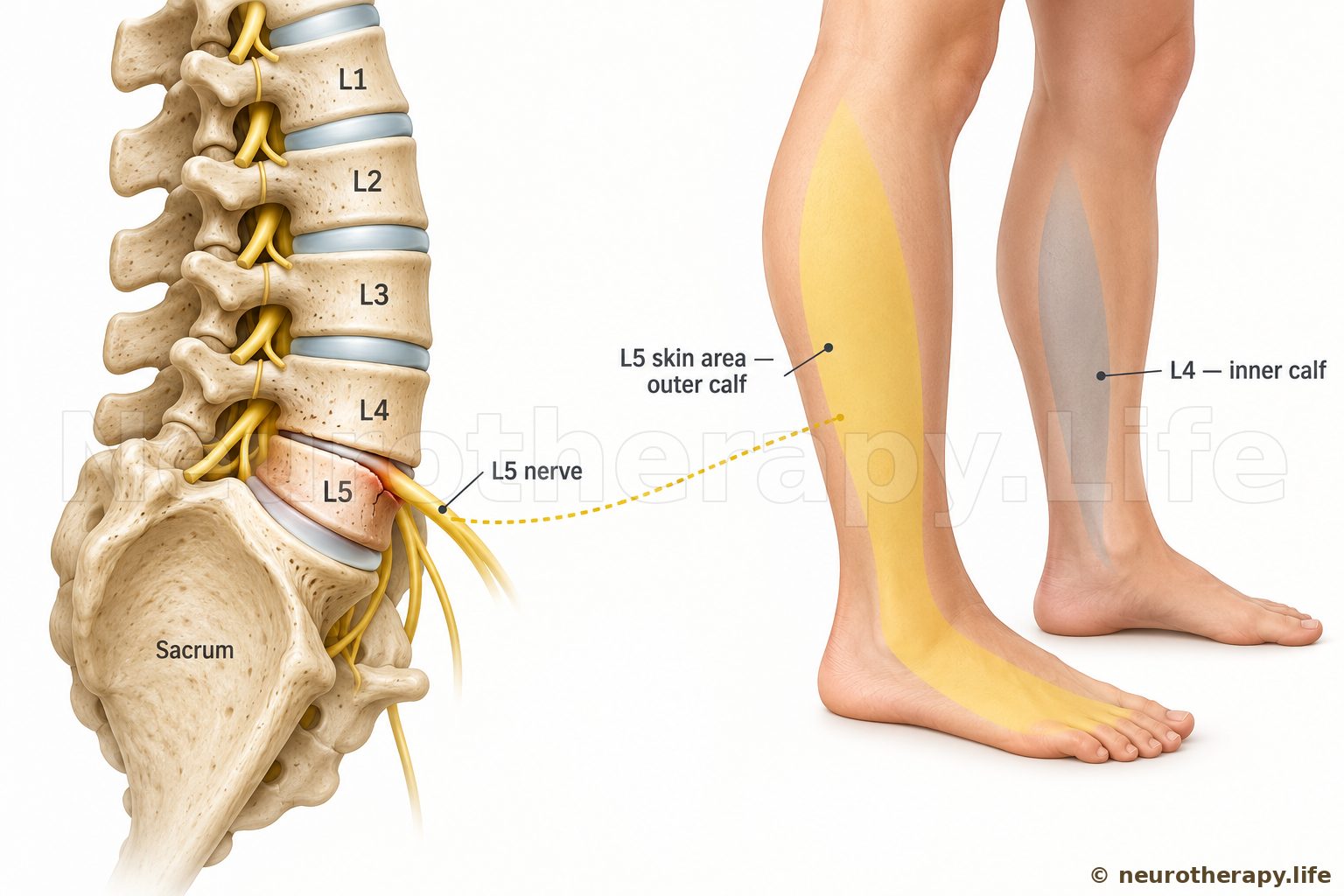
1The L5 skin strip
The L5 dermatome runs down the outer side of the leg and covers the top of the foot and the first three toes.
Source: Whitman PA, Launico MV, Adigun OO. Anatomy, Skin, Dermatomes. StatPearls. 2023.
Also called: L5 fracture point, L5 फ़्रैक्चर पॉइंट
L5 Fracture is the Neurotherapy (LMNT) treatment given when the fifth lumbar bone (L5) has broken or slipped. It is given lying face down on the outer side of both calves — the skin area served by the L5 nerves — never on the broken spine, and only once a doctor knows about the fracture and is looking after it.
L5 is the last of the five bones of the low back, sitting just above the sacrum. It carries more of the body's weight than any lumbar bone above it. The L5 Fracture point is LMNT's treatment for a broken or slipped L5 vertebra or disc.
Like its twin, L4 Fracture, it is built on dermatome charts — the maps of which spinal nerve serves which patch of skin. The nerves of L5 go to the outer side of the calves, so LMNT works there, stretching the L5 nerves so that the broken vertebra gradually sets.
Everything is mirrored between the two: L4 is given face up on the inner calf, L5 face down on the outer calf. 'L4 inner, L5 outer' keeps them apart.
You lie face down — उल्टा लिटाकर — with pillows under the chest, the head straight, the toes turned outward and a pillow under the feet. Turning the toes out rolls the outer border of the calf up toward the therapist; the pillow under the feet lets the calf lie soft.
The work runs along the outer side of both calves, from just below the knee toward the heel. A wrongly placed leg would present the back of the calf instead — a different point aimed at a different level.
How this point is given — the tool, the pressure, the count and the exact movement — is deliberately not described here. Watch the demonstration video on this page, and learn the method hands-on from a trained Neurotherapist before giving it. Please do not give any point from a written description alone: a point given in the wrong place or the wrong way can do harm.
The number written before a point's name is not a strength setting. Each numbered form is a separate named treatment with its own method and timing, taught hands-on in the course.
The exact technique is taught hands-on in the Neurotherapy (LMNT) course. See the course →
LMNT works where the L5 nerves end, stretching them so that the broken or slipped vertebra or disc slowly comes back to its correct place; the teaching says such patients get relief. These are the therapy's own clinical observations. The bone itself heals by the body's own repair, which needs stillness and a doctor's care.
It belongs to the low-back group; its closest partner is its mirror twin.
It is given only to someone whose fracture is already known about and being looked after by a doctor. Neurotherapy (LMNT) works alongside medical care.
It rolls the outer side of the calf upward so the correct side is worked. Without it the back of the calf would be worked instead.
No. First an X-ray and a doctor. This point is for a fracture that is already known and being looked after.
It is firm work on the calf muscle. The therapist checks your comfort throughout and never presses on bone. Say at once if it is too much.
The L5 dermatome runs down the outer side of the leg and covers the top of the foot and the first three toes.
Source: Whitman PA, Launico MV, Adigun OO. Anatomy, Skin, Dermatomes. StatPearls. 2023.
The discs at L4–L5 and L5–S1 carry most of the load of the low back, and together account for the great majority of slipped discs.
Source: Standard spine references (e.g. StatPearls, Lumbar Disc Herniation)
At L5 the moving column of the spine meets the fixed plate of the sacrum on a slope — the junction that most often slips forward.
Source: Gray's Anatomy, 41st ed.

A practical demonstration of the L5 Fracture point: the patient lies face down with pillows under the thigh and knees, and the therapist presses along the calf muscles from just below the knee towards the ankle in three rounds of rising pressure, keeping off the knee and bone and checking the patient's comfort, then finishes by rubbing the heel and the top of the foot.
The demonstration uses small jerks. In LMNT teaching this point is given only after a doctor has checked the fracture, with the pressure on the calf muscle, never on the spine or a bone, and only as much as the patient can bear.
A reference review of dermatomes — the strips of skin each spinal nerve serves — including the L5 area on the outer leg and the top of the foot. It explains the map this point is built on; it does not test Neurotherapy (LMNT).
Whitman PA, Launico MV, Adigun OO. Anatomy, Skin, Dermatomes. StatPearls. 2023.
This page explains what a Neurotherapy (LMNT) treatment is for; it is not a self-treatment guide and does not diagnose. Neurotherapy (LMNT) works alongside your medical care — keep taking the medicines your doctor prescribed.
Send COURSE for course details, or your name, age and health issue for a consultation.