1The widest muscle of the back
The latissimus dorsi is the broadest muscle of the back. It starts low, from the spine and the back of the pelvis, and ends on the upper arm bone.
Source: Standard anatomy: Gray's Anatomy (41st ed.), latissimus dorsi.
Also called: Bindu, बिंदु, बिंदु पॉइंट
Bindu Point is a long diagonal stroke across the back, from the low back up to the opposite shoulder, given while the patient lies face down. It relaxes the muscles of the whole back and is used for people who have pain in both the upper and the lower back.
Bindu (बिंदु) means a point or a drop. In Neurotherapy (LMNT), Bindu Point is a physical treatment of the low-back group. Guruji's teaching says it relaxes the muscles of the whole back and is useful for those who have pain in both the upper and the lower back.
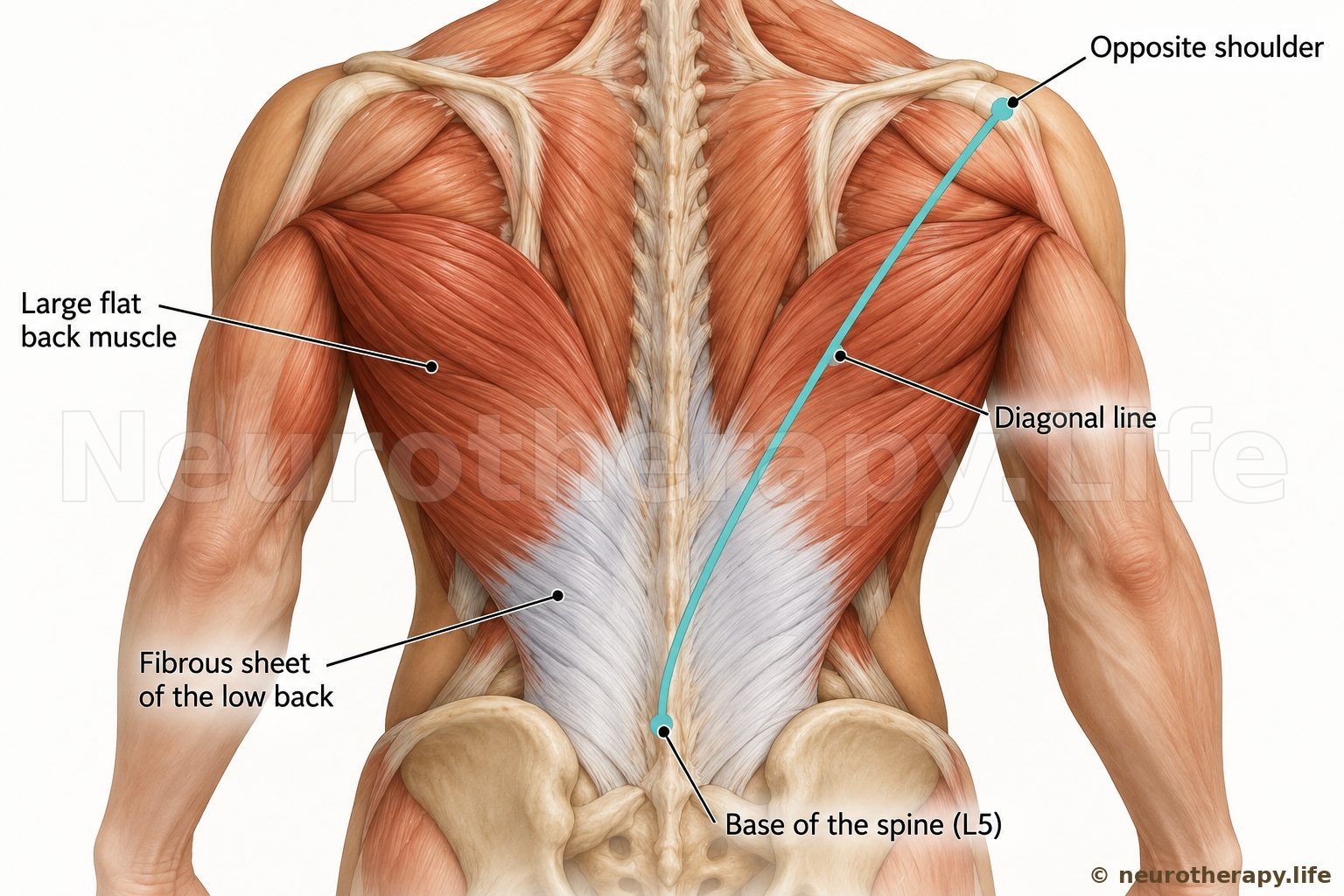
Despite its name, it is not a spot but a journey: a long diagonal line from the bottom of the spine, near the last lumbar bone (L5), up across the back to the opposite shoulder — then the same on the other side.
That diagonal follows very nearly the direction of the fibres of the broad fibrous sheet over the low back and of the large flat back muscle that rises from it to the upper arm. It is one of the few long lines in the body where a stretch at one end is felt at the other.
The patient lies face down with pillows under the chest and the head straight. The therapist takes full support from the chairs.
The area is the whole back along two diagonals: from the bottom of the lumbar spine up to the opposite shoulder, crossing the back in the shape of an X.
How this point is given — the tool, the pressure, the count and the exact movement — is deliberately not described here. A demonstration video for this point is being prepared; until it is on this page, learn the method hands-on from a trained Neurotherapist before giving it. Please do not give any point from a written description alone: a point given in the wrong place or the wrong way can do harm.
The exact technique is taught hands-on in the Neurotherapy (LMNT) course. See the course →
A slow, loaded slide along this diagonal is a long stretch of a real, continuous structure — the back's fibrous sheet and its large flat muscle. That is the honest meaning of 'relaxes the muscles of the whole back', and it is enough.
Bindu is one of the face-down low-back treatments.
Bindu is chosen when the whole back aches, inside a plan built from the patient's findings.
“This relaxes the muscles of the whole back. It is useful for those who have pain in both the upper and the lower back.”
The name means a point or a drop. Like several Neurotherapy (LMNT) treatments, it is a named treatment rather than a single spot — here, a diagonal journey across the back.
It holds the pelvis still so the long stroke actually stretches the back instead of just rolling your hips.
Yes, with the therapist holding the chairs so the weight that reaches you is controlled and can be eased at once.
The latissimus dorsi is the broadest muscle of the back. It starts low, from the spine and the back of the pelvis, and ends on the upper arm bone.
Source: Standard anatomy: Gray's Anatomy (41st ed.), latissimus dorsi.
The thoracolumbar fascia, the tough sheet over the low back, links the buttock muscle on one side with the large back muscle on the other — which is why the body has natural diagonal lines.
Source: Willard FH et al., The thoracolumbar fascia: anatomy, function and clinical considerations. J Anat 2012;221(6):507–536.
When you walk, your right arm swings with your left leg. The diagonal links across the back help store and pass on energy with every step.
Source: Willard FH et al., J Anat 2012;221(6):507–536.
This page explains what a Neurotherapy (LMNT) treatment is for; it is not a self-treatment guide and does not diagnose. Neurotherapy (LMNT) works alongside your medical care — keep taking the medicines your doctor prescribed.
Send COURSE for course details, or your name, age and health issue for a consultation.