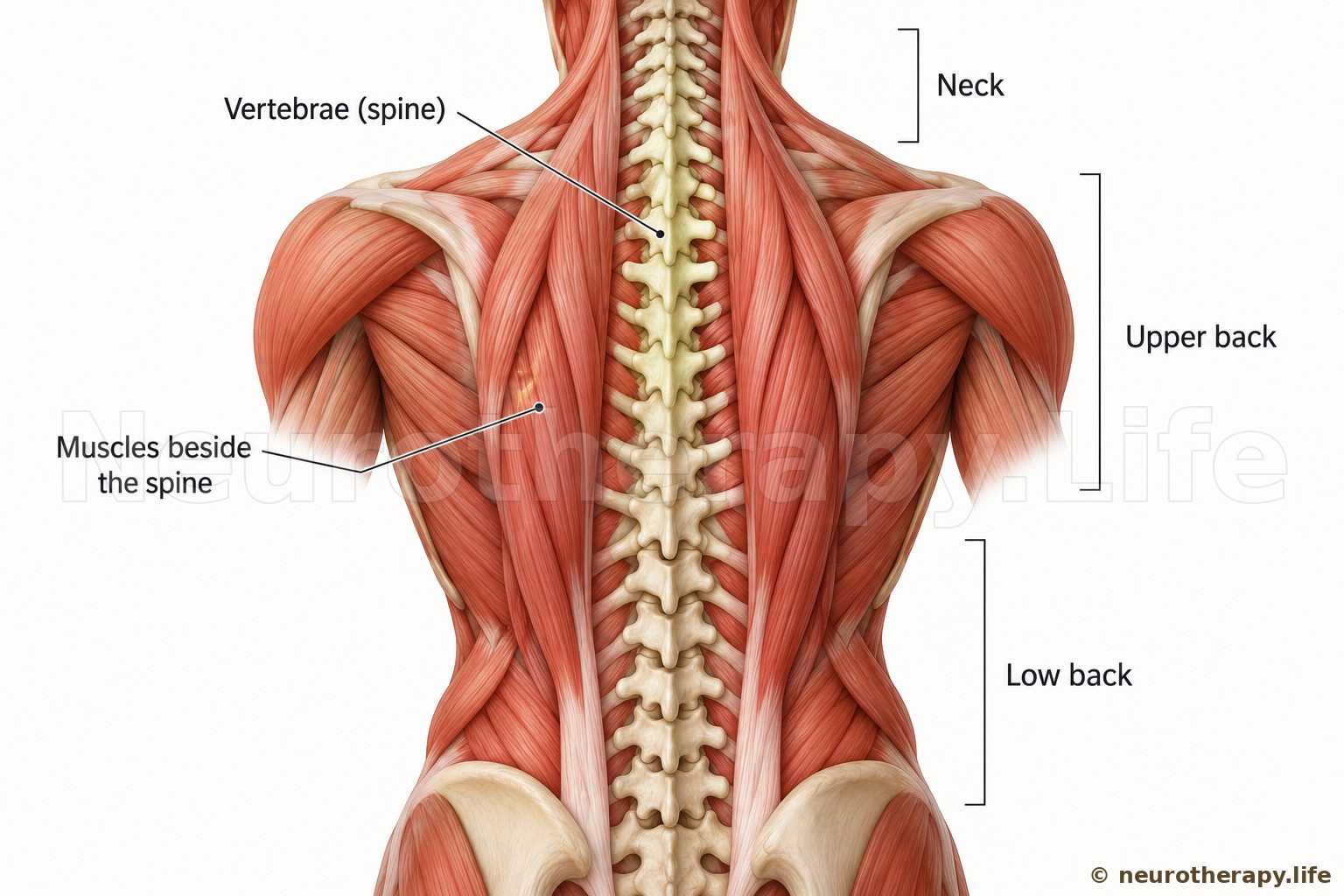
Sudhakar is a Neurotherapy (LMNT) back treatment, given lying face down, in which the muscles around all the vertebrae of the back are moved and set back in their correct place. It is used for neck pain, back pain and all pains.
Overview
What is Sudhakar?
Sudhakar is named after the patient in whom it was first worked out. Several Neurotherapy (LMNT) treatments carry a person's name in this way — Shukla, Vasanti, Pradeep, Giriraj — and the name records how the therapy grew: one problem, one patient at a time.
The teaching about it is short. In this treatment, the muscles around all the vertebrae of the back — the bony beads of the spine — are moved and brought back to their correct place. It is held to be beneficial for the neck, the back, and all pains.
Sudhakar is a physical point. Physical points relax and set muscles and tissues; they bring quick comfort. The chemical points, which rouse the glands, are the ones that address the root cause — so Sudhakar is usually one part of a wider plan, not the whole of it.
Sudhakar works on the muscles that run beside every vertebra of the back.
Where it is given
Where is Sudhakar given?
PositionLying face down
Body areaThe whole back, beside every vertebra of the spine
You lie face down, arranged as for every face-down treatment: pillows under the chest so that the chin rests and the head stays straight, not turned to one side. This arrangement protects the neck during the whole session and is never skipped.
The treatment covers the back along the whole spine — the muscles on both sides of every vertebra of the back.
How it is given
How is Sudhakar given?
How this point is given — the tool, the pressure, the count and the exact movement — is deliberately not described here. A demonstration video for this point is being prepared; until it is on this page, learn the method hands-on from a trained Neurotherapist before giving it. Please do not give any point from a written description alone: a point given in the wrong place or the wrong way can do harm.
Kind of pointA physical point — it works on muscles, not glands
The exact technique is taught hands-on in the Neurotherapy (LMNT) course. See the course →
What it does
What does Sudhakar do in the body?
Sudhakar is held to move the muscles beside each vertebra and bring them back to their correct place. Body science confirms that these deep muscles hold the spine upright and that tight or strained back muscles are a very common cause of pain; how this treatment settles them is the therapy's own teaching from practice.
Moves the muscles around all the vertebrae of the back and sets them back in place.
Is held to be beneficial for neck pain.
Is held to be beneficial for back pain.
Is given for all pains — as a comfort measure inside a wider plan.
Organs it reaches
Spine — The column of vertebrae that Sudhakar follows from top to bottom.
Muscles — The long and short back muscles beside each vertebra — the tissue it aims to set.
Neck — The neck is named first among the areas it is used for.
Its family
Which treatments work the same area?
These face-down back treatments share Sudhakar's territory and have a fully taught method.
Three Arrows — The three spinal strokes over the same strip of back — given where Sudhakar has not been taught in person.
Organ Clearance — Works over the whole back; the other taught alternative.
Round Arrow — Pressure on the side of the vertebrae, one of the arrow family.
Beside the Spine — Works the gutter beside the vertebrae, along the back.
On the Spine — Works on the beads of the spine themselves.
What it is used for
What is Sudhakar used for?
Sudhakar is named for three uses only: the neck, the back and all pains.
Sudhakar is given only by a therapist who has been shown it hand to hand. It is never improvised from its description; where it has not been taught, the taught treatments of the same area are given instead.
The face-down arrangement is compulsory: pillows under the chest so the head stays straight. A neck held turned to one side for a whole session can be left stiff and painful. Where pillows go during treatment, and where they never go
Back pain after a fall, in an older person, or with weakness or numbness in the legs, loss of bladder or bowel control, fever or weight loss needs a doctor's examination first. How to tell a patient to see a doctor
It is named after the patient in whose treatment it was worked out. Several Neurotherapy (LMNT) treatments are named this way, after a person rather than a body part.
My card says Sudhakar but I was given other back treatments. Why?
Sudhakar is given only by a therapist who has learned it in person. If yours has not, the taught treatments of the same area, such as the Three Arrows or Organ Clearance, are given instead and written on your card.
Will Sudhakar alone fix my back pain?
It may bring quick comfort, but it is a physical point. Lasting relief usually needs the chemical points that work on the cause, and a doctor's check where the pain has warning signs.
Surprising facts
1A column of many small bones
The spine is built of 24 movable vertebrae — seven in the neck, twelve in the chest and five in the low back — sitting on the sacrum and the tail bone.
Source: Standring S (ed.). Gray's Anatomy, 41st ed. Elsevier, 2016 — the vertebral column.
2Muscles in layers
Beside the spine lie long upright muscles on the surface and short slanting ones underneath that link one vertebra to the next. Together they hold you upright all day without you noticing.
Source: Standring S (ed.). Gray's Anatomy, 41st ed. — deep muscles of the back.
3Back pain is very common
Low back pain is the single leading cause of disability worldwide, and most of it comes from muscles, joints and ligaments rather than from a serious disease.
Source: World Health Organization. Low back pain — fact sheet, 2023.
This page explains what a Neurotherapy (LMNT) treatment is for; it is not a self-treatment guide and does not diagnose. Neurotherapy (LMNT) works alongside your medical care — keep taking the medicines your doctor prescribed.
Ready to begin?
Send COURSE for course details, or your name, age and health issue for a consultation.