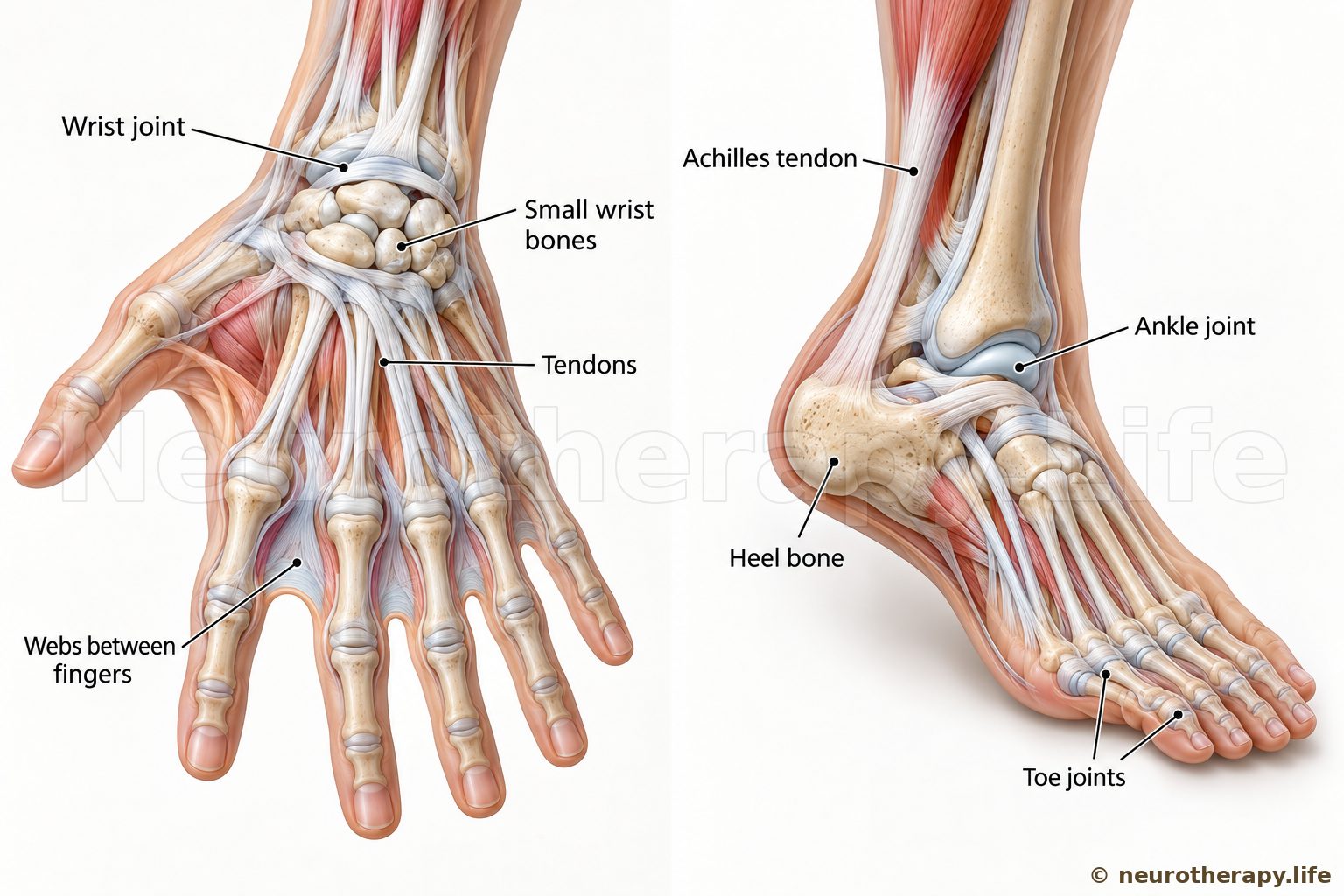
Shukla is a hands-only Neurotherapy (LMNT) treatment that loosens the wrist and the ankle of a limb that has been paralysed or has gone stiff. One hand holds the limb still while the other moves the joint in four directions. It is never given to people with osteoporosis.
Overview
What is Shukla?
Shukla is named after a person — in Neurotherapy (LMNT), some treatments carry the name of the student or patient in connection with whom they were first worked out. It is given to make the muscles of a hand or foot that has been paralysed loose and flexible again.
After a stroke or other paralysis, the wrist and fingers often curl and the ankle stiffens, because the muscles that are never moved shorten and the small joints set. A person who cannot move a limb themselves needs someone else to move it for them. Shukla does exactly that, at two joints: the wrist and the ankle.
It is given in two stages — first in the hand, then in the leg — on the affected limbs. The holding hand is the whole secret: if the forearm or the leg is allowed to travel, the movement is lost up the limb and nothing is lengthened.
Shukla works at two joints — the wrist and the ankle — that stiffen first in a paralysed limb.
Where it is given
Where is Shukla given?
PositionLying on the back
Body areaThe wrist and fingers of the affected hand; the ankle and toes of the affected leg
Shukla can be given in any comfortable position, so long as the wrist and the ankle can be reached. The therapist works beside the patient with the hands only — no chairs, no feet.
The areas are the wrist and fingers of the affected hand, and the ankle and toes of the affected leg. In the hand, the forearm just above the wrist is held still; in the leg, the heel is held firmly.
How it is given
How is Shukla given?
How this point is given — the tool, the pressure, the count and the exact movement — is deliberately not described here. A demonstration video for this point is being prepared; until it is on this page, learn the method hands-on from a trained Neurotherapist before giving it. Please do not give any point from a written description alone: a point given in the wrong place or the wrong way can do harm.
Feels likeA slow, guided movement of a joint you cannot move yourself
The exact technique is taught hands-on in the Neurotherapy (LMNT) course. See the course →
What it does
What does Shukla do?
Shukla is a plain mechanical treatment: it moves joints that the patient cannot move, so the muscles around them stay loose and flexible. Body science agrees that regular passive movement helps prevent a paralysed limb from stiffening into a fixed position.
Loosens the muscles of a paralysed hand or foot.
Eases stiffness of the hands and feet.
Opens the webs between the fingers and toes, where stiffness sets first.
Organs it reaches
Joints — The wrist, the ankle and the small joints of the fingers and toes.
Muscles — Muscles that shorten when a limb is not moved.
Brain — Where most paralysis after a stroke begins; the limb is kept supple while the brain recovers.
Its family
Which treatments go with Shukla?
Shukla is usually part of a gentle plan for a paralysed limb.
Paralysis Clockwise — Works the whole arm and leg — inner side downward, outer side upward.
Feather Touch — The lightest treatment, given with the fingertips; often closes the session.
Opposite Point — When a limb cannot be touched, its diagonal partner is treated instead.
Motor Neuron Point — A forceful point for paralysis — unlike Shukla, it carries a jerk and has strict bars.
Vasanti — Another gentle treatment named after a person, for the leg.
What it is used for
What is Shukla used for?
Shukla is for limbs that cannot move themselves or have gone stiff.
Never given to people with osteoporosis: for them this treatment may increase the pain. The rule is not softened for a patient who looks sturdy. Osteoporosis
A new weakness of the face, arm or leg is an emergency — call emergency services (108/112) first. Shukla is for a paralysis that is already known and under a doctor's care. Paralysis and stroke
Read the doctor's letter: a patient on blood-thinning medicine is not given the forceful paralysis points, though gentle ones like Shukla remain open if nothing else bars them. Motor Neuron Point
“For osteoporosis patients this treatment may perhaps increase the pain — so do not give them this treatment.”
— Dr. Lajpatrai Mehra
A teaching case
Teaching case: the hand that opened at home
A teaching case, put together from several patients: a man some years after a stroke came with a curled right hand and a stiff ankle, and his doctor's letter said he was on blood-thinning medicine, so the forceful paralysis points were left out. He was given gentle treatments including Shukla, and by the fourth week the ankle moved further but the fingers had barely opened. The family were then shown how to keep the hand moving every day — and the gains in the hand came from that daily care, not from twice a week at the clinic.
A composite case written to teach the reasoning — not one patient’s file.
Common questions
Why is Shukla not given if I have weak bones?
Because for osteoporosis patients it may increase the pain. The instruction says plainly: do not give it — not 'give it gently'.
Can Shukla make a paralysed hand work again?
Shukla keeps the hand and foot loose and flexible so they are ready to be used. What rebuilds movement is the brain's own recovery and using the limb; Shukla supports that, alongside your doctor's and physiotherapist's care.
Is it painful?
It should not be. The movement is slow and guided. Tell the therapist at once if any movement hurts.
Does it matter which hand holds the limb?
What matters is that the limb above the joint is held still. If the forearm or leg moves, the movement is lost up the limb and the joint is not loosened.
Surprising facts
1Stiffness can start within weeks
After a stroke, muscle stiffness (spasticity) and shortening can begin within the first weeks, which is why stroke guidelines stress positioning and regular movement of the weak limbs.
Source: National Clinical Guideline for Stroke for the UK and Ireland, 2023 — spasticity and contractures.
2The wrist is many joints
The wrist contains eight small carpal bones arranged in two rows, and together they let the hand bend, tilt and turn.
Source: Gray's Anatomy, 41st ed., Wrist and hand.
3Using it changes the brain
After a stroke, practising movement with a weak hand helps healthy parts of the brain take over lost work — a property called neuroplasticity.
This page explains what a Neurotherapy (LMNT) treatment is for; it is not a self-treatment guide and does not diagnose. Neurotherapy (LMNT) works alongside your medical care — keep taking the medicines your doctor prescribed.
Ready to begin?
Send COURSE for course details, or your name, age and health issue for a consultation.