Paralysis Clockwise: helping a bent hand and a dragged leg open out
After paralysis the hand often stays bent inward and the leg is dragged in walking. Paralysis Clockwise is the treatment given to help them open out, using small clockwise circles down the inner side of the limb and up the outer side.
Overview
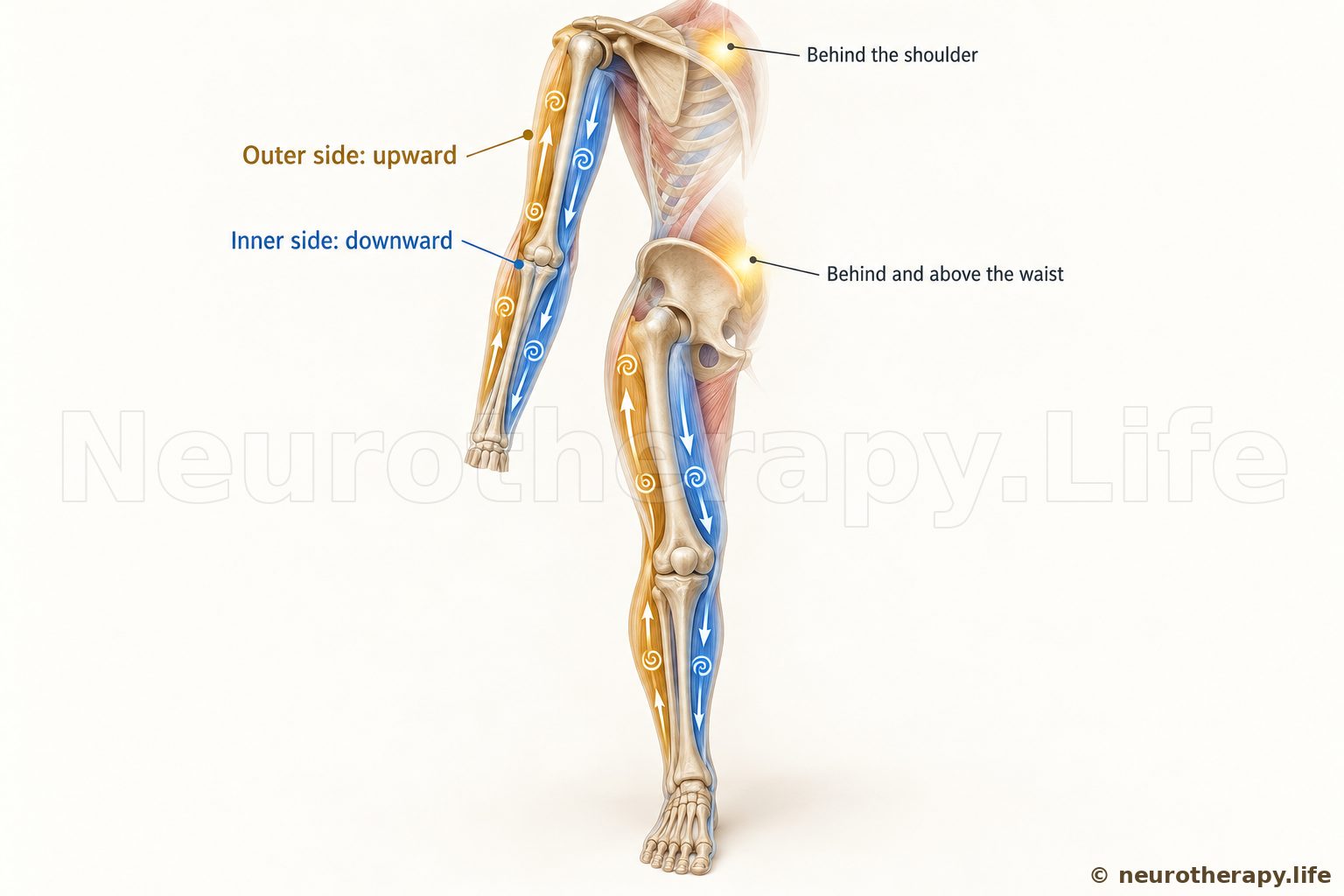
After a stroke or other paralysis, the hand often stays bent inward and the person walks dragging the leg. Paralysis Clockwise is the treatment given to help them open out.
The therapist gathers the fingers together and turns them in small clockwise circles on the muscles of the arm and the leg, rolling the muscle rather than stroking the skin. One pattern governs both limbs: down the inner side, up the outer side. Each limb ends with a gentle lift beyond the limb itself, behind the shoulder for the arm and behind and above the waist for the leg. These end lifts are easy to forget.
Why that pattern? Because that is where the limb has gone. The inner surfaces have shortened, and the outer surfaces have been overpowered. The work runs along the shortened tissue in the direction it needs to lengthen, and along the slack tissue in the direction of its work.
This work sits alongside proper rehabilitation, never instead of it. Families are encouraged to tell the neurologist and the physiotherapist what the patient is receiving. The exact method is taught hands-on in the course.
Key points
- Paralysis Clockwise helps the bent hand and dragged leg of paralysis open out.
- Gathered fingers roll the muscle in small clockwise circles.
- Down the inner side, up the outer side, for both arm and leg.
- Each limb ends with a lift behind the shoulder or above the waist.
- It sits alongside rehabilitation, never instead of it.
Go deeper
Paralysis Clockwise
The full point page for Paralysis Clockwise
Shukla
Shukla, for the wrist and the ankle
Vasanti
Vasanti, a very soft treatment in this group
Paralysis and stroke
Paralysis and stroke
Spasticity (stiff, tight muscles)
Spasticity: stiff, tight muscles
Thrombosis (blood clots)
Blood clots, the check before leg work
Nervous system and brain
The nervous system and brain
Uncommon Problems: Neurotherapy (LMNT) Points Found One Patient at a Time
The full guide to treatments for uncommon problems
Read the full guide
This topic is part of: Uncommon Problems: Neurotherapy (LMNT) Points Found One Patient at a Time
Safety: when it is held back
- Compare the calves first. One warm, swollen, tender calf may hide a clot, and vigorous work could send it to the lungs. That leg is not rubbed; it is sent to a doctor the same day. Thrombosis (blood clots)
- Do not use a weak arm as a handle. After a stroke the shoulder on the affected side is often loose in its socket; support the limb from beneath at the elbow and wrist instead of pulling it. Paralysis and stroke
- Sudden new weakness, a drooping face or slurred speech is an emergency: call emergency services (108/112) at once.
- Neurotherapy (LMNT) works alongside your medical care. Do not stop or change any medicine on your own.
This page explains what a Neurotherapy (LMNT) treatment is for; it is not a self-treatment guide and does not diagnose. Neurotherapy (LMNT) works alongside your medical care — keep taking the medicines your doctor prescribed.