Uncommon Problems: Neurotherapy (LMNT) Points Found One Patient at a Time
Some Neurotherapy (LMNT) treatments do not belong to one region of the body. Each was worked out for one particular trouble, such as an arm that will not lift after a blow, a descended womb, a hand closed after a stroke or numb diabetic feet, and then kept because it helped. This guide explains what each is used for and when it must not be given.
Overview
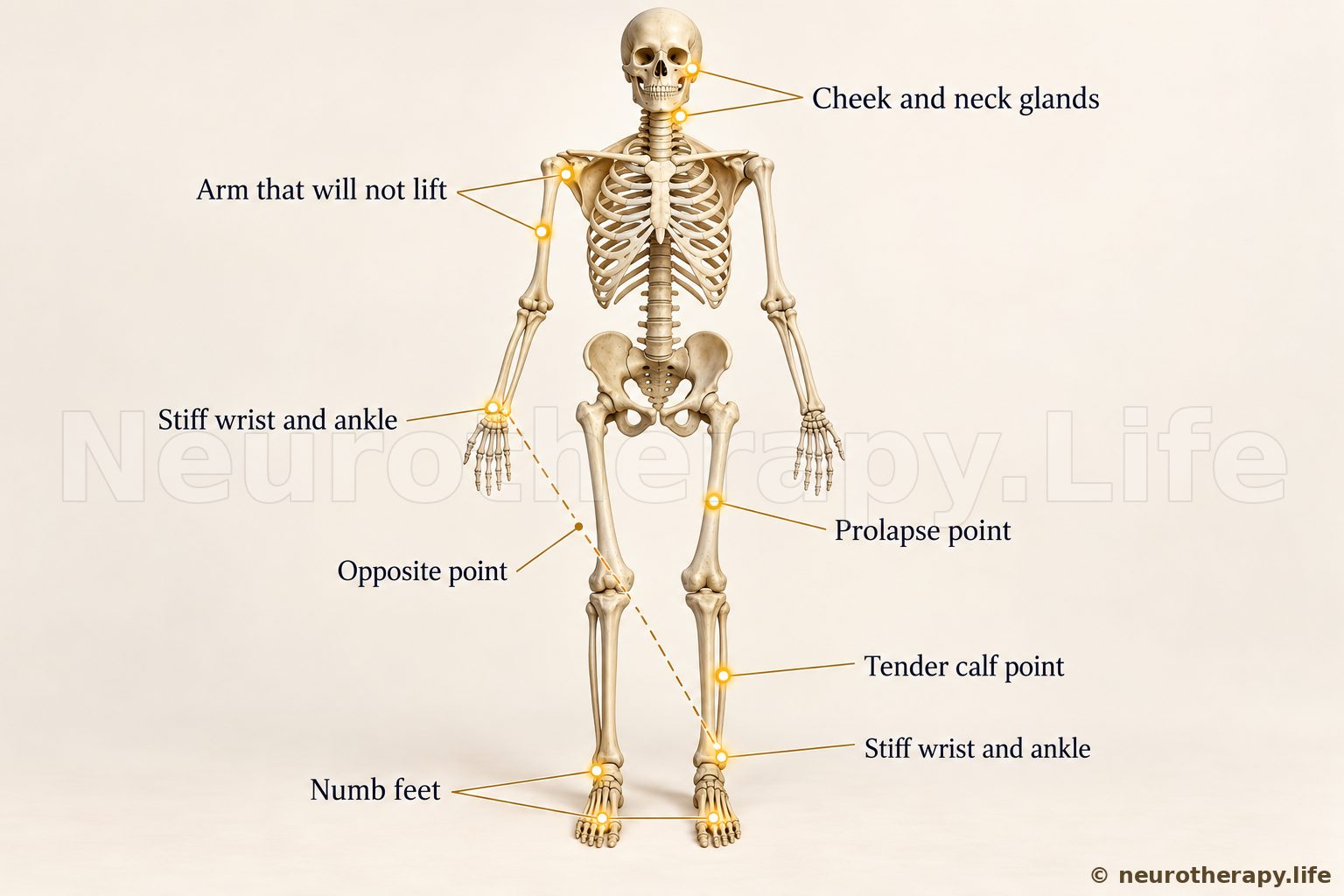
Some Neurotherapy (LMNT) treatments do not belong to one region of the body. Each was worked out for one particular trouble, such as an arm that will not lift after a blow, a descended womb, a hand closed after a stroke or numb diabetic feet, and then kept because it helped. This guide explains what each is used for and when it must not be given.
Arranged by problem, not by region
The other point groups walk down the body from head to toe. These do not fit that order, because they were never discovered by region. Each was worked out on one patient for one trouble and then kept. So each one carries its own patient position and its own place for the therapist, and nothing here may be given in the position used for the last treatment.
Their names make sense once you know there are four kinds. Some are named for a sound or a direction: Katka is the sudden snap, Rocket is everything travelling upward. Some are named for the anatomy, like T8 or Ankle Point. Some are a picture, like Sangam, the meeting of rivers, or Feather Touch. And some carry the name of the student or patient in connection with whom they were found, like Shukla and Vasanti.
Shoulders, arms and dizziness
The shoulder blade floats on the back of the ribs, held only by muscle, and those muscles run on into the arm. So the two shoulder-blade treatments start beside the spine and finish at the hand. Lower Shoulder Blade Pain, given with the palms, is for pain in the lower part of the blade; Upper Shoulder Blade Pain, given with the feet and the arms raised, is for the upper part. After these two, BAFA is said to be of great benefit in cervical problems.
Rocket Point is for an arm that cannot be raised after a blow to the shoulder, neck or arm: the muscles are said to have come down, and everything in the treatment drives them back up, from the wrist toward the shoulder and then behind the ear. Down Arrow and Up Arrow are one stroke along the spine run in opposite directions, for two different dizzinesses: Down Arrow for Meniere's disease, where the fluid in the inner ear increases, and Up Arrow for vertigo, which the therapy links to the fluid decreasing. T8 is a press around one bone in the middle of the back, with one firm limit: the pressure must never be so much that the pain increases.
Troubles people find hard to mention
Hydrocele Point is for swelling or itching in the scrotum. The source notes that such men have a very tender spot in the calf, a little above the ankle, and the point is given there. But a scrotal swelling is a diagnosis to be made by a doctor, not a symptom to treat around. Any new, painful or quickly growing swelling must be examined the same day, and sudden severe pain there is an emergency.
Prolapse Point, also written P Point, is used for women whose womb has moved from its place, and it is always paired with (6) WD. Whether the womb has moved back is decided by a doctor's examination, not by how a woman feels, so no planned operation is cancelled on the strength of it. Ton 'P' is for the parotid glands in the cheek and Ton 'T' for the tonsil glands in the neck; they differ only in their counts. Sangam Points are paired with Ton 'T' and are also useful in cough and throat problems.
Paralysis, stiffness and numb limbs
After a stroke, a hand often stays bent inward and the leg is dragged in walking. Paralysis Clockwise opens them out, with gathered fingers turning in small circles on the muscles, down the inner side of the limb and up the outer side. Shukla gently moves the wrist and the ankle in four ways while the joint above is held still. Neither replaces rehabilitation; both sit alongside the neurologist and the physiotherapist. Opposite Point is a rule rather than a technique: when a limb cannot be touched, its diagonal partner is treated instead, so the right hand pairs with the left leg.
Vasanti is a very soft rub with the sole, used especially to ease numbness in the limbs of people with diabetes. 'Very softly' is written twice, because these are the patients least able to say that the pressure is too much. Feather Touch is the lightest of all: the fingertips stroke the body as softly as a peacock's feather. It is used in paralysis, stiffness, pains and diseases of the brain, and it stays open for the patient who can be given nothing else, such as a newborn, someone in late pregnancy or someone in the first days after a stroke.
Strains, the belly, and two points given only after much thought
Superfast is for a leg that suddenly slipped, leaving a sharp pain in the groin or waist; it is given on the other leg, never on the painful one. Gal–Spl Ghisai is a soft rub over the outer rim of the hip bone, used to correct blockage in the lymph nodes and reduce swelling in the leg, especially in people who wear tight trousers. Ankle Point loosens the skin around the ankle of the leg that has the problem. Abdomen Setting is used when the stomach is very bad, yet no hand touches the belly: the therapist moves the hips and low back through the knees, while the patient stays completely relaxed.
Katka and Motor Neuron Point are the most forceful treatments in the therapy. They share a special pillow set-up with a check that the patient can breathe freely, only a mild jerk is allowed, and the source itself says they should be used only after much thought. Motor Neuron Point is named for the anatomy beneath it. It is not a treatment for motor neurone disease, which belongs to a neurologist. The exact methods of all these points are taught hands-on in the course.
After the treatment: the card tells the truth
When the session ends, every pain point is checked again and the result is written on the card with plus and minus signs: four plus for extreme pain, fewer plus signs as it eases, and a single minus when it has gone. The patient is shown or told where the pain has reduced, and by how much.
Guruji gave two reasons. Seeing the pain go down builds trust. And when a patient returns after many days saying nothing helped, the old card shows whether that day's treatment really reduced the pain, so the therapist can decide whether to repeat it or change it.
Key points
- These treatments are arranged by problem, and each names its own patient position.
- The two shoulder-blade treatments run from the spine to the hand; BAFA after them helps in cervical problems.
- Hydrocele Point and P Point never replace a doctor's examination.
- Opposite Point treats the diagonal partner of a limb that cannot be touched.
- Vasanti and Feather Touch are gentle by design; for numb limbs, gentle is the treatment.
- Katka and Motor Neuron Point are given only after much thought, with only a mild jerk.
- Pain points are rechecked and written as plus or minus after every session.
Topics in this guide
Go deeper
Lower Shoulder Blade Pain
Lower Shoulder Blade Pain
Rocket Point
Rocket Point — an arm that will not lift after a blow
Hydrocele Point
Hydrocele Point — and why a doctor comes first
P point
P Point — for a womb that has moved
Paralysis Clockwise
Paralysis Clockwise — opening a closed hand
Vasanti
Vasanti — numbness in diabetes
Feather Touch
Feather Touch — the gentlest contact
Opposite Point
Opposite Point — the diagonal rule
Knee, Leg and Foot: Neurotherapy (LMNT) for Knee Pain and the Lower Leg
The knee, leg and foot group before this one
The Record That Shows the Truth: The Patient Card in Neurotherapy (LMNT)
How the card records the truth of each session
Safety: when it is held back
- Shoulder-blade pain with chest pressure, breathlessness, sweating, or pain into the jaw or arm: stop, sit the patient up and call for emergency help. Angina (chest pain from the heart)
- An arm that will not lift after a blow, with deformity, a cold or pale hand, numbness or no movement at all: send to a doctor; do not treat. Shoulder dislocation
- Any new, painful or fast-growing scrotal swelling is examined by a doctor the same day; sudden severe pain there is an emergency. Hydrocele
- Ton 'P' is not given to women who wish to become mothers. Ton 'P'
- Shukla is not given in osteoporosis, because it may increase the pain. Osteoporosis
- Katka and Motor Neuron Point: only after much thought, a mild jerk only, and never with brittle bones, long steroid use, a history of cancer, rheumatoid arthritis, blood thinners or signs of a pinched cord in the neck. Motor neuron disease
- A face drooping on one side, an arm that will not hold up or thick speech is a stroke: call an ambulance at once. Paralysis and stroke
- Abdomen Setting is not given in later pregnancy, after recent belly, pelvic or hip surgery, after a hip replacement, or with crumbling spinal bones. Pregnancy care
- Groin pain after a slip in an older person may be a broken hip: a leg that cannot take weight goes to hospital. Frail and elderly patients (gentle care)
- A warm, swollen, tender calf is checked before any paralysis treatment; numb diabetic feet get light contact only. Thrombosis (blood clots)
- Never ATF in alkalosis, never ALTF in acidosis. In cancer, never (10) Pan, Thymus, Pit, Lu+Sh, Rt.Ov/Lt.Ov or (30) Medulla. Children get light treatment. When the Hand Must Stop: Blocked Points and Safety in Neurotherapy (LMNT)
Guruji says
“The thing to note here is that so long as any treatment reduces the pain of the pain points, there is no need to change it and give another.”
“Do not hold a feeling of enmity towards anyone!”
Common questions
Why are you pressing my calf when my problem is the swelling in my private parts?
Because the therapy finds a tender point in the calf in this condition, and treating it can ease that pain. But a swelling there must be examined by a doctor; Neurotherapy (LMNT) goes alongside that examination, never instead of it.
My doctor says the womb must be removed. Can I cancel the operation if I come to you?
Please do not cancel anything on the therapist's account. The treatment often gives relief from the dragging and heaviness, but whether the womb has moved back is decided by an examination. Take any change back to your doctor.
My father has had a stroke. Will this bring his hand back?
No one should promise that. What families often see is that the hand becomes easier to open and clean, the stiffness settles and he is more comfortable. This works alongside his doctors and physiotherapist, and they should know what he receives.
There was a cracking sound in my back. Did something break?
No. It is a small pop from inside a joint, like knuckles cracking. Some people make the sound and some never do, and it is not the aim of the treatment.
Watch
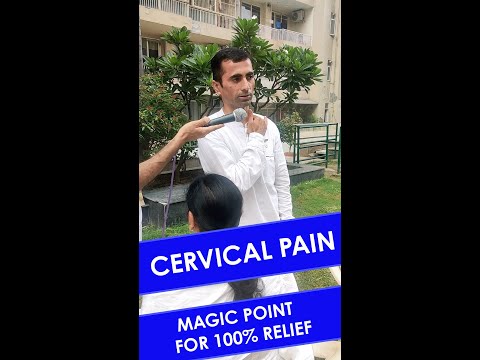
Shows a seated routine for neck pain: zig-zag fingertip massage from the base of the skull to the shoulder blades and down the arm, cross-rubbing, rounds of breathing out through the mouth, and a gentle grip massage at the back of the neck. It is shared for relief in cervical pain and tingling in the hands.
Test yourself
Explore more
Organs
Body systems
Diseases
Points
Topics
Read more
This page explains what a Neurotherapy (LMNT) treatment is for; it is not a self-treatment guide and does not diagnose. Neurotherapy (LMNT) works alongside your medical care — keep taking the medicines your doctor prescribed.