Upper Shoulder Blade Pain is a Neurotherapy (LMNT) treatment named for what it is given for: pain in the upper part of the shoulder blade. You lie face down with the elbows bent, palms facing the ground and arms raised, and the therapist draws the muscles from the shoulder out along the arm with the feet. Followed by BAFA, it is described as of great benefit in neck problems.
Overview
What is Upper Shoulder Blade Pain?
The shoulder blade (scapula) is a flat triangle of bone that does not sit in a socket. It floats on the back of the rib cage, held there by muscle alone, and the muscles that hold it run on into the arm. So a pain in the shoulder blade is rarely a pain in the bone; it is a pain in a sheet of tissue that starts at the spine and ends at the hand.
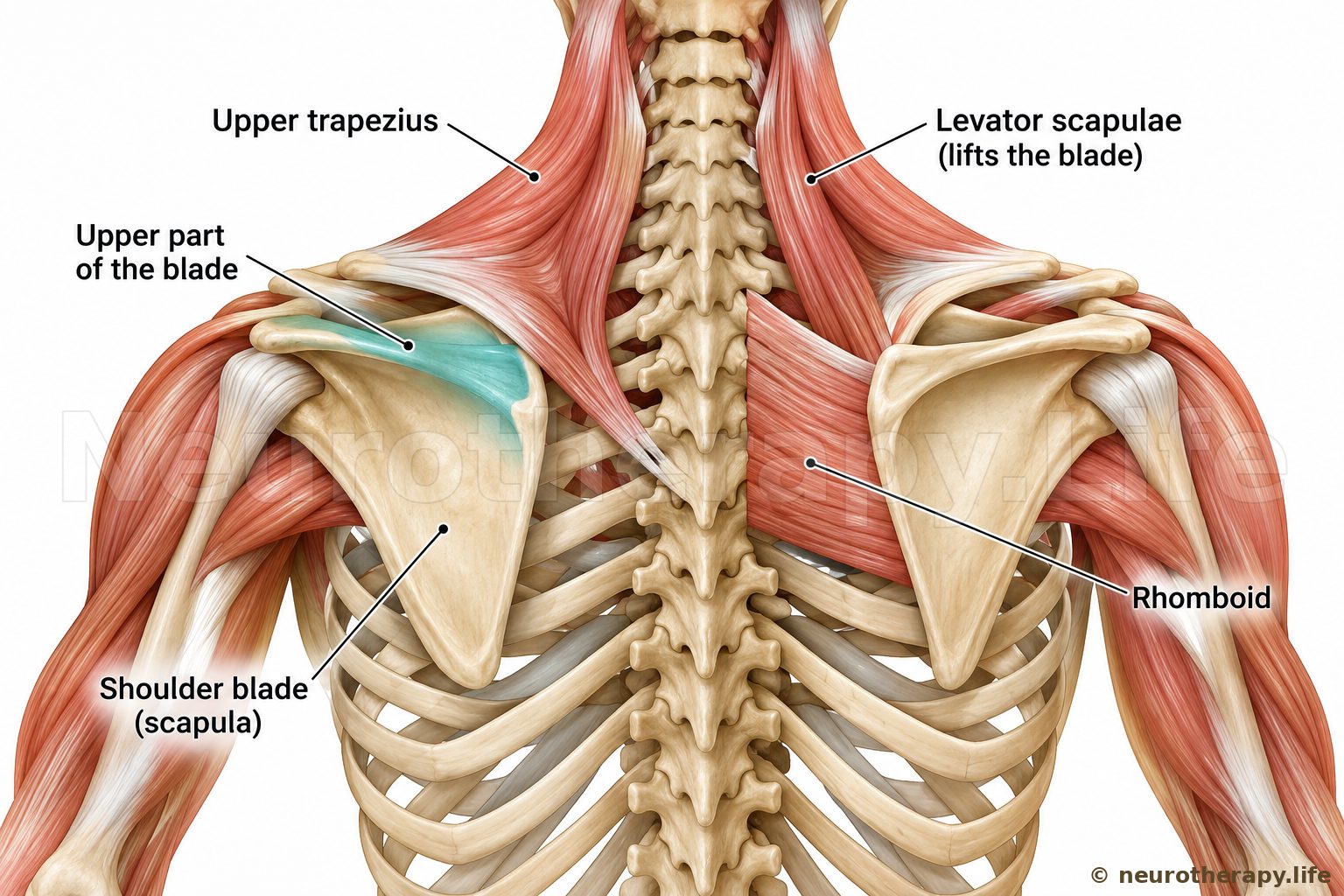
The upper part of the blade lies inside its top edge, over the upper ribs. Here run the upper trapezius, the muscle that lifts the shoulder blade (levator scapulae) and the small rhomboid — muscles that also tie the blade to the neck. That is why pain here so often travels with a stiff neck.
Neurotherapy (LMNT) has two shoulder-blade treatments, told apart by which part of the blade hurts and by what the arm is doing: this one for the upper part, given with the feet, and Lower Shoulder Blade Pain for the lower part, given with the palms. It is a physical treatment for muscle and soft tissue, not a chemical point for a gland.
The upper shoulder blade is held by muscles that run up into the neck and out into the arm.
Where it is given
Where is it given?
PositionLying face down
Body areaThe shoulder and both arms, from the shoulder to the palm, lying face down with the arms raised and palms down
You lie face down, with one and a half pillows under the chest — the chest on the upper pillow, the chin on the lower — so the head stays straight. Your elbows are bent, the palms face the ground and the arms are raised up beside the head.
The treatment covers the shoulder, the upper arm down to the elbow, and on along the forearm towards the palm — on both arms.
How it is given
How is it given?
How this point is given — the tool, the pressure, the count and the exact movement — is deliberately not described here. A demonstration video for this point is being prepared; until it is on this page, learn the method hands-on from a trained Neurotherapist before giving it. Please do not give any point from a written description alone: a point given in the wrong place or the wrong way can do harm.
Feels likeA firm, smooth drawing of the muscles along both arms
Its twinLower Shoulder Blade Pain — given with the palms, palms up, arms down
The exact technique is taught hands-on in the Neurotherapy (LMNT) course. See the course →
What it does
What does it do?
This is a physical treatment: it works on muscle and soft tissue by drawing it back along its length, from the shoulder out to the hand.
Puts right pains in the upper part of the shoulder blade — which is exactly why it is named upper shoulder blade.
Draws the muscles of the shoulder and arm inward along their whole length, from the shoulder to the palm.
Followed by BAFA, it is described as of great benefit in cervical (neck) problems.
Organs it reaches
Muscles — The upper trapezius, levator scapulae and rhomboids, which hold and lift the blade.
Neck — The muscles of the upper blade climb into the neck — the reason it is paired with BAFA in neck problems.
Spine — Where the muscles of the shoulder blade take their origin.
Joints — The shoulder joint, which these muscles steady and move.
Its family
Which treatments go with it?
The two shoulder-blade treatments, the arm treatment that follows them, and a sister treatment for an arm that will not lift.
Lower Shoulder Blade Pain — For the lower part of the blade — given with the palms, palms facing the sky, arms down.
BAFA — Both Arms, Both Forearms — given after the shoulder-blade treatments for neck problems.
Rocket Point — For an arm that cannot be raised after a blow to the shoulder, neck or arm.
Back Arrow — Another back treatment that travels from the mid-back towards the arm.
What it is used for
What is it used for?
After the cause of the pain has been thought through — the back also reports the trouble of inner organs.
The shoulder blade
Shoulder blade painPain in the upper part of the shoulder blade, inside its top edge.
This is a foot treatment. Small children, very weak or frail persons, and anyone with osteoporosis (thin, fragile bones) are treated with the hand only — not with the feet. Osteoporosis
The chairs carry the therapist's weight; only as much comes down as the therapist lets down. This is why a foot treatment is given only by a trained therapist. Why the therapist stands between two chairs
Face down, the one-and-a-half-pillow arrangement under the chest is compulsory, above all for a stiff neck or cervical spondylosis: a neck left twisted while lying face down can be strained. Where pillows go during treatment, and where they never go
The back reports the trouble of inner organs. Upper back or shoulder pain that comes with exertion, chest pain, breathlessness or sweating needs a doctor first — it can come from the heart. How to tell a patient to see a doctor
Tingling or numbness running into the hand during the treatment means stop at once.
“After these two treatments, giving BAFA will be of great benefit in cervical problems.”
— Dr. Lajpatrai Mehra
Common questions
My pain is at the top of my shoulder blade. Why does the therapist work along my arms?
Because the muscles that hold the shoulder blade run on into the arm. The treatment follows the whole sheet of tissue, from the shoulder to the hand.
How is it different from Lower Shoulder Blade Pain?
This one is for the upper part of the blade and is given with the feet, palms down, arms raised. The lower one is given with the palms, palms up, arms down.
Isn't a foot treatment too heavy?
The therapist's weight is carried on two chairs, so only as much comes down as is needed. Frail patients and anyone with fragile bones are treated with the hands instead.
Does it help a stiff neck?
The teaching says that following the shoulder-blade treatments with BAFA is of great benefit in cervical problems.
Surprising facts
1A bone with no socket
The shoulder blade joins the rest of the skeleton only through the small joint at the end of the collar bone; everything else that holds it to the chest is muscle.
Source: Gray's Anatomy, 41st ed. — scapula and pectoral girdle.
2A muscle named for lifting
Levator scapulae means 'lifter of the shoulder blade'. It runs from the upper neck bones to the upper corner of the blade, so tension in it is felt both at the top of the blade and in the side of the neck.
Source: Gray's Anatomy, 41st ed. — muscles of the back and shoulder.
3The heart can speak through the shoulder
Pain from the heart is often felt in the left shoulder, arm or upper back rather than in the chest — called referred pain, because the heart and those areas report to the same levels of the spinal cord.
Source: Guyton & Hall, Textbook of Medical Physiology, 14th ed. — referred pain.
This page explains what a Neurotherapy (LMNT) treatment is for; it is not a self-treatment guide and does not diagnose. Neurotherapy (LMNT) works alongside your medical care — keep taking the medicines your doctor prescribed.
Ready to begin?
Send COURSE for course details, or your name, age and health issue for a consultation.