Why the therapist stands between two chairs
Many Neurotherapy (LMNT) points are given with the foot. Two upturned chairs let the therapist carry most of their weight on the arms and let down only a measured part of it, which they can take back in an instant.
Overview
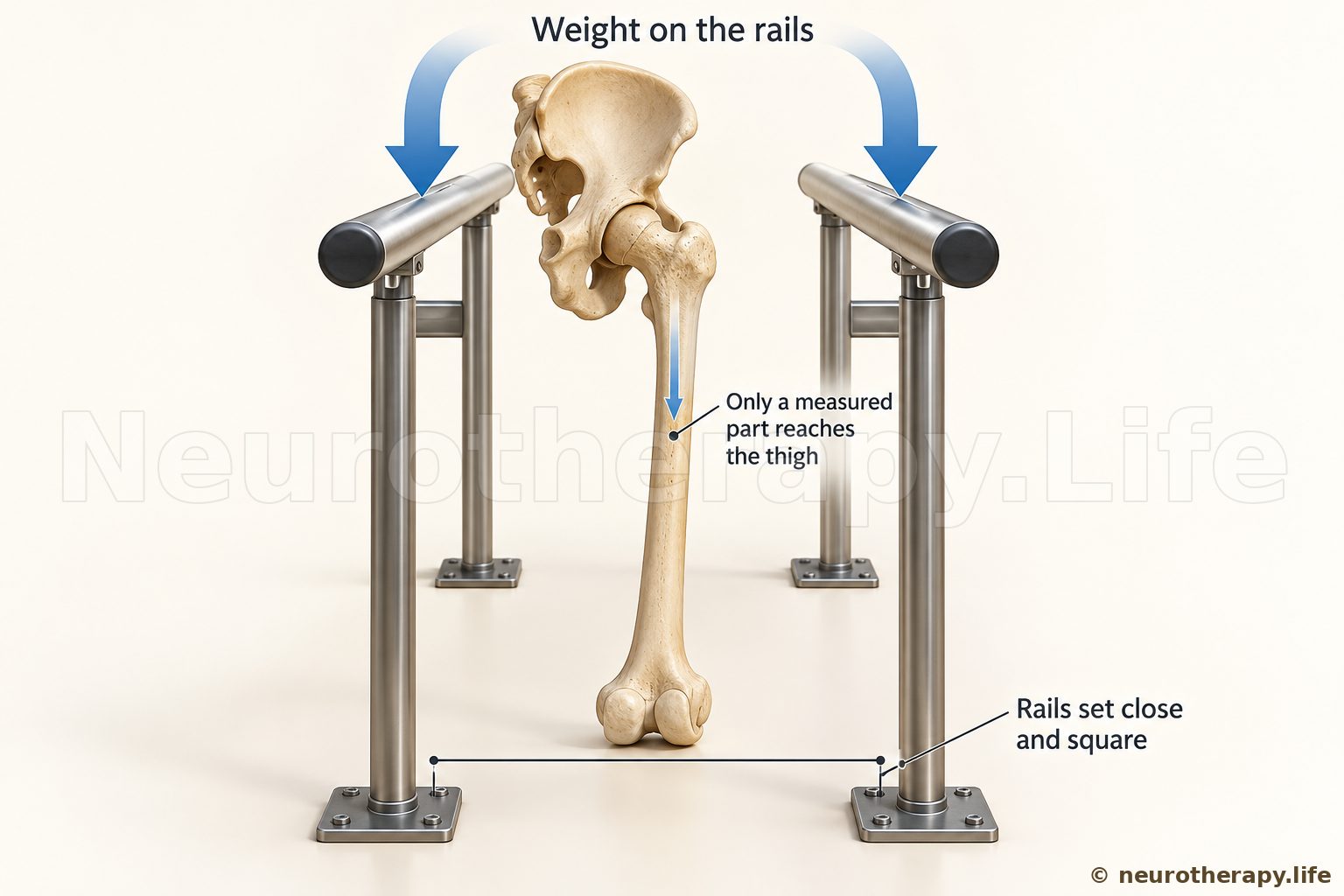
Two ordinary four-legged chairs are turned over and set facing each other, so their frames make two rails at about hip height. The patient lies between them, and the therapist stands astride with both hands on the frames. Most of the therapist's weight rides on the arms.
This turns the chairs into a measuring tool. Only as much weight reaches the patient as the therapist deliberately lets down, and it can be taken back at any moment. A therapist without chairs has only one setting: all of their weight.
The chairs are kept close and square, and moved as often as the work needs, rather than leaning or reaching. A lean is felt by the patient as a sideways drag, and a wobble makes a relaxing muscle grip again. The contact is the soft middle of the sole; the toes prick and the heel can leave soreness for days, unless a treatment names the heel.
One foot is laid first, lightly, as a signal. A muscle that is touched without warning grips almost instantly, through a reflex in the spinal cord; a gentle first touch calms that reflex. It also protects the therapist if a hand slips.
Key points
- The chairs carry the therapist's weight, not the patient.
- Weight is let down by choice and can be taken back at once.
- Move the chair, never reach or lean over the patient.
- The soft middle of the sole is the usual contact.
- A light first touch keeps the muscle from bracing.
Go deeper
Placing the Patient: The Four Positions of Neurotherapy (LMNT)
Placing the patient: the full guide
Before You Touch Anyone: Room, Conduct and Consent
Setting up the room before anyone is touched
How a Neurotherapy (LMNT) treatment room is set up
What a treatment room needs
How the therapist presses to examine your belly
How pressure is given: broad and inward
Pan
Pan, a point given with both feet
Liv
Liv, where one foot works the arm and one the thigh
Read the full guide
This topic is part of: Placing the Patient: The Four Positions of Neurotherapy (LMNT)
Safety: when it is held back
- Small children, very weak people, anyone with osteoporosis, and anyone who has lost feeling in the legs or feet (for example after many years of diabetes) are treated with the hand, not the foot. Osteoporosis
- During the arm-and-thigh points, a chair leg must never touch the patient's hand.
- The exact method is taught hands-on in the course, under a trained therapist. Please do not try it on yourself or others from this page.
Watch

Shows how to find the Pan (pancreas) point in the fold at the top of both thighs, and how to give 1 Pan, 2 Pan, 2 Pan × 6 and 8 Pan with the feet, holding chairs for support. It is used to support the pancreas in diabetes and indigestion.
This page explains what a Neurotherapy (LMNT) treatment is for; it is not a self-treatment guide and does not diagnose. Neurotherapy (LMNT) works alongside your medical care — keep taking the medicines your doctor prescribed.