How the therapist presses to examine your belly
A Neurotherapy (LMNT) examination begins with gentle, slow presses on the belly to find tender or stiff points. This page explains what a good examining press feels like and why it is done that way.
Overview
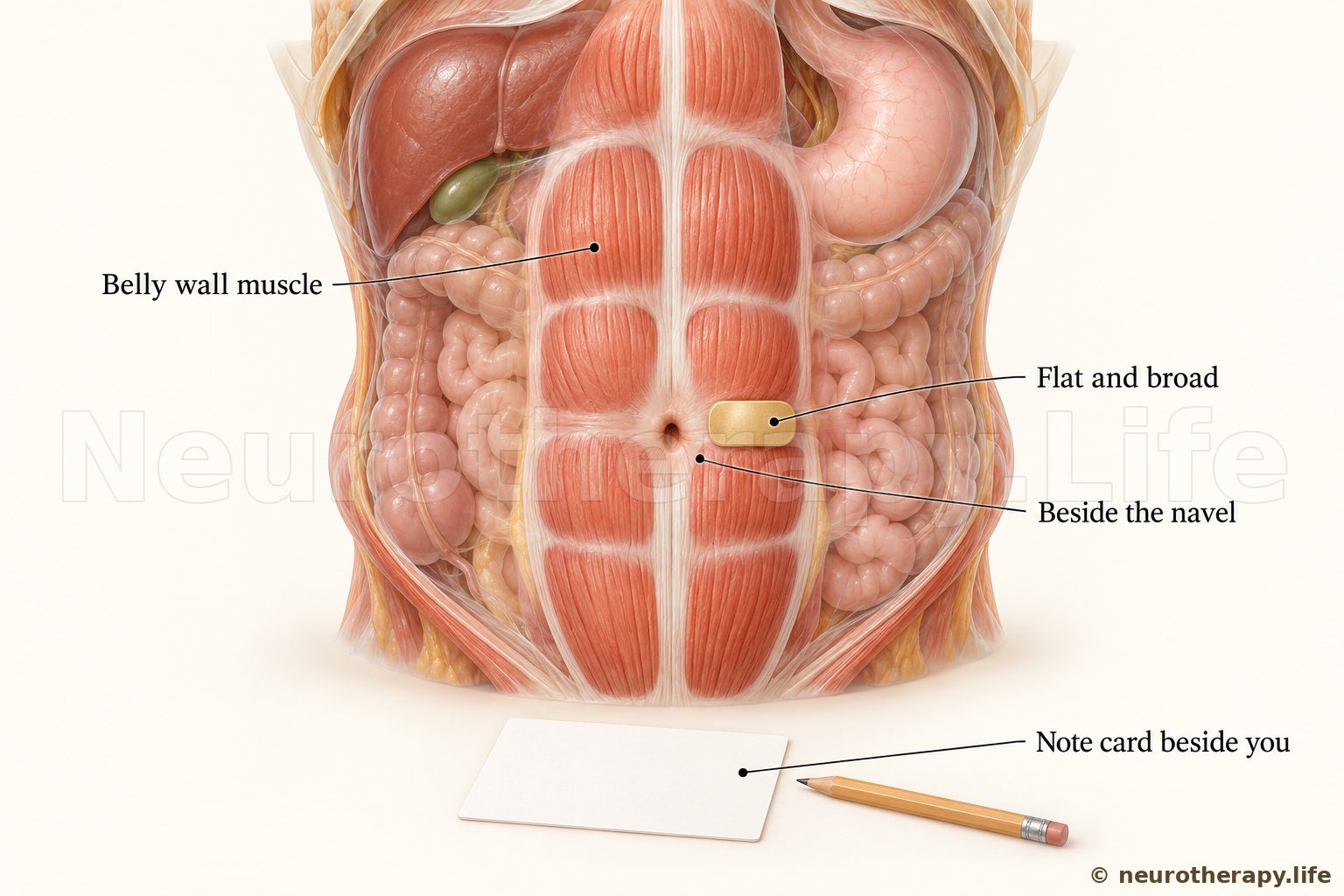
Before any treatment, a Neurotherapy (LMNT) therapist examines the points around your navel. This is done with the soft pads of two or three fingers held side by side — never a thumb, never a knuckle, never one finger boring in. Nails are short and hands are warm, because a cold hand makes the belly tighten, and that tightness can be mistaken for a finding.
The therapist kneels at your side, level with your hip, and rests the other hand quietly on you so that nothing comes as a surprise. The pressure comes from leaning a little body weight through a soft arm, not from squeezing the fingers. A finger that is working hard cannot feel; a finger that is only carrying weight stays sensitive.
Each press follows the same calm pattern. The therapist tells you first, rests the fingers flat, and waits for you to breathe out, when the belly wall softens. The fingers then sink in slowly, straight into the body, and stop where something stops them — that is the finding. The press is brief, then released as slowly as it came. Meanwhile the therapist watches your face, which often reports discomfort before you say a word.
An examining press is short on purpose. Held on and on, it stops telling the therapist anything and starts creating soreness of its own. Holding a point belongs to treatment, not examination. The finer details of the examining hand are taught hands-on in the course.
Key points
- The belly is examined with the flat pads of two or three fingers, never a thumb or knuckle.
- Warm hands and a warning first keep the belly from tightening.
- The finger sinks slowly on an out-breath and stops where it is stopped.
- The therapist watches your face, not the hand.
- An examining press is brief; holding a point belongs to treatment.
Go deeper
The Educated Hand: How the Pain Points Are Felt
Guide: The Educated Hand
Navel
The navel, where the examination is centred
Feather Touch
Feather Touch — the lightest contact
Frail and elderly patients (gentle care)
Gentle care for frail and elderly patients
Before You Touch Anyone: Room, Conduct and Consent
Guide: Before You Touch Anyone
Read the full guide
This topic is part of: The Educated Hand: How the Pain Points Are Felt
Safety: when it is held back
- Small children, very weak people and anyone with osteoporosis (thin, fragile bones) are examined and treated with the hand only, with the softest press. Stay off the rib margins and the hip-bone rim. Osteoporosis
- In long-standing diabetes, feeling can be dulled, so the patient may not warn you. Reduce the pressure, not the attention. Diabetes
- A belly that stays hard as a board whatever you do, especially with severe tenderness, vomiting or swelling, is a reason to stop and call a doctor the same hour. How to tell a patient to see a doctor
Watch

An overview of LMNT's diagnostic pain points — the places around the navel that the therapist presses to read the body before choosing a treatment.
This page explains what a Neurotherapy (LMNT) treatment is for; it is not a self-treatment guide and does not diagnose. Neurotherapy (LMNT) works alongside your medical care — keep taking the medicines your doctor prescribed.