Before You Touch Anyone: Room, Conduct and Consent
Before a single point is pressed, a Neurotherapy (LMNT) session needs a prepared therapist, a safe floor, the right pillows and the clear, spoken agreement of the patient. This guide explains what is checked and why each rule protects the person on the mat.
Overview
Before a single point is pressed, a Neurotherapy (LMNT) session needs a prepared therapist, a safe floor, the right pillows and the clear, spoken agreement of the patient. This guide explains what is checked and why each rule protects the person on the mat.
The first patient he was not allowed to touch
This is a teaching case, put together from the first mornings of many students. A young student arrived at a centre and was told: sit and watch, you will touch nobody today. His half-pants were swapped for full pyjamas, his long nails were cut, and his phone went onto a shelf. Then a widow came in, and the senior therapist sat on the floor at her level and told her, in her own language, exactly what he would do — and that she could stop him at any moment.
She said yes. Afterwards, at the door, she said: "Nobody has asked me anything for eleven years. They only tell me." The points of this therapy can be learned in a year. The things on this page decide whether anyone will let you use them.
The therapist arrives before the treatment does
A patient reads you before you say a word. The therapist's clothes should cover the whole body and be neither tight nor very loose — pyjama-kurta, salwar-kameez, or full pants with a full shirt. There is a practical reason: tight clothes at the hip or knee make it hard to keep your balance between the two chairs. There is also a cultural reason, and in a therapy where a stranger trusts you near her abdomen, what feels proper to her is part of the care.
- Nails of hands and feet short and smooth — nails should never touch the patient.
- Feet washed and dry; no cracked or open skin goes onto a patient.
- Hands washed before and after every patient.
- Nothing hard or scented on the body — no ring, watch, bangle or chain; hair tied back.
The floor, the two chairs and the pillows
Before the patient lies down, the carpet and sheet must be flat, neither too soft nor too hard, with nothing small underneath. Guruji's picture is hard to forget: a bone on a flat surface can bear a hundred kilos, but with a pencil under it, even a small tin falling on it can break it. Pressure is force shared over an area, so a hairclip under the back turns gentle pressure into a sharp point. The therapist runs an open palm over the whole sheet, every time.
When the sole of the foot is used, two ordinary chairs are turned over on either side of the patient. The therapist holds them and carries most of the body weight on the arms, so only as much weight reaches the patient as is needed — and it can be taken back in an instant.
A pillow here is not comfort but positioning. It goes under the part that needs it — never under the head and never under the back or waist. A pillow under the knees lets the low back settle flat; a pillow under the waist holds the back arched for the whole session and can leave back pain. Even if the patient is in a hurry, the pillows are placed properly, and the therapist lifts the knees for the patient rather than asking them to lift their own leg.
The fixed check before every treatment
The same check is run in the same order every time, so that on a busy day nothing is quietly dropped.
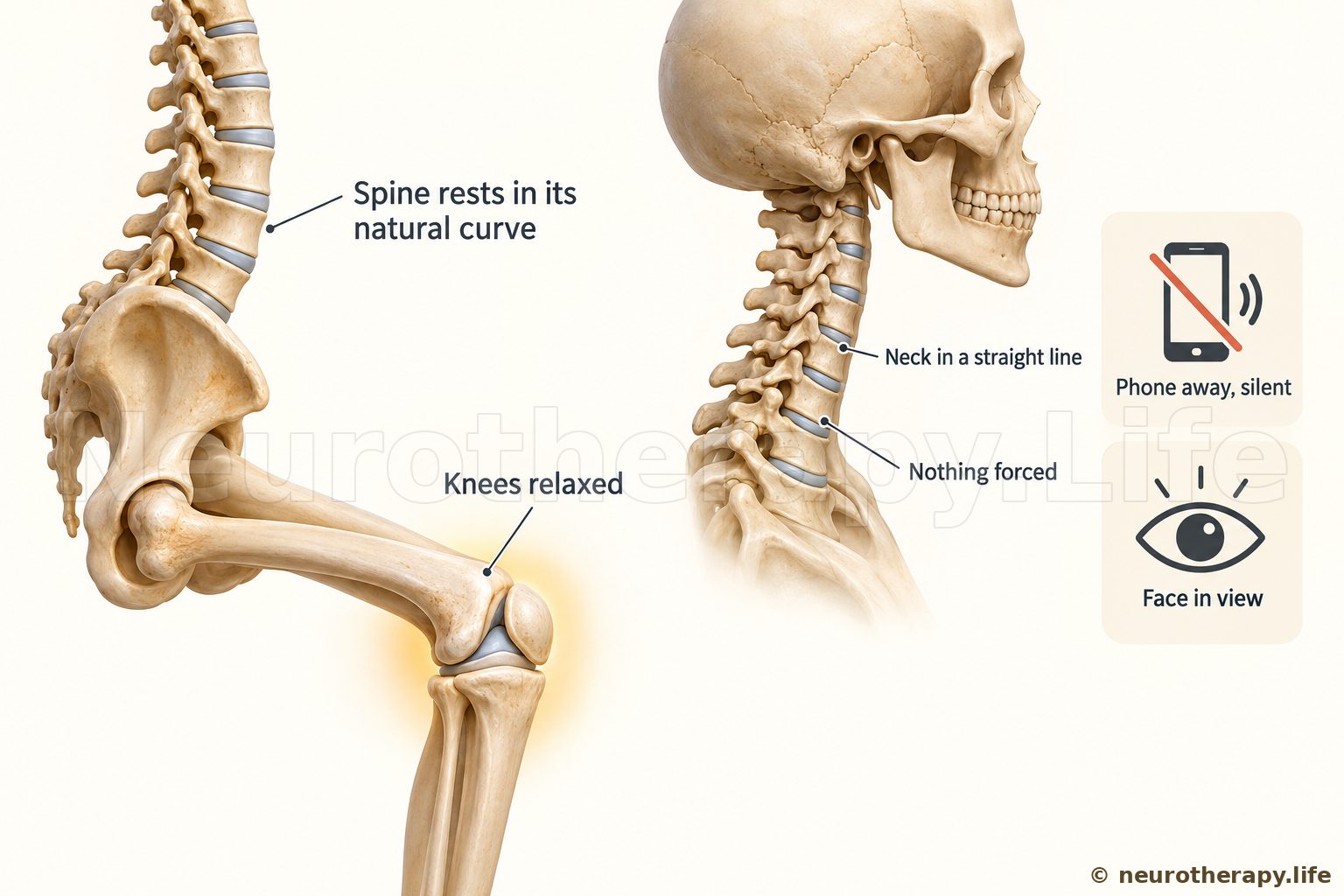
- The therapist's phone is kept away on silent and not touched until the patient's treatment is fully finished.
- The patient empties their pockets, and their name and address are matched with the card, so no mix-up happens.
- The patient passes urine first where possible.
- What was eaten, and when, is asked: at least an hour after breakfast, and two to two and a half hours after a heavy midday meal.
- Diabetes (sugar) and blood pressure are asked about directly, marked on the card and told to the chief therapist.
- Ordinarily women are not treated during their period, and this is told to them beforehand.
- Every patient is shown how to lie down and get up by rolling onto the side, never with a jerk — a sudden rise can stir the balance fluid of the inner ear and cause giddiness.
Consent, dignity and the chaperone
In this therapy a near-stranger stands over a patient and places a bare foot on her thigh or abdomen, over her clothes, while she lies with her eyes closed. No ordinary therapy asks for so much, so it must be asked for — every time, in words. Silence is not consent, and simply lying down when told is not consent either.
Real consent has five parts, and all five must happen. The patient is told what will be done and where on the body; she is told in words she herself uses; she is told it should feel like firm pressure, not pain; she is told she may stop it at any moment without a reason; and she says yes, out loud, before anything starts. Consent is renewed, not saved up: agreement for the abdomen on Monday is not agreement for the chest on Thursday.
A chaperone — a relative or companion — is offered, not merely allowed, and sits where they can see the patient's face. The body stays covered. Before beginning, the therapist bows and touches the patient's feet with both hands (naman). In Indian life a foot is the lowest part of the body, so this bow turns the order around before the foot is ever placed, and prepares the patient's mind to receive the treatment.
During the treatment: listen, and stay quiet
If the patient screws up her face or says it hurts, the therapist changes the angle or reduces the weight — without arguing. Only she knows her pain. A therapist who says "nobody has ever complained" can lose the patient and harm the therapy. Pain kept silent may stay after the session or leave weakness.
The therapist does not chat during the treatment. But in the gap after each formula, the patient is always asked how she feels. If any point or formula makes the trouble worse, the chief therapist is asked at once, and it is written clearly on the card so that the point is not repeated, or is repeated only with care.
The blessing is the fee
This therapy was practised free for decades before a nominal fee was ever charged, and free work still goes on alongside it. A modest fee, stated before the first session and the same for everyone who can pay, keeps a centre alive. Four things are never charged for: hope sold in advance, a plan stretched to fit the fee, a person who cannot pay, and the teaching kept secret to earn from it. Above all: do not take wrong advantage of a patient's illness.
Key points
- Preparation starts with the therapist: covering clothes, short nails, clean feet, nothing hard on the body.
- The sheet is checked by hand every time — a small object under a bone can turn gentle pressure into injury.
- The two chairs carry the therapist's weight, so only the needed pressure reaches the patient.
- Pillows go where the treatment needs them — never under the head, the back or the waist.
- Consent has five parts, is spoken aloud, and is renewed for every new area of the body.
- A chaperone is offered, the body stays covered, and pain is always believed.
- A fair, stated fee is proper; taking advantage of a patient's illness never is.
Topics in this guide
Go deeper
The Hand That Heals: What Neurotherapy (LMNT) Is
What Neurotherapy (LMNT) is, in plain words
The Timed Press: Why Time, Angle and Order Are Fixed
Why place, time and angle are fixed in every press
The Navel Speaks First: The Map of the Pain Points
Why the examination begins at the navel
Placing the Patient: The Four Positions of Neurotherapy (LMNT)
The positions a patient is treated in
When the Hand Must Stop: Blocked Points and Safety in Neurotherapy (LMNT)
When the hand must stop
Treating Women: Periods, Pregnancy and Care
Treating women: periods and pregnancy
The Child, the Elder and the Frail: Neurotherapy (LMNT) for Delicate Bodies
Gentle care for children, elders and the frail
Why the therapist stands between two chairs
How the two chairs carry the therapist's weight
How to lie down and get up by turning onto your side
Lying down and getting up by rolling to the side
Safety: when it is held back
- Never put a pillow under the head or under the back or waist unless it is specifically needed; a pillow at the waist can cause back pain during or after treatment. Where pillows go during treatment, and where they never go
- If pressure hurts, the angle is changed or the weight reduced at once — never argued about.
- Ask about diabetes and blood pressure before every new patient's first treatment and inform the chief therapist. Diabetes
- Ordinarily women are not treated during their period; tell them beforehand. Treating Women: Periods, Pregnancy and Care
- If trouble increases after any point or formula, ask the chief therapist at once and write it on the card. The Record That Shows the Truth: The Patient Card in Neurotherapy (LMNT)
- Small children, the very weak and people with thin bones are treated with the hand only, lightly. The Child, the Elder and the Frail: Neurotherapy (LMNT) for Delicate Bodies
- Neurotherapy (LMNT) never replaces your doctor; do not stop any medicine because you are taking it. How to tell a patient to see a doctor
Guruji says
“The patient is a form of God. If your spectacles are the right ones, then a therapist — whether a woman or a man — can treat any patient.”
“Their blessing is our real "fee", and it cannot be priced.”
Common questions
You are going to put your foot on my stomach?
The therapist stands between two chairs with the weight on the arms, so only a small part comes down through the foot, and it can be taken back instantly. The sole is broad and soft in the middle, so the pressure spreads out. It is over your clothes, you stay covered, and the therapist bows to your feet before beginning.
Can my daughter sit with me?
Yes, please. Most people prefer it, and it is quite usual. If you had not asked, the therapist would have offered.
What if it hurts? I don't want to make a fuss.
Say so at once — it is the one thing the therapist needs from you. It should feel like firm pressure, not pain. The angle is changed and the treatment loses nothing. You may also ask to stop at any moment, without a reason.
Why doesn't the therapist talk to me during treatment?
The therapist is concentrating on the treatment. In the gap after each part, you will be asked how you feel — that is the time to say everything, including anything you did not like.
Is this a religious treatment? I am not a Hindu.
No. Prayers open and close the classes at the school, the way any school has an assembly. The treatment itself is pressure at particular places. Nobody is asked to believe or say anything.
Watch

A practical demo by Dr. Diwakar Shukla on how to give 1, 2 and 8 Pan — the pancreas point — to support a weak pancreas.

Shows how to find the Pan (pancreas) point in the fold at the top of both thighs, and how to give 1 Pan, 2 Pan, 2 Pan × 6 and 8 Pan with the feet, holding chairs for support. It is used to support the pancreas in diabetes and indigestion.
Test yourself
Explore more
Organs
Body systems
Diseases
Points
Formulas
Topics
Read more
This page explains what a Neurotherapy (LMNT) treatment is for; it is not a self-treatment guide and does not diagnose. Neurotherapy (LMNT) works alongside your medical care — keep taking the medicines your doctor prescribed.