The Timed Press: Why Time, Angle and Order Are Fixed
The smallest unit of Neurotherapy (LMNT) is a single press: laid on, held for a fixed time, and released. Every formula is built from these presses, given at set places, at a set angle, in a set order, with rests between. Change any of these and it is no longer the same treatment.
Overview
The smallest unit of Neurotherapy (LMNT) is a single press: laid on, held for a fixed time, and released. Every formula is built from these presses, given at set places, at a set angle, in a set order, with rests between. Change any of these and it is no longer the same treatment.
The therapist whose results faded
A teaching case. A young, newly trained therapist did everything properly: he examined carefully, kept his cards and never pressed hard. For months his patients improved. Then, as his afternoon list grew busier, the results quietly thinned out. Nobody got worse; they just stopped saying they felt lighter.
A senior therapist stood beside him with a watch and found the reason in minutes. Under the pressure of a long queue, his holds had shortened without his noticing. Nobody counting silently in their own head ever notices. He checked himself against a watch every day for a month, and the results came back. Nothing else had changed — not the points, not the order, not the plan. Only the time of each press.
One press: contact, hold, release
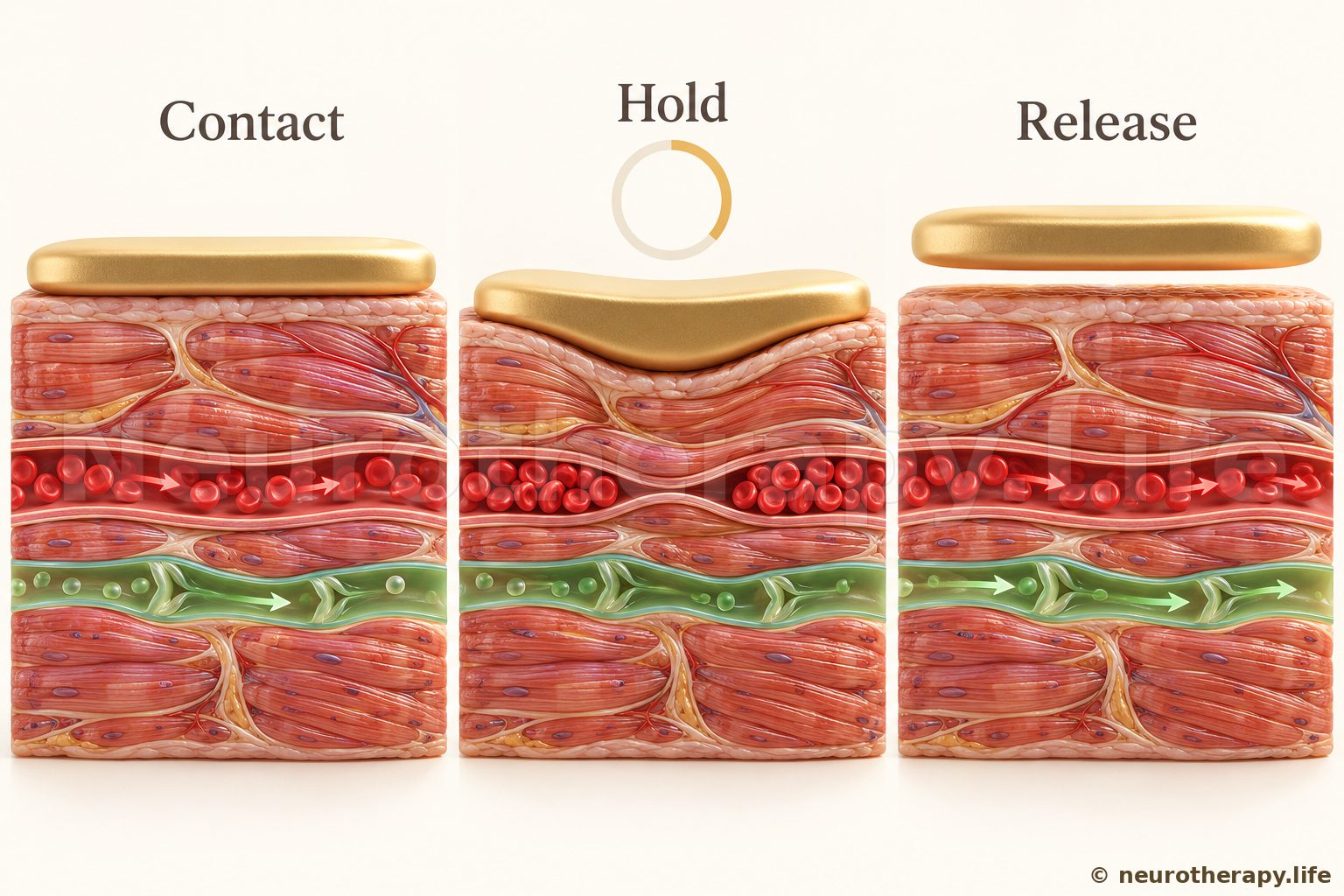
Every treatment is built from one small, complete act with three parts. Contact: the soft middle of the sole, or the flat of the palm, is laid broad and flat on the chosen place, without pressure. Hold: the weight is let down and held for a fixed time, at the right angle, so the muscle is drawn inward. Release: the weight is taken back gently, not snatched, and the tissue refills. A press that is not released is not complete; the letting-go is half of the act.
Notice what is missing: any instruction about how hard. Weight is not what decides the result. If the place, time, angle and order are right, a small therapist gets the same result as a large one, and a woman of sixty the same as a young man. The exact timing and method are taught hands-on in the course, with a watch, until they are fixed for life.
Why the time is fixed, and why longer is not better
Guruji fixed the length of the press about fifty years before anyone could explain it, from his own watching of bodies. He compared this to the Indian mathematician Srinivasa Ramanujan, who wrote down exact results that others spent a century proving. Many facts of Neurotherapy (LMNT), he said, have been proved by experience and will be explained by the coming generations. Because the rule was written as an exact number, it could be tested.
The therapy's own explanation is about rhythm. When pressure makes a muscle contract, the opposite muscle contracts when the pressure is released; the two are called agonist and antagonist, and their rhythm must be kept. Pressure also squeezes the small blood vessels underneath, so blood gathers on both sides. Held too long, that trapped blood uses up its oxygen; on release the muscle then burns fuel without enough air, and acid (lactic acid) builds up. So the fixed time is a ceiling, not a minimum. More benefit comes from repeating correctly, never from holding on longer.
Place, time and angle
Three things are decided inside every single press, and each one fails in its own way.
Wrong angle is the only one that hurts. The weight must fall over a broad surface and draw the muscles inward, along their natural direction. Pressure across that direction, or on an edge, causes real pain. If the patient's face tightens or they say it hurts, the therapist changes the angle or reduces the weight at once, without arguing — only the patient knows the pain.
- Place: not just 'the thigh' but a specific station on it. Move a little and you are treating something else — and nothing warns you, the treatment simply does not work.
- Time: too short and the press is under-given; too long and it works against the release it relies on.
- Angle: the direction the pressure travels into the body — always broad, always drawing the muscle inward.
The count and the order belong to the treatment
Guruji divided treatment points into two kinds. Chemical points rouse the working of glands, and many of them give different effects when given a different number of times — from which he understood that they make different chemicals. So variants such as (2) Pan and (4) Pan, or (6) Gas 'I' and (9) Gas 'I', are named as separate treatments: same place, different result. Physical points relax muscles and allow a little more freedom for comfort. A therapist must know which is which before taking any liberty.
Order matters just as much. Organs cannot be roused in any order we like. The general rule for the bowel is called 'right follows left': the organs on the right side of the navel are roused before those on the left. This works with the direction in which the bowel moves its contents, helping the wave already travelling. A reversed order slows the bowel; it is used only when that is wanted, as in loose motions, and afterwards the body is brought back with the Normal formula. That is why a formula is defined as organs roused one after another in a particular sequence. The sequence is not packaging — the sequence is the formula.
Rests, sessions and the length of a course
Many formulas carry stated rests, and on a busy day it is tempting to close them up. Guruji gave the reason they matter. Where circulation is poor, carbon dioxide from the cells builds up in the tissue as carbonic acid, which the therapy links to joint pain. When circulation improves, it turns back into carbon dioxide and water, travels to the lungs and is breathed out — and that takes a number of breaths. A rest is the share of the treatment the patient's own body performs. It also stops a change from arriving faster than the body can bear.
For common ailments a day's treatment takes about half an hour, with gaps. A course depends on the person's build, the disease, how many organs it has touched, how long it has been there and how well the diet rules are kept. Ordinary ailments usually need about a week to ten days; long-standing ones take many months, often tapering from daily visits to fewer as the body improves. A disease that came over many years needs at least some months to settle.
After the treatment, and what improvement looks like
The last minutes matter. Every pain point is re-checked and written on the card with plus and minus signs, before and after, so both patient and therapist can see what changed. This record shows months later whether a treatment truly helped, and decides whether to repeat it or change it. The patient then rolls onto the side and gets up slowly; rising with a jerk can bring on giddiness.
Patients notice small changes long before the disease goes: hunger improves, sleep improves, energy rises, weakness reduces and the body feels light. Over longer spans, measured values such as blood pressure, sugar, cholesterol and uric acid have been reported to settle. Judge the first weeks by appetite, sleep and energy, not against a cure.
Key points
- Every treatment is built from one press: contact, a fixed hold, and a gentle release.
- Weight is not the variable — place, time, angle and order are.
- The fixed time is a ceiling: holding longer works against the body, not for it.
- At chemical points, a different number makes a different, separately named treatment.
- The order is the formula; reversing it is a tool used only for a stated reason.
- Rests belong to the treatment — the body completes the change during them.
- Nobody can feel their own timing; competent therapists check against a watch.
Topics in this guide
Go deeper
Place, time, angle and order: the four things fixed in every treatment
Place, time and angle, on one page
Right side first, then left: why belly treatment follows the bowel's own wave
Why the order follows the bowel
Why the rests between points are part of the treatment
The rests, and why they are kept
The plus-and-minus scale: how pain and stiffness at a point are graded and written down
The plus-and-minus scale on the card
How a Formula Is Built: Points, Order and Rests
How a formula is built from presses
The Shorthand: How Neurotherapy (LMNT) Treatments Are Written and Read
How formulas are written down
The Record That Shows the Truth: The Patient Card in Neurotherapy (LMNT)
The record that shows the truth
Weeks, Not Sessions: How a Neurotherapy (LMNT) Course Is Planned
Weeks, not sessions — how long a course takes
Pan
Pan — a chemical point with named variants
Safety: when it is held back
- If the patient's face tightens or they say it hurts, change the angle or reduce the weight at once, without arguing.
- Never press harder or hold longer to 'make it work better' — more is done by repeating correctly.
- Rests between parts of a treatment are not optional; too much change at once can be more than the body can bear.
- A reversed order is used only for its stated purpose, such as loose motions, and the body is then brought back with the Normal formula. Normal Treatment Formula
- After treatment, the patient rolls onto the side and rises slowly to avoid giddiness. How to lie down and get up by turning onto your side
Guruji says
“Whether or not the patient gets immediate benefit from our treatment, let no harm reach him through our carelessness — attend to this.”
Common questions
Why exactly this length of press? It sounds made up.
Guruji fixed it from watching bodies long before it could be explained. The therapy's explanation is that it is long enough for the good effect and stops before the trapped blood runs out of oxygen and acid starts to build on release.
Can you press longer today? My pain is worse.
More of the treatment can be given if the examination calls for it. But each press cannot be held longer, because past the fixed time it starts to work against you.
You spend more time waiting than pressing. Why?
The gaps belong to the treatment. After each step, your body has to carry something away in the breath, and that takes time. Running everything together would give you less benefit, not more.
What are the plus and minus signs on my card?
They record what was found at each pain point before and after today's treatment — more plus signs for more pain, a minus for none. It is how you and the therapist will know in a few weeks whether a treatment is doing its job.
Test yourself
Explore more
Organs
Body systems
Diseases
Points
Formulas
Topics
Read more
This page explains what a Neurotherapy (LMNT) treatment is for; it is not a self-treatment guide and does not diagnose. Neurotherapy (LMNT) works alongside your medical care — keep taking the medicines your doctor prescribed.