How to lie down and get up by turning onto your side
Never go down flat from sitting, and never come up flat from lying. Go down by way of the side and come up by way of the side, always, not only during treatment.
Overview
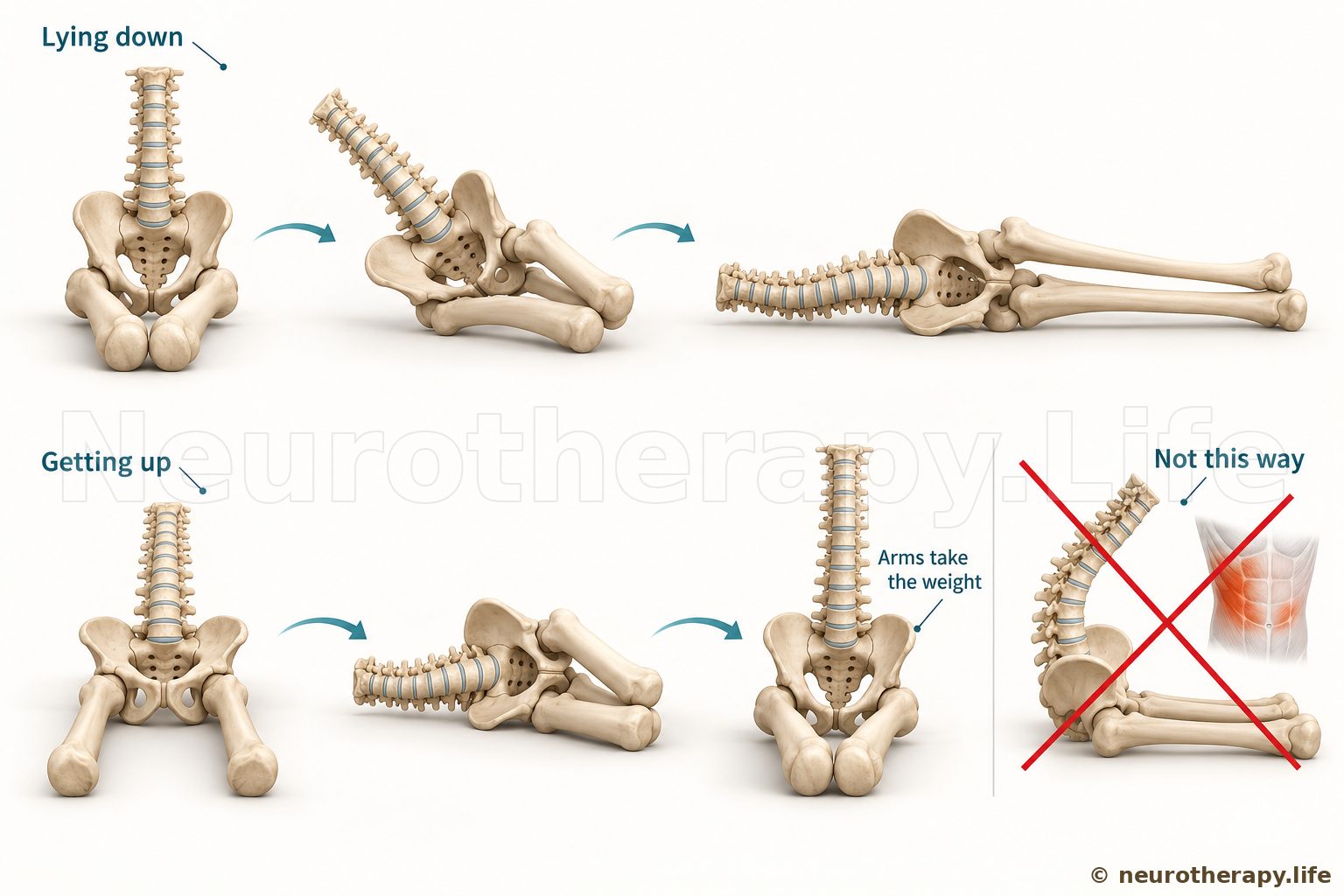
Going down: sit on the bed, bring the feet together and bend the knees. Taking the support of your hands, lie down on either side, whichever feels natural. Then straighten the legs. Getting up: do not rise straight. First turn onto your side, then bend the straight legs, then push up with your hands.
This is a rule for the whole of life, not only for the treatment hour, so that no strain falls on the muscles of the belly and the back. The teaching holds that rising straight puts a wrong strain on the navel and raises the heart's demand for blood, and may in time become one cause of indigestion, asthma, diabetes, cervical spondylosis or heart trouble.
Picture it plainly. Sitting straight up from lying makes the muscles between ribs and hips haul the whole upper body in one pull, right across the navel. Roll first and the arms do the work instead. It takes only a moment. A movement is learnt by moving, so the therapist shows it on the mat and has the patient try it before leaving.
Key points
- Lie down by way of the side.
- Get up by way of the side, with the hands taking the weight.
- It applies to every bed, sofa and mat, every day.
- The aim is to spare the belly, the navel and the back.
Go deeper
Navel
The navel and why it matters
Low back pain
Low back pain
Cervical spondylosis
Cervical spondylosis
During a session: say when it hurts, and never help with the pillow
What to do during a session
Oil before the bath, plain water after: the daily bathing rule
The daily bathing rule
The four treatment positions: on the back, seated, on the side and face down
The positions used in treatment
Insomnia (sleeplessness)
Sleeplessness
Read the full guide
This topic is part of: Between Two Sessions: Daily Rules for Patients
Safety: when it is held back
- After recent surgery on the belly or spine, follow your surgeon's advice on how to get out of bed.
- Neurotherapy (LMNT) works alongside your medical care. Do not stop or change any medicine on your own; ask the doctor who prescribed it.
This page explains what a Neurotherapy (LMNT) treatment is for; it is not a self-treatment guide and does not diagnose. Neurotherapy (LMNT) works alongside your medical care — keep taking the medicines your doctor prescribed.