The four treatment positions: on the back, seated, on the side and face down
Every Neurotherapy (LMNT) point is given in one of four body positions. The position is part of the treatment itself, not just a matter of comfort.
Overview
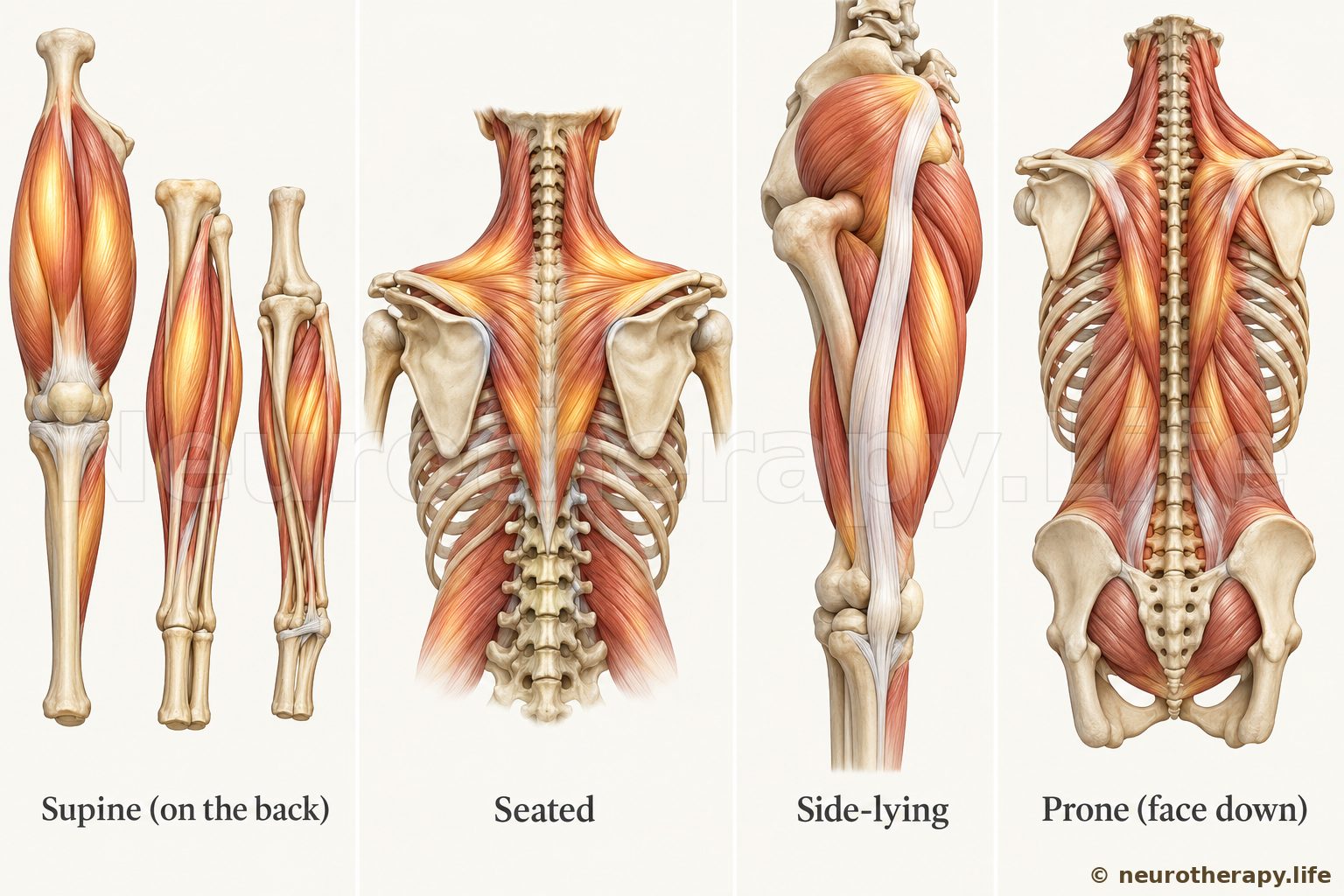
Neurotherapy (LMNT) uses four positions: lying on the back (supine), sitting on a chair (seated), lying on one named side (side-lying), and lying face down (prone). The whole list of points is arranged under these four headings and nothing else.
The position changes the angle at which pressure enters, how long and relaxed the muscle is, and what lies underneath. So a point given in a different position is not a gentler version of the same treatment. It is a different treatment.
A formula is usually not written with its position, because the point's own name tells it. Acid is given on the side, Adr face down, and Medulla seated. If you do not know a point's position, you do not yet know the point.
Turning a patient costs time, comfort and dignity, and a frail patient pays the most. So the therapist plans the session as a route: everything that one position allows is done before the patient is moved. The general principle of the pressure itself is simple: broad and inward, spread over a wide surface and along the natural direction of the muscle.
Key points
- Four positions: on the back, seated, on the side, face down.
- A different position makes a different treatment.
- The position is carried in the point's name, not written on the line.
- A session is planned so the patient is turned as few times as possible.
- Pressure is broad and inward, never sharp or pulling outward.
Go deeper
Placing the Patient: The Four Positions of Neurotherapy (LMNT)
The full guide to placing the patient
Why the therapist stands between two chairs
Why the therapist stands between two chairs
Where pillows go during treatment, and where they never go
Where pillows go, and where they never go
Covering a limb from joint to joint: the station rule
Covering a limb from joint to joint
On the Side: Treatments Given Lying on One Side
The points given on the side
Face Down: Treatments Given on the Back and Spine
The points given face down
Seated Treatments I: The Back of the Head and the Neck
The points given seated
Read the full guide
This topic is part of: Placing the Patient: The Four Positions of Neurotherapy (LMNT)
Safety: when it is held back
- Small children are treated with the soft part of the palm only, so lightly that it is not felt as pressure. Lighter formulas for children, the elderly and the weak
- The exact method is taught hands-on in the course, under a trained therapist. Please do not try it on yourself or others from this page.
- Neurotherapy (LMNT) works alongside your medical care. Do not stop or change any medicine on your own; ask the doctor who prescribed it.
This page explains what a Neurotherapy (LMNT) treatment is for; it is not a self-treatment guide and does not diagnose. Neurotherapy (LMNT) works alongside your medical care — keep taking the medicines your doctor prescribed.