Seated Treatments I: The Back of the Head and the Neck
With the patient seated on a chair, Neurotherapy (LMNT) works the back of the head and the neck: Medulla and its sister points, the shoulder lift called Raman, a breathing treatment, and a few gentle points around the jaw and collarbone. Everything here is a glide, a press, a lift or a circle — never a jerk or a twist.
Overview
With the patient seated on a chair, Neurotherapy (LMNT) works the back of the head and the neck: Medulla and its sister points, the shoulder lift called Raman, a breathing treatment, and a few gentle points around the jaw and collarbone. Everything here is a glide, a press, a lift or a circle — never a jerk or a twist.
Sitting right comes first
These treatments are given with the patient seated on a firm chair with a flat seat — not an armchair and not a stool. The patient sits well back, feet flat on the floor, back supported, hands loose in the lap. The therapy carries its own exception: if the patient is very ill or very weak, the same treatments may be given lying down. A weak person sitting upright may go pale and faint, and a faint from a chair is a fall.
The therapist has three stations: at the patient's left side for the neck work, behind for the shoulder lift and the base of the skull, and in front for the collarbone and jaw. Nails are short, because here the thumbs are the instruments and the skin is thin. A teaching case shows how exact this group is: a student misread how the card is counted in these points and gave only part of each treatment for a whole week, then decided the point did not work. Once the card was read properly, the patient's afternoon headaches settled over the following weeks.
Glide, never thrust
One rule outranks all others in this group. Every contact is a rub, a press, a lift or a circle. Nothing is a jerk, a snap, a twist or a pull: no turning of the head, no traction, no leverage, no sudden movement. The reason is real anatomy. Deep at the top of the neck, an artery on each side turns a sharp corner across the topmost neck bone on its way to the back of the brain. A steady, light, moving glide does not trouble it; a sudden force can.
The front of the neck is never pressed, by hand or by foot, whatever a card says. And some findings end the session rather than change it: new neck pain or a headache unlike any before, together with disturbed vision, dizziness, unsteady walking, slurred speech or numbness of the face or a limb. Nothing is given at the head or neck, and the patient is seen by a doctor the same day.
Three lanes of the nape: Medulla, Mesencephalon, Dorsal
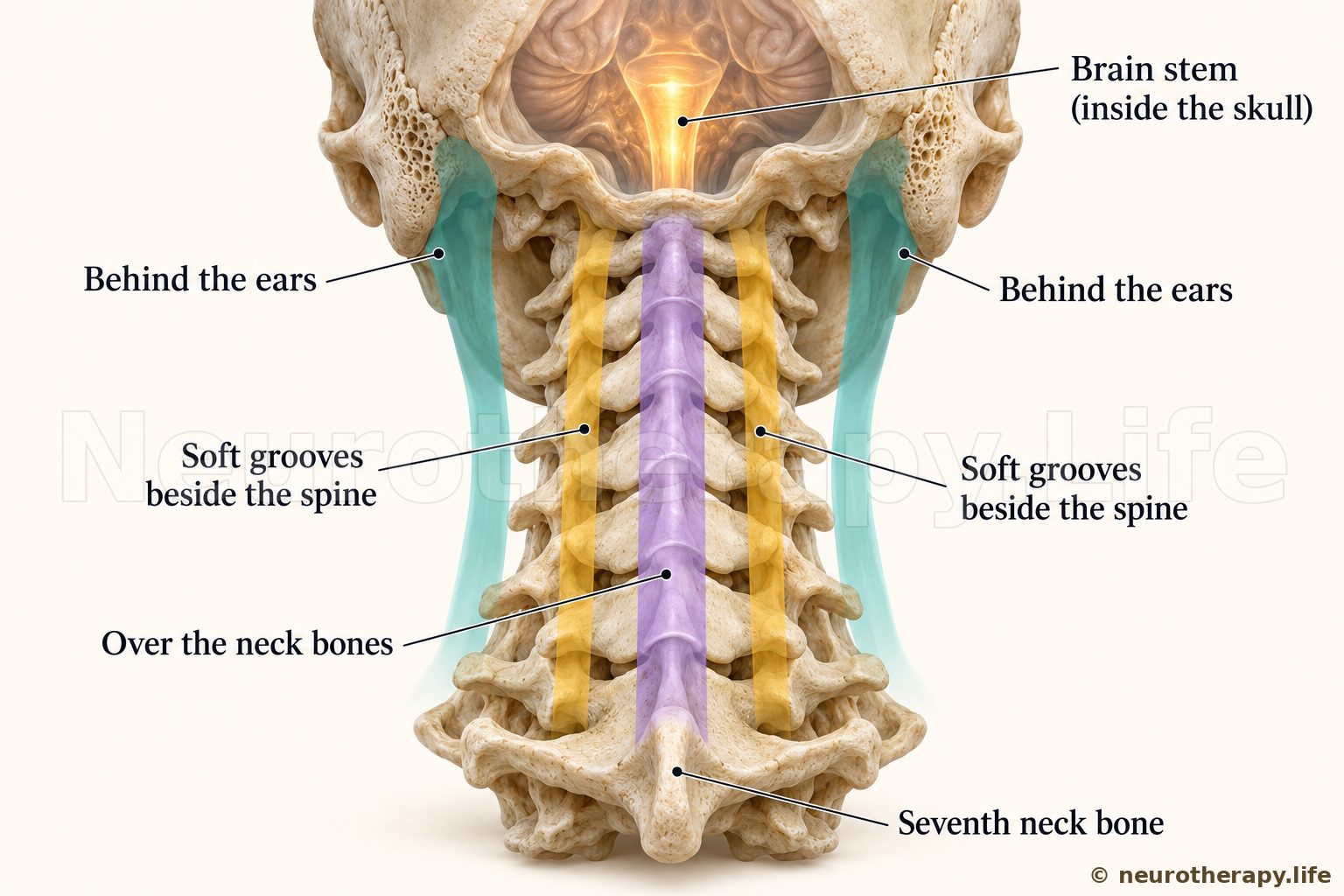
These three are the same gentle downward thumb-glide given in three places. Medulla starts behind the ears, just under the edge of the skull bone, and runs down the sides of the neck to the shoulders. Mesencephalon is given in the soft grooves either side of the spine at the back of the neck. Dorsal runs over the beads of the neck spine themselves, where there is almost no padding, so it stays light. When Left Medulla or Right Medulla is written, only that side is given; and the therapy is firm that different counts of Medulla show different effects, so the card must be read exactly. The exact method is taught hands-on in the course.
What do the names mean? The medulla (the lowest part of the brain, where it becomes the spinal cord) and the mesencephalon (the midbrain, the top part of the brain stem) both sit inside the skull; no thumb reaches them. The names record an intention. What the thumbs do reach is useful: the nerves of the scalp, small muscles packed with position sensors, and a level of the upper spinal cord where nerves from the face and from the neck arrive on the same nerve cells. That shared meeting point is why neck tension can be felt as a headache, and why work at the nape can be felt in the head.
Raman and Mukha Dhauti: a lift and a breath
Raman is given from behind: both hands over the tops of the shoulders lift the big fan of muscle that runs from the skull to the shoulder, hold it, and release it slowly; the patient then takes a few easy breaths. It looks like a muscle treatment, but the therapy says it reduces acid, so alkali rises a great deal. That is why Raman is given only after checking two diagnosis points near the navel, Liv° and Mu°. More pain at Mu° and little or none at Liv°: it may be given. Pain at Liv° and none at Mu°: given without checking, the pain can increase very much. The finding also decides the side: Left Raman, Right Raman, or both.
A teaching case: a woman with a burning stiffness across both shoulders had once been given Raman at a camp without the check, and her pain increased badly. When examined properly, Liv° was painful and Mu° silent, so Raman was held back and the work went to digestion and water first. Weeks later, when the picture had turned and Mu° was the painful one, Raman was given and helped.
Mukha Dhauti asks nothing of the therapist's hands. The patient takes a long breath in through the nose and lets it out through the mouth, which the therapy says gives immediate relief in the body's pains. The navel finding chooses the form: with pain at Mu°, the mouth is wide open with a soft 'haa'; with pain at Liv°, the mouth is nearly closed with a slow whistling 'hoo'. It is gentle, never forced, and it can be taken home.
Endorphin, Subclavian, Neck Clockwise, Ptyalin and Necklace
Endorphin starts where Medulla starts, below the ear, but runs down the back of the neck to the prominent bead at its base, as gentle presses rather than a glide. It is used to lessen the feeling of pain in the body. Subclavian is a closed circuit of thumb pressures along the collarbone, out to the shoulder, into the hollow below and back along the side of the neck; it presses onto bone, never deep into the hollow. Neck Clockwise is a soft circling of gathered fingers on the side muscles of the neck, from ear to shoulder, left side first.
Ptyalin is given with light palms on the cheeks and below the jaw, over the salivary glands, to increase the flow of saliva. Necklace is a string of small presses along the edge of the skull bone at the back of the head, from ear to ear, with the forehead lightly steadied. It is given to relax the muscles just below the skull so that messages between brain and body move freely, and the therapy says the pains of the whole body become much less. Thoracic T1/T2, the two beads just below the base of the neck, is rarely given alone; it belongs to the clockwise Medulla formula.
- A point that dulls pain can also hide a warning, so a new, sudden or unusual headache is assessed before it is softened.
- Stay behind the big strap muscle at the side of the neck; its front edge is a fence.
- Dizziness, greying vision or nausea during neck work means stop — not lighter pressure.
Key points
- The seated group is given on a firm, flat chair; a very ill or very weak patient may be treated lying down instead.
- Glide, never thrust: no twisting, pulling, levering or sudden movement of the head or neck.
- Medulla, Mesencephalon and Dorsal are one gentle glide in three lanes of the nape.
- Raman is a chemical decision as much as a muscular one: Liv° and Mu° are always checked first.
- Mukha Dhauti is a breathing treatment in two forms, chosen by the navel finding, that patients can use at home.
- The front of the neck is never pressed, and warning signs of a stroke or artery tear stop all neck work.
Topics in this guide
Go deeper
Medulla
Medulla — the first of the seated points
Raman
Raman, and the check that comes before it
Mukha Dhauti
Mukha Dhauti — the breath in two forms
Necklace
Necklace at the base of the skull
(4) Medulla clockwise with T1/T2
The clockwise Medulla formula with T1/T2
The Medulla Family: One Place, Many Treatments
The whole Medulla family of treatments
Seated Treatments II: The Face, Jaw, Ear and Sinuses
Seated II — the face, jaw, ear and sinuses
Cranial Nerve and Brain Formulas
Formulas for the cranial nerves and brain
Headache and migraine
Headache and migraine
Cervical spondylosis
Cervical spondylosis and neck pain
Safety: when it is held back
- Glide, never thrust: no rotation of the head, no traction, no leverage, no sudden movement, nothing held at the end of a range. When the Hand Must Stop: Blocked Points and Safety in Neurotherapy (LMNT)
- New neck pain or an unusual headache with disturbed vision, dizziness, unsteadiness, slurred speech or numbness: stop, give nothing at the head or neck, and send the patient to a doctor the same day. Paralysis and stroke
- No pressure on the front or the sides of the neck at any time, by hand or by foot, whatever a card says. The Front of the Body II: Glands, Toes, Lymph, Chest and Arms
- Thin bones, long steroid use, a fracture from a small injury, or cancer that may have reached bone: light contact only. Blood thinners or a bleeding disorder: light only. Clumsy walking, clumsy hands and new bladder urgency together: no sustained neck pressure until assessed. Cervical spondylosis
- Raman is given only after checking Liv° and Mu°; with pain at Liv° and none at Mu° it is withheld. Raman
- In cancer, (30) Medulla is never given. In heart disorders, (10) Medulla is never given on both sides — only (10) Left Medulla. Cancer care: Neurotherapy (LMNT) support
- A lump in a salivary gland, above the collarbone or at the side of the neck is referred, not rubbed; a hot, swollen, painful gland with fever is seen the same day. Stop Subclavian at once for pain, numbness or weakness running into the arm. Saliva problems (dry mouth and drooling)
Guruji says
“Different counts show different effects, so take care that there is no mistake in the count.”
“Further experience will make it understood.”
Common questions
You are pressing the back of my neck. Is that safe? I have heard of strokes from neck treatment.
It is a sensible question. What you have heard about is twisting and jerking the neck, and there is none of that here: the thumbs slide and press, and never turn or pull your head. If anything changes while you are being treated — dizziness, a wobble, double vision — say so at once and the therapist stops.
My problem is my knee. Why are you working on my neck?
Because the top of the neck is one of the places from which the body's sense of pain is turned up or down, and quietening it there often reduces pain far away. The knee is not being ignored; it is treated too.
Last time someone lifted my shoulders like that, I could not turn in bed all night.
Thank you for saying so — it matters. That treatment suits some bodies and not others, and the therapist can tell which by checking two places on your abdomen first. If they point the wrong way, it simply will not be given.
Breathing exercises? Is that really treatment?
Yes. Breathing in slowly and letting the breath out long is one of the few things a person can do for themselves, in a minute, that changes how the body settles. The shape of the mouth on the out-breath depends on what was found at your navel. Use it when the pain comes, not only at the clinic.
Watch

This video shows the right way to give (4) Medulla, Raman and the T1–T2 point for neck and shoulder pain and numbness.
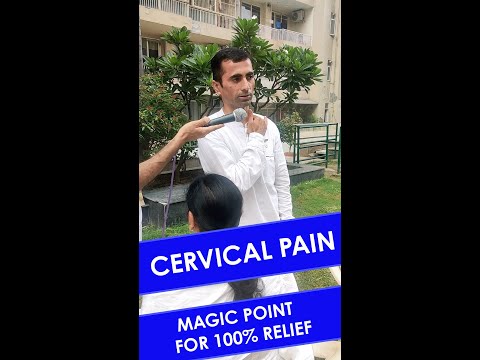
Shows a seated routine for neck pain: zig-zag fingertip massage from the base of the skull to the shoulder blades and down the arm, cross-rubbing, rounds of breathing out through the mouth, and a gentle grip massage at the back of the neck. It is shared for relief in cervical pain and tingling in the hands.
Test yourself
Research
- Emerging evidence
A laboratory study showed that stimulating the large nerve at the back of the scalp made nerve cells in the upper spinal cord respond more strongly to signals from the coverings of the brain. It supports the idea that the neck and the head share one meeting point for pain signals — which helps explain why the neck can refer pain to the head.
Explore more
Organs
Body systems
Diseases
Points
Formulas
Topics
Read more
This page explains what a Neurotherapy (LMNT) treatment is for; it is not a self-treatment guide and does not diagnose. Neurotherapy (LMNT) works alongside your medical care — keep taking the medicines your doctor prescribed.