Also called: Mukh Dhauti, Mouth cleansing, मुख धौति, मुख धौती
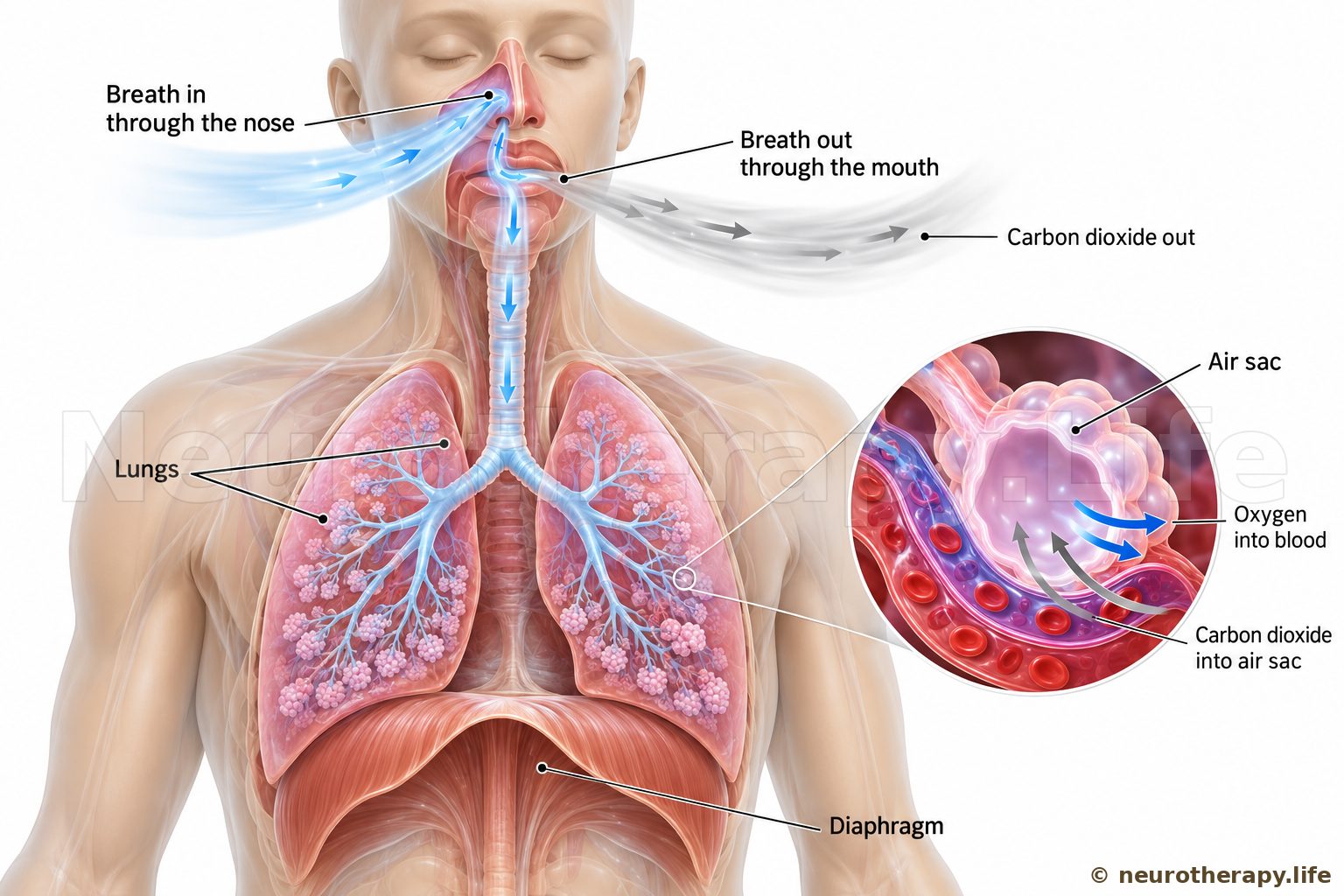
Mukha Dhauti is the one Neurotherapy (LMNT) treatment given without the therapist's hands: the patient, seated, is coached in a breath taken in through the nose and released out through the mouth. It is used for quick relief in the body's pains and, in a measured form, for joint pain on the acid side, as in rheumatoid arthritis.
Overview
What is Mukha Dhauti?
Mukha means mouth; dhauti is the name the classical yoga texts give to a family of cleansings — of the mouth, the throat, the stomach and the gut. Mukha Dhauti is a cleansing carried out at the mouth, with the breath.
It came into Neurotherapy (LMNT) through a patient no one could touch. Guruji met a woman whose fingers had become bent and crooked from long rheumatoid arthritis and who was in too much pain to allow any hand on her. Remembering a breathing practice from the ashram's morning yoga class, he reasoned that she could do it sitting where she was — and it helped her pain lessen.
The teaching gives it two uses. As a seated point, it brings immediate relief in the body's pains, in two forms chosen by whether Mu° or Liv° is tender. As a measured treatment, it is given to joint-pain patients whose pain comes back on the acid side within a few hours of treatment.
Mukha Dhauti works through the breath: in through the nose, out through the mouth.
Where it is given
Where and how is the patient placed?
PositionSitting
Body areaNo contact — the breath, in through the nose and out through the mouth
You sit on a firm chair, feet flat, back supported, hands loose in your lap. The therapist's hands do nothing: this is a treatment you are taught and coached in, not one given to you.
Because nothing touches the body, it can be given where hands cannot — to a patient in too much pain to be touched — and it can be taken home, as your therapist instructs.
How it is given
How is Mukha Dhauti done?
How this point is given — the tool, the pressure, the count and the exact movement — is deliberately not described here. A demonstration video for this point is being prepared; until it is on this page, learn the method hands-on from a trained Neurotherapist before giving it. Please do not give any point from a written description alone: a point given in the wrong place or the wrong way can do harm.
The exact technique is taught hands-on in the Neurotherapy (LMNT) course. See the course →
What it does
What does Mukha Dhauti do?
The teaching explains it as letting acid leave the body through the breath. Body science agrees that the lungs are the body's fastest way of removing acid: carbon dioxide dissolved in the blood forms carbonic acid, and breathing it out lowers the acid within minutes. Whether that is what eases joint pain is the therapy's own clinical reasoning.
Gives immediate relief in the body's pains when done in the proper way.
Lets the carbonic acid trapped in painful joints leave the body as carbon dioxide on the breath, so the acid falls and alkali rises.
In joint pain whose relief does not hold — where the left ring finger hurts again within a few hours — it answers the acid that keeps rising.
Can be used for a patient who cannot be touched at all, until hands can be laid on safely.
Organs it reaches
Lungs — Carbon dioxide leaves the blood through the lungs.
Blood — The balance of acid and alkali in the blood.
Joints — The painful joints of the acid-side patient.
Mouth — The breath leaves through the mouth — the mukha of the name.
Its family
Which treatments are close to Mukha Dhauti?
It works on the same acid–alkali balance as the kidney points and the acid treatments, and sits beside them in the joint-pain work.
Mu° — The left kidney point; much pain here helps select Mukha Dhauti.
Liv° — The right kidney point; its tenderness selects the other form of the breath.
Raman — The shoulder lift, also closed with easy breaths; given after Mukha Dhauti in Guruji's case.
Acid — The acid point — another way the acid side is answered.
What it is used for
What is Mukha Dhauti used for?
It is not an extra for everybody. In joint pain it is for the patient whose left ring finger hurts more than the right, or who has much pain at Mu°.
Given after Mukha Dhauti and Raman in Guruji's case of the crooked fingers.
Safety: when it is held back
Light-headedness or tingling fingers mean the breathing is too hard: stop, breathe normally for a while, and begin again more gently. The out-breath is soft, never forced.
The rest between sets is necessary. If too much acid leaves at once, the alkali rises for a while and the body may not bear it. For the same reason it is stopped as soon as the left ring-finger pain has gone. Alkalosis
Not for the patient whose right ring finger is the worse one, or who is tender at Liv° and silent at Mu° — that patient is already on the alkali side. Liv°
Pain in the ring fingers of both hands should also be seen by a doctor, to look for rheumatoid arthritis properly with tests. How to tell a patient to see a doctor
People with lung or heart disease, or who become breathless easily, follow only the gentle form their therapist and doctor agree on. Children receive light treatment. Breathing difficulty (shortness of breath)
Keep taking your medicines for arthritis; Neurotherapy (LMNT) works alongside them, never instead.
Guruji says
“No treatment of ours whatever can be given to her. Then what other means can be adopted?”
— Dr. Lajpatrai Mehra, on the patient who could not be touched
A teaching case
Teaching case from Guruji's practice: the woman who could not be touched
A case recorded in Guruji's own account: a woman with long-standing rheumatoid arthritis was brought in with bent, crooked fingers and so much pain in her left ring finger that she would let no one touch her. Unable to use his hands, Guruji taught her Mukha Dhauti seated where she was, and she continued it at home; little by little her pain lessened. Only then were the Raman treatment and, later, the New Star Modified formula given — and her fingers were seen to become somewhat straighter.
A composite case written to teach the reasoning — not one patient’s file.
Common questions
Is Mukha Dhauti just a breathing exercise?
It is a breathing treatment with a purpose, a form chosen from your findings, and a rule for when to stop. That is what makes it more than an exercise.
Why does my therapist keep checking my ring finger?
In this teaching, pain in the left ring finger reads the acid side. The finger is the gauge: when its pain goes, the breathing has done its work and is stopped.
Can I do it at home?
Yes, if your therapist teaches you the form that suits you and tells you when to stop. Doing more is not better — too much can push the body past the middle.
I felt dizzy and my fingers tingled. Is that the treatment working?
No — it means you were breathing too hard. Stop, breathe normally, and start again more slowly and softly.
Surprising facts
1Your lungs remove acid fastest
Carbon dioxide in the blood forms carbonic acid. By breathing faster or slower, the lungs can shift the blood's acid within minutes — far faster than the kidneys, which take hours to days.
Source: Guyton & Hall, Medical Physiology, 14th ed. (respiratory regulation of acid-base balance).
2Over-breathing makes fingers tingle
Breathing out too much carbon dioxide makes the blood briefly too alkaline, which lowers the free calcium in the blood — the reason for tingling fingers and light-headedness. It is exactly the warning sign this treatment watches for.
Source: Guyton & Hall, Medical Physiology, 14th ed. (alkalosis and tetany).
3An old cleansing family
The classical yoga texts describe dhauti as a family of cleansings of the mouth, throat, stomach and gut, performed with cloth, water or air — set down centuries ago with the matter-of-factness of a recipe.
Source: Gheranda Samhita, first upadesha (the dhauti cleansings); Hatha Yoga Pradipika 2.22 (the six cleansing acts).
This page explains what a Neurotherapy (LMNT) treatment is for; it is not a self-treatment guide and does not diagnose. Neurotherapy (LMNT) works alongside your medical care — keep taking the medicines your doctor prescribed.
Ready to begin?
Send COURSE for course details, or your name, age and health issue for a consultation.