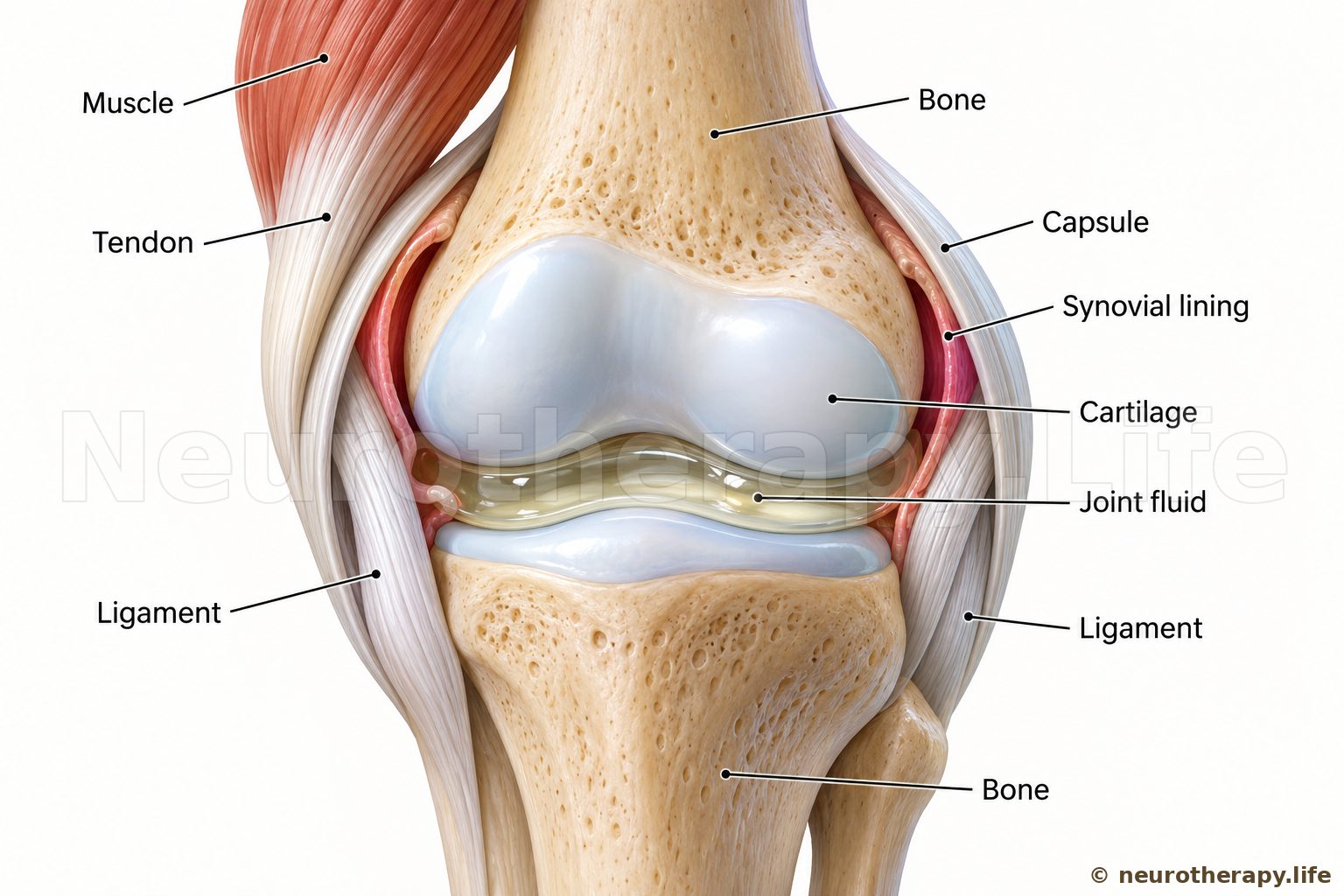
A joint is any place where two bones meet. Most of your moving joints glide on cartilage slipperier than ice, oiled by a fluid like egg white. In LMNT teaching, joint pain is read with two fingers and two kidney points before any treatment is chosen.
Overview
What are joints?
A joint is the meeting place of two or more bones. Some joints, like the seams of the skull, do not move at all. Some, like those between the bones of the spine, move a little. Most of the joints you think of — knees, hips, shoulders, elbows, wrists, fingers — move freely.
In a moving joint, the bone ends are capped with smooth cartilage and sealed inside a capsule that holds a little slippery fluid. Ligaments tie the bones together, and muscles pulling through tendons move them.
Joint pain is one of the commonest troubles of all — worn joints (osteoarthritis) alone affect hundreds of millions of people worldwide. In Hindi it is often called sandhi vāt, 'wind in the joints'. In LMNT teaching it is looked at through the whole body — digestion, the acid–alkali balance and the kidneys — and not only the joint that hurts.
Inside a moving joint: cartilage-capped bone ends glide on a thin film of fluid, sealed in a capsule and tied by ligaments.
Function
What do joints do?
Joints turn a rigid skeleton into a body that can walk, write, chew and dance. Each joint balances two needs: to move freely, and to stay stable.
Let bones move against each other — bending, straightening, turning and gliding.
Keep the skeleton stable, so bones stay lined up under load.
Absorb shock through cartilage, discs and cushions such as the knee's menisci.
Allow growth: in children, the cartilage near the ends of long bones is where bones lengthen.
Tell the brain where each limb is, through sensors in the capsule and ligaments — so you can touch your nose with your eyes closed.
How do joints work with other organs?
Muscles — Muscles cross joints and move them; strong muscles also protect joints by taking load off them.
Knee — The knee is the largest joint in the body and the one that most often hurts.
Kidneys — The kidneys clear uric acid and help keep the body's acid–alkali balance; in LMNT the two kidney points are read in every joint patient.
Lymph and immunity — In rheumatoid arthritis the body's own defences attack the joint lining.
Digestive system — The protein and calcium that joints and bones are built from must first be digested and absorbed.
Lungs — In LMNT teaching, acid loosened from a joint by treatment leaves the body through the lungs as carbon dioxide.
Anatomy
What are the parts of a joint?
Joints come in three structural kinds. The moving ones have a set of parts that work together, and come in six shapes.
Three kinds of joint
Fibrous joints — fixed — Bones stitched together by tough fibre, like the seams of the skull and the joint holding each tooth in its socket.
Cartilage joints — slightly movable — Bones joined by a pad of cartilage that gives a little — the discs of the spine, the joint at the front of the pelvis, the ribs' joints to the breastbone.
Synovial joints — freely moving — The joints of the limbs, jaw and fingers, with a fluid-filled space between the bones.
Inside a moving joint
Articular cartilage — A smooth, firm, rubbery layer, a few millimetres thick, over each bone end. It has no blood vessels or nerves of its own.
Joint capsule — A tough sleeve that wraps the joint and seals it.
Synovial lining — A thin inner lining of the capsule that makes the joint fluid. In rheumatoid arthritis it is this lining that becomes inflamed and swollen.
Synovial fluid — A small amount of clear, slippery fluid that oils the joint and feeds the cartilage.
Ligaments — Strong bands of fibre that tie one bone to another and stop the joint moving too far.
Menisci, labrum and bursae — Extra cushions: C-shaped pads in the knee, a rim of cartilage deepening the shoulder and hip sockets, and small fluid sacs that let tendons slide over bone.
Tendons — Cords that join muscle to bone; they cross the joint and move it.
Six shapes of moving joint
Ball-and-socket — A rounded head in a cup — moves in every direction. The shoulder and the hip.
Hinge — Bends and straightens in one direction, like a door. The elbow, the knee and the finger joints.
Pivot — One bone turns around another. The joint under the skull that lets you shake your head 'no', and the forearm turning palm-up and palm-down.
Saddle — Two saddle-shaped surfaces fitting together — the base of the thumb, which lets it reach across the palm.
Condyloid — An oval end in an oval hollow — bends and swings side to side but does not spin. The wrist and the knuckles.
Plane (gliding) — Flat surfaces that slide a little on each other — between the small bones of the wrist and foot, and the small joints at the back of the spine.
Where are the joints located?
Everywhere two bones meet — from the skull to the tips of the toes. The largest moving joints are the shoulders, elbows, wrists, hips, knees and ankles. The hands and feet are packed with small joints: each finger has three and each thumb two.
Some joints lie just under the skin, like the knuckles and the knee; others, like the hip, sit deep under thick muscle. There are also joints most people never think of — between the ribs and the spine, in the jaw in front of each ear, and between the three tiny bones of the middle ear.
In LMNT treatment a foot or hand travels along the limbs between the joints, never onto them — the station rule: at the knee, elbow and wrist the step goes over the joint, not on it.
Inside a healthy moving joint, the cartilage is smooth, glistening and pearly bluish-white, like the tip of a chicken bone. The joint fluid is clear to pale yellow and thick and stringy, rather like raw egg white — which is where its name comes from (synovia, from Latin ovum, 'egg').
A worn joint looks different: the cartilage becomes thin, rough and cracked, and small spurs of bone grow at the edges. An inflamed joint has a thick, red, swollen lining and more, cloudier fluid.
How big are joints?
The largest joint is the knee; the smallest are between the three tiny bones of the middle ear, each only a few millimetres across. An adult body has several hundred joints — the exact count depends on how they are counted.
Joint cartilage is only a few millimetres thick — about 2 to 4 mm in the knee, thickest under the kneecap. A healthy knee holds only a teaspoon or less of joint fluid; a swollen knee can hold many times more.
The shoulder has the largest range of movement of any joint; the skull's seams have almost none.
Conditions and disorders
What conditions and disorders affect the joints?
Joint problems come mainly from wear of the cartilage, inflammation of the lining, crystals, injury, or trouble in the soft parts around the joint.
Heel spurA small spur of bone where a tendon pulls on the heel.
ObesityExtra body weight multiplies the load on knees and hips with every step.
Inflammation and crystals
Rheumatoid arthritis (RA) and rheumatismThe immune system attacks the joint lining — swollen, warm joints on both sides, often the small joints of the hands, with long morning stiffness.
GoutUric acid crystals form in a joint — sudden, very painful swelling, often at the base of the big toe.
Stiffness — especially in the morning or after sitting
Swelling, warmth or redness
Creaking or grinding with a reduced range of movement
A joint that locks, catches or gives way
Pain in the same joints on both sides of the body, with morning stiffness over an hour — see a doctor within weeks
A single hot, swollen joint with fever — see a doctor the same day
What tests check the health of the joints?
Physical examination — Which joints are swollen or tender, on one side or both, and how far they move.
X-ray — Shows narrowing of the joint space, spurs and bone damage.
Blood tests — ESR and CRP for inflammation; RA factor and anti-CCP for rheumatoid arthritis; uric acid for gout. A positive RA factor alone does not prove rheumatoid arthritis, and a negative one does not rule it out.
Joint fluid test — A little fluid is drawn off with a needle and checked for crystals, infection and inflammation.
Ultrasound and MRI — Show the soft parts — cartilage, lining, tendons, ligaments and menisci.
Arthroscopy — A thin camera through a small cut looks directly inside a joint, sometimes to repair it at the same time.
How are joint conditions treated?
Exercise and physiotherapy — Strengthening the muscles around a joint and keeping it moving — the first treatment for worn joints.
Weight control — Losing even a few kilos takes a real load off the knees and hips.
Medicines — Pain relief and anti-inflammatory medicines; disease-modifying medicines that calm the immune attack in rheumatoid arthritis; uric-acid-lowering medicines for gout — prescribed by a doctor.
Injections — Sometimes a steroid injected into a very inflamed joint.
Supports and aids — Splints, braces, a walking stick held in the opposite hand, and good footwear.
Surgery — Keyhole repair of torn cartilage or ligaments, or replacing a badly worn hip, knee or shoulder.
Neurotherapy (LMNT)
In LMNT teaching, joint pain is read before it is treated, and the reading needs no machine: the therapist squeezes the middle joint of both ring fingers together and asks which hurts more, and presses the two kidney points, Liv° and Mu°. Pain in both ring fingers points to rheumatoid-type joint pain — even when the blood report is negative, the teaching records the finding but never writes 'RA positive' on the card. The findings then choose the formula: the New Star Modified for the acid side, the Alkaline Star for the alkali side, and the Lactic Acid formula where both kidney points hurt. The teaching's reason is that poor blood flow lets acid collect in a joint; after each joint is very lightly rubbed, the therapist waits one full minute — about sixteen breaths — so the loosened acid can leave through the lungs. Digestion is put right first, and sour foods are kept off the plate. All of this works alongside a doctor's care, never instead of it.
Points
Liv° — With Mu°, the two kidney points read in every joint patient. Which one hurts more helps choose between the acid-side and alkali-side formulas.
Mu° — Strong pain at Mu° with both ring fingers sore points to the New Star Modified.
(4) Medulla — Given clockwise with T1/T2 as part I of the full protocol for joint pain and RA — the road the arm's pain travels on.
Thoracic T1/T2 — The station at the base of the neck, given with (4) Medulla clockwise.
Mukha Dhauti — Forceful breathing out through the mouth — ten times, rest a minute, ten again — until the pain goes from the left ring finger. The teaching says it lowers acid.
(10) Pan — The insulin point, which the teaching also gives for joint pain of many years.
(4) Ku — For stiffness. Not during menstruation or in low blood pressure.
Raman — May be given in joint pain to ease the shoulders.
BAFA — Both arms and forearms walked in short close steps from the shoulder to the fingertips, stepping over each joint — for pain, numbness or burning from the neck to the fingers, after nerve warning signs have been checked.
Shukla — The wrist and ankle moved four ways, six times each, with the limb held steady. Not given in osteoporosis.
The working Star formula: three navel-setting stations (ONS, TF, NNS), then Gal, WD, the forty-second (½) Ku and the Round Arrow. For joint pain on the acid side — chosen when Mu° is strongly painful with the ring-finger signs. Never where the pain is only in the right ring finger, nor where Liv° hurts and Mu° does not.
After the New Star Modified: very, very light palm rubbing of every joint from the fingers to the shoulder, with one full minute between joints — the time for about sixteen breaths.
The Star formulas broken apart and rebuilt in five stages: a push to one side, Mukha Dhauti checked on the ring finger, a push back, re-centring, and the Ajay Normal to finish.
“The coming of UDF is itself a chief cause of the coming of the great diseases.”
— Dr. Lajpatrai Mehra
“We do not give treatment for any one disease; rather we treat according to the condition of the body on that day.”
— Dr. Lajpatrai Mehra
“Wherever there is a question mark, it is an indication that this is my own thinking, on which other people can now do research.”
— Dr. Lajpatrai Mehra
Never do this
A single hot, swollen, very painful joint — especially with fever or shivering — needs a doctor the same day; it can be an infection inside the joint. Infections
Both ring fingers sore, or joints swollen on both sides with long morning stiffness: see a doctor within the month — early treatment of rheumatoid arthritis protects the joints. The LMNT finding is recorded, but 'RA positive' is never written without a report. Rheumatoid arthritis (RA) and rheumatism
Pain, numbness or burning from the neck to the fingers: see a doctor first if there is real weakness or wasting in the hand, or symptoms in both arms; stop and seek urgent care for clumsy hands, an unsteady walk or new bladder urgency. BAFA
Cancer: if the person has cancer, (10) Pan, Thymus, Pit, Lu + Sh, Rt. Ov / Lt. Ov and (30) Medulla are never given — the therapist changes the plan.
Keep taking the medicines your doctor prescribed, including arthritis and gout medicines. Neurotherapy (LMNT) works alongside your medical care, never instead of it.
Care
How can I keep my joints healthy?
Joints are built to move. Gentle, regular use keeps them healthy; too little or too much load harms them.
Move every day
Cartilage has no blood vessels; it is fed by joint fluid squeezed in and out as you move. Walking, cycling and gentle joint exercises all help.
Build the muscles around them
Strong thigh muscles protect the knees; strong shoulder muscles protect the shoulders.
Keep a healthy weight
Every extra kilo is felt several times over by the knees on each step.
Keep sour foods low
LMNT teaching asks people with joint pain to keep away from sour things — curd, tamarind, tomato and lemon — and to notice for themselves how their joints feel.
Digest well and drink water
In LMNT, undigested food in the stool is put right before any joint work begins. Enough water also helps the kidneys clear uric acid.
Protect them
Warm up before sport, wear supportive footwear, lift with bent knees, and take breaks from repetitive work with the hands.
Common questions
Is it bad to crack my knuckles?
Studies have not linked it to arthritis. The pop is a bubble forming in the joint fluid when the joint is pulled apart. If a joint cracks with pain, swelling or locking, have it checked.
Can weather make my joints ache?
Many people say so, especially in cold, damp weather, but studies disagree on how strong the link is. Keeping joints warm and moving does no harm and often feels better.
What is the difference between osteoarthritis and rheumatoid arthritis?
Osteoarthritis is wear of the cartilage, often in knees, hips and the finger joints nearest the nails, and is worse after use. Rheumatoid arthritis is the immune system attacking the joint lining, usually the small joints of both hands and wrists, with long morning stiffness.
My RA test is negative but my joints hurt. What does that mean?
A negative RA factor does not rule rheumatoid arthritis out, and a positive one can occur in other illnesses too. The pattern of joints, their swelling and morning stiffness matter as much. Show your doctor; an LMNT therapist will record the ring-finger finding but will not call it 'RA positive'.
Why does the therapist wait a minute between joints?
In LMNT teaching, the light rubbing opens up the blood flow of the joint so that acid collected there passes into the blood and out through the lungs. It takes about sixteen breaths — about one minute — for most of it to leave, so the next joint is not started until then.
Should I rest a painful joint or keep it moving?
A freshly injured or hot, swollen joint needs rest and a doctor's check. For long-standing worn joints, gentle movement and strengthening usually help more than rest.
What should I ask my doctor or therapist?
Is this wear-and-tear, inflammation, gout or something else?
Which blood tests or scans do I need, and what do the results mean?
Which exercises are good for my joints, and how much?
Could my weight, my diet or any of my medicines be adding to the pain?
Which signs mean I should come back quickly?
(To the therapist) What did the ring-finger and kidney-point checks show, and which formula are you giving me?
Surprising facts
1Slipperier than ice on ice
Healthy cartilage sliding on cartilage, oiled by joint fluid, has less friction than ice sliding on ice. Engineers still cannot make a man-made bearing that matches it for a lifetime of use.
Source: Jahn S, Seror J, Klein J. Lubrication of articular cartilage. Annu Rev Biomed Eng 2016;18:235–258 (friction coefficients down to ~0.001–0.01).
2Cartilage eats by being squeezed
Joint cartilage has no blood vessels at all. It soaks up food and oxygen from the joint fluid like a sponge — squeezed when you put weight on it, refilling when you lift it off. That is why movement matters so much to a joint.
Source: Sophia Fox AJ, Bedi A, Rodeo SA. The basic science of articular cartilage: structure, composition, and function. Sports Health 2009;1(6):461–468.
3The knuckle crack is a bubble
When scientists filmed a knuckle cracking inside an MRI scanner, they saw the pop happen as a gas-filled cavity suddenly formed in the joint fluid as the joint surfaces were pulled apart. Studies of habitual knuckle-crackers have not found more arthritis.
Source: Kawchuk GN et al. Real-time visualization of joint cavitation. PLoS One 2015;10(4):e0119470; deWeber K, Olszewski M, Ortolano R. Knuckle cracking and hand osteoarthritis. J Am Board Fam Med 2011;24(2):169–174.
4Joint fluid is named after an egg
The word synovia is usually traced to the Swiss physician Paracelsus in the 1500s, who likened the thick, clear, stringy fluid to raw egg white — ovum is Latin for egg.
Source: Oxford English Dictionary, 'synovia' (coined by Paracelsus; probably from syn- + ovum).
5The shoulder trades safety for freedom
The shoulder has the widest range of movement of any joint, because its ball sits in a very shallow socket, like a golf ball on a tee. The price is stability: it is the large joint that dislocates most often.
People who can bend their thumbs back to the wrist do not have double joints. Their ligaments are simply looser, which lets the same joints move further than usual. It is fairly common, especially in children and in women.
Source: Cleveland Clinic, 'Joint Hypermobility Syndrome'; Beighton score (Beighton P et al., Ann Rheum Dis 1973).
7Two kinds of arthritis live in two halves of the hand
Rheumatoid arthritis favours the knuckles at the base of the fingers, the middle knuckles and the wrists, on both hands, and spares the joints nearest the nails. Wear-and-tear arthritis does the opposite, making bony knobs at the joints by the nails. LMNT's sign — the middle joint of both ring fingers — points at the half where the inflammatory kind lives.
Source: Aletaha D et al. 2010 ACR/EULAR rheumatoid arthritis classification criteria. Arthritis Rheum 2010;62(9):2569–2581 (DIP joints excluded); Heberden's nodes in osteoarthritis. LMNT: wiki_db 36.14.
8About 600 million people have worn joints
A global study estimated that about 595 million people were living with osteoarthritis in 2020 — nearly 1 in 13 people on Earth — and expects the number to keep rising as people live longer and weigh more.
Source: GBD 2021 Osteoarthritis Collaborators. Global, regional, and national burden of osteoarthritis, 1990–2020 and projections to 2050. Lancet Rheumatol 2023;5(9):e508–e522.
Yoga
Finger and wrist loosening Muṣṭikā Bandhana & Maṇibandha Cakra
Benefits
Moves every small joint of the hand and the wrist through its range.
Helps with morning stiffness of the hands.
How to do it
Sit tall, legs forward or on a chair, and hold both arms out in front.
Spread the fingers wide, then close them into a soft fist with the thumb outside. Repeat 10 times.
Keeping soft fists, slowly circle the wrists 5 to 10 times one way, then the other.
Lower the arms and shake the hands loosely.
Take care
Move only within comfort; never force a swollen, hot joint. In a flare of rheumatoid arthritis, rest the joint and do only what your doctor or physiotherapist advises.
Shoulder circles Skandha Cakra
Benefits
Moves the shoulder — the body's most mobile joint — through its whole range.
Loosens the shoulder blades and upper back after desk work.
How to do it
Sit tall on the floor or a chair and place the fingertips on the tops of the shoulders.
Bring the elbows together in front of the chest.
Breathing in, lift them up; breathing out, take them back and down, drawing a big circle.
Do 5 to 10 circles, then reverse the direction.
Take care
Keep the circles small with a frozen shoulder or after a dislocation, and never push into sharp pain. After a shoulder dislocation or surgery, follow your physiotherapist's plan first.
Ankle rotation Gulpha Cakra
Benefits
Moves the ankle and foot joints and helps the calf muscles pump blood back up the legs.
Easy for older people and can be done on a chair or in bed.
How to do it
Sit with the legs stretched forward, a little apart, and lean back on your hands.
Point the toes away, then pull them back towards you, 10 times.
Slowly circle the feet from the ankles, 5 to 10 times each way.
Rest and shake the legs gently.
Take care
After an ankle sprain, wait until walking is comfortable and move gently. With gout, do not work a hot, swollen toe or ankle during an attack.
Watch
(2) Para vs (4) Para — One Point, Two Powerful Actions | LMNT Neurotherapy Explained
This video explains the Para point and how (2) Para differs from (4) Para, in relation to low calcium, bone pain and blood pressure.
How to Give 4 Medulla, Raman & T1 T2 in Neurotherapy | LMNT Cervical, Shoulder pain & Numbness
This video shows the right way to give (4) Medulla, Raman and the T1–T2 point for neck and shoulder pain and numbness.
घुटने का दर्द और न्यूरोथेरेपी KNEE PAIN AND NEUROTHERAPY TREATMENT
A podcast on knee pain: the parts of the knee, common causes and signs, and how Neurotherapy (LMNT) looks at digestion, folic acid, vitamin D and lactic acid in knee pain. No points are demonstrated.
Test yourself
Research
Strong evidence
The Global Burden of Disease study counted about 595 million people with osteoarthritis worldwide in 2020, most often in the knee, and expects the number to keep rising.
The international criteria for rheumatoid arthritis score the number and size of swollen joints, blood tests and how long symptoms have lasted — so a person can be diagnosed even with a negative RA factor, and the joints nearest the nails are left out.
This page explains how the body works; it does not diagnose. Neurotherapy (LMNT) works alongside your medical care — keep taking the medicines your doctor prescribed, and see a doctor for any new or severe symptom.
Ready to begin?
Send COURSE for course details, or your name, age and health issue for a consultation.