Autoimmune disorders
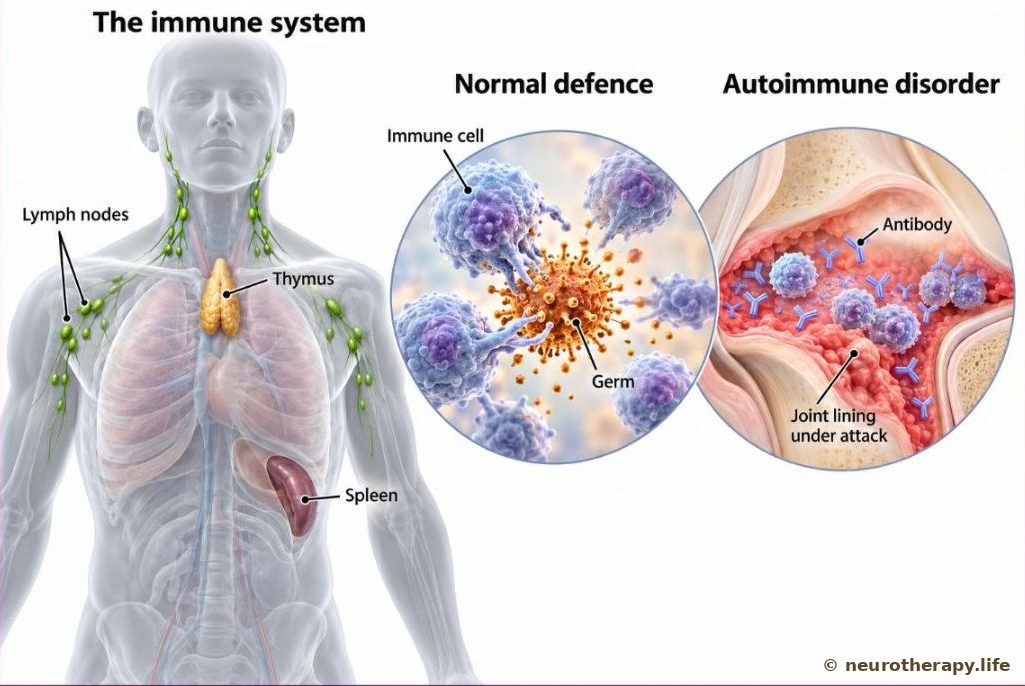
In an autoimmune disorder, the body's defence system attacks its own healthy cells by mistake. It can strike the joints, skin, glands, nerves or almost any organ.
- More than 80 types are known — some sources count over 100
- About 1 in 15 people in the United States has one
- Women get many of them much more often than men
Source: MedlinePlus (US National Library of Medicine); Cleveland Clinic
What is Autoimmune disorders?
Your immune system is your body's defence force. Normally it knows the difference between your own cells and germs such as viruses and bacteria. It attacks only the germs.
In an autoimmune disorder, this defence goes wrong and attacks healthy tissue. In rheumatoid arthritis it attacks the joints; in type 1 diabetes, the cells of the pancreas that make insulin; in alopecia areata, the hair roots. These are long-term conditions. Symptoms often come and go in flares, and good medical care helps keep them under control.
What are the symptoms?
- Redness, swelling, heat and pain — the signs of inflammation
- Joint pain, swelling and stiffness
- Muscle weakness
- Skin redness or rashes
- Problems with vision
- Flares — times when symptoms get worse, then settle again
What causes it, and who is more likely to get it?
Family and genes
- They tend to run in families
- Having one autoimmune disease raises the chance of another
Triggers from outside
- Some viral infections
- Chemicals and other things in the surroundings
- Smoking and tobacco
How is it found?
There is usually no single test. Doctors put together your family history, your symptoms over time and a few tests — sometimes with help from more than one specialist.
History and examination
The doctor asks about your symptoms, when they come and go, and whether anyone in the family has a similar disease.
Blood tests
These look for signs, or markers, that the immune system is attacking the body.
Imaging
X-ray, ultrasound, MRI or CT scans show the damage in a joint or organ.
Before the first session, a neurotherapist asks which autoimmune disease you have, and about diabetes, kidney disease, heart disease, high BP, pregnancy and cancer. The points that must not be given are then marked on your card before any treatment starts.
How Neurotherapy (LMNT) sees Autoimmune disorders
LMNT teaching starts with one rule: where the immune system is already misbehaving, you do not stimulate it. Many LMNT points raise immunity — Thymus, Thymus + Chest, Armpits, Lymph, Ton 'P', Ton 'T' and Spl. In any autoimmune disorder, all seven are held back. The plan is then built inside that limit, to calm inflammation and support the liver and digestion.
How an LMNT plan is built in an autoimmune disorder
- Block firstThe seven immunity points are marked 'not to be given' on the card before treatment begins
- Calm the inflammation(30) Medulla and (6) Adr — the points LMNT gives for inflammation
- Support the liver(1) point Liv × 6 treatments — given through the day, an hour apart
- Digestion without SplAjay Normal — a digestive formula that leaves out the spleen point
The bar travels into formulas too. T. Heparin, TT. Heparin and PT. Heparin carry Thymus + Chest inside them, so they are not given. On an injury, (8) Ch. Only and (20) Round Arrow take the place of Thymus + Chest. VTF is not given. LMNT now gives Spl in some inflammatory diseases — but that does not touch the autoimmune bar. And because LMNT reads almost all kidney diseases as autoimmune, Thymus + Chest is not given in kidney disease either.
Whether or not the patient gets immediate benefit from our treatment, let no harm reach him through our carelessness — attend to this.
Neurotherapy (LMNT) treatment for Autoimmune disorders, step by step
Examine first
The therapist checks the diagnostic points Liv° and Mu°, reads the reports, and asks about heart disease, high BP, infection and cancer — each changes which points can be used.
Block the card
Thymus, Thymus + Chest, Lymph, Armpits, Ton 'P', Ton 'T' and Spl are marked 'not to be given' — so neither the therapist nor a helper can give them by mistake.
(30) Medulla and (6) Adr
For the inflammation — only when their own bars do not apply.
(1) point Liv × 6 treatments
Six liver treatments through one day, an hour apart — LMNT gives this in all serious or long-standing diseases.
Ajay Normal
The digestive formula, with Spl left out.
Points and formulas used
(30) Medulla
The Medulla count LMNT gives for inflammation. Not in heart disease or in diseases of infection.
Open →(6) Adr
The adrenal point for inflammation. It lowers immunity, so it is not given where immunity is already low, or in high BP.
Open →(1) point Liv × 6 treatments
Six liver treatments in one day, an hour apart — for serious or long-standing disease.
Open →Never do this
- Never in any autoimmune disorder: Thymus, Thymus + Chest, Lymph, Armpits, Ton 'P', Ton 'T' and Spl — nor formulas that contain them, such as T., TT. and PT. Heparin. Th + Ch
- On an injury, (8) Ch. Only and (20) Round Arrow are given in place of Thymus + Chest. VTF is not given. Round Arrow
- (30) Medulla is not given in heart disease or in infection. (6) Adr is not given in high BP or where immunity is already low. (30) Medulla
- Go to a hospital at once for trouble breathing, severe chest pain, a sudden severe headache, or sudden weakness or paralysis.
- Cancer: if the person has cancer, (10) Pan, Thymus, Pit, Lu + Sh, Rt. Ov / Lt. Ov and (30) Medulla are never given — the therapist changes the plan.
- Keep taking the medicines your doctor prescribed. Neurotherapy (LMNT) works alongside your medical care, never instead of it.
From Ayurveda and the kitchen
Viruddha — right things, wrong together
Classical Indian medicine calls some food pairings viruddha, 'contrary': each is harmless alone, but harmful together or at the wrong time. LMNT's bar lists work the same way — a point that helps many people can be wrong for this body, and the reason is written beside the rule.
Test yourself
What research says
- Strong evidence
Standard immunology teaching explains that the thymus removes most immune cells that react against the body itself, but some escape. Genes and outside triggers can later switch these cells on and cause autoimmune disease.
No clinical trial of Neurotherapy (LMNT) in autoimmune disorders has been published yet. Improvements reported by neurotherapists are clinical observations.
For you
People with diabetes, rheumatoid arthritis or kidney disease
The same immunity points are barred for you. Tell your therapist about every diagnosis before the first session.
Women
Many autoimmune diseases are more common in women. Joint pain, rashes or tiredness that keep coming back are worth a doctor's check.
Anyone in a flare
Do not change or stop your medicines on your own. Keep a diary of when symptoms come and go, and share it with your doctor and therapist.
This page explains; it does not diagnose. Neurotherapy (LMNT) works alongside your medical care — keep taking the medicines your doctor prescribed, and see a doctor for any new or severe symptom.