Also called: 6 Adr, Six Adr, Adrenal treatment, (6) एड्रिनल
(6) Adr is the form of the ADR (adrenal) point used to calm inflammation — the red, hot, painful swelling of a defence that will not switch off. It is given on the middle of the back while you lie face down, and it is never given where immunity is already low or the blood pressure is high.
Overview
What is (6) Adr?
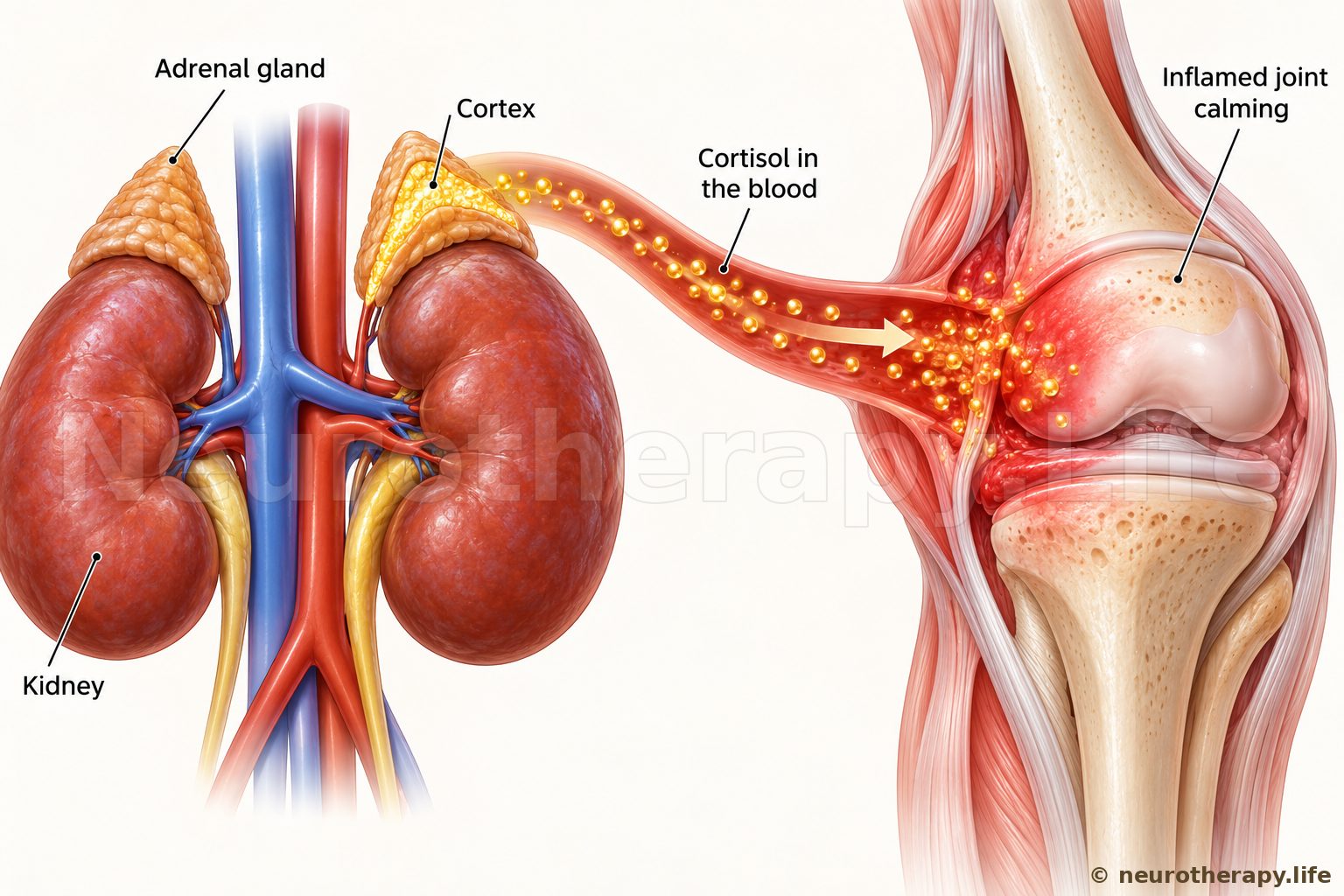
When you are hurt or bitten, the body sends a defence to the spot: it turns red, hot and swollen. That is healthy. Inflammation is what happens when the defence will not go home. Body science knows who calls it off: cortisol, a hormone made by the outer layer (cortex) of the adrenal glands, which sit on top of the kidneys.
(6) Adr is the Neurotherapy (LMNT) treatment aimed at that officer. The number six is not a strength setting; it names which ADR treatment is meant. (2) Adr and (4) Adr, given at the same place, are different treatments with different uses.
The teaching calls it the most important treatment the therapy has for putting inflammation right, and it is the seed from which the whole inflammation family of formulas grew.
Cortisol from the adrenal cortex is the body's own signal to end inflammation. (6) Adr is the treatment aimed at it.
Where it is given
Where is (6) Adr given?
PositionLying face down
Body areaMiddle of the back, very close beside the sixth thoracic vertebra (T6), lying face down
You lie face down with one and a half pillows under the chest — the chest on the upper pillow, the chin resting on the lower one — so the head stays straight and breathing stays easy. This pillow arrangement is compulsory.
(6) Adr is given on the middle part of the back, with the hands very close beside the sixth bone of the upper back (T6) and at a few places across the mid-back. In a heart patient for whom lying face down is not suitable, the teaching allows it to be given seated.
How it is given
How is (6) Adr given?
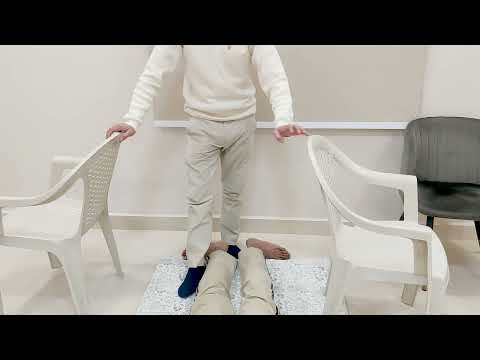
How this point is given — the tool, the pressure, the count and the exact movement — is deliberately not described here. Watch the demonstration video on this page, and learn the method hands-on from a trained Neurotherapist before giving it. Please do not give any point from a written description alone: a point given in the wrong place or the wrong way can do harm.
The number written before a point's name is not a strength setting. Each numbered form is a separate named treatment with its own method and timing, taught hands-on in the course.
Feels likeA warm, even rubbing across the mid-back
The exact technique is taught hands-on in the Neurotherapy (LMNT) course. See the course →
What it does
What does (6) Adr do?
LMNT teaching holds that (6) Adr stimulates the adrenal cortex to make cortisol, which ends inflammation anywhere in the body, and through it suppresses the thymus (a gland of the immune system). Body science agrees that cortisol is the body's strongest natural anti-inflammatory and that it damps the immune response. How a hand on the back reaches the gland is the therapy's own explanation, from long clinical experience.
Ends inflammation, whether in the intestine, the gall bladder or elsewhere — for any disease whose name ends in '-itis'.
Pain at the Mu point is relieved at once; mucus in the stool settles after a few treatments.
Used where cortisol medicine would otherwise be needed, and in auto-immune disease to quieten the thymus.
Used as support in poisoning, drug side-effects, snake and scorpion bites — on the way to hospital, never instead of it.
Opens a blocked nose, eases tonsil throat pain, and is used for fear and deep sadness.
Reduces acid and raises alkali — which is why it is barred in high blood pressure.
Organs it reaches
Adrenal glands — The cortex makes cortisol, the hormone (6) Adr is aimed at.
Thymus — Cortisol quietens the thymus — useful in auto-immune trouble, harmful where immunity is already low.
Joints — Knee pain with heat and swelling is one of its named uses.
Intestines — Inflammation in the intestine, pain at Mu and mucus in the stool.
Its family
How does (6) Adr relate to the other ADR forms?
All are given at the same place; each number is its own treatment with its own bars.
ADR — The parent ADR (adrenal) point — what the gland is and how the family works.
(2) Adr — The salt-holding form — cramps from salt loss.
(4) Adr — The sugar-raising form — weakness from low sugar.
(30) Medulla — The partner in the Inflammation Treatment Formula: it works at the site, while (6) Adr works from the gland.
(6) Swt — Often given beside it in loose motions with abdominal pain, to slow the bowel.
What it is used for
What is (6) Adr used for?
The list of uses is long, so the bars are read first. A use never overrides a bar.
Inflammation and '-itis'
InflammationThe core use — ending inflammation anywhere in the body.
Ends with (6) Adr — weakness and dizziness from very low sugar.
Safety: when it is held back
Low immunity: (6) Adr reduces immunity, so under no circumstances is it given in septicaemia, HIV/AIDS, cancer, or diseases of infection. Septicaemia (sepsis)
High blood pressure: it lowers acid and raises alkali, so it is not given. High blood pressure
Cancer: blocked. In cancer the therapy also never gives (10) Pan, Thymus, Pit, Lu+Sh, Rt.Ov/Lt.Ov or (30) Medulla — so the Inflammation Treatment Formula is closed in cancer. Cancer care: Neurotherapy (LMNT) support
Diabetes: (6) Adr stands on the diabetes blocked list. The teaching also records diabetics who benefited and some who felt unwell after it; it is given only on a trained therapist's judgment, and never again to a patient who felt unwell after it. Diabetes
Poisoning, bites and appendicitis are races against time. (6) Adr given while someone is carried to hospital is one thing; given instead of carrying them is another. How to tell a patient to see a doctor
“This has proved to be the most important treatment for putting inflammation right.”
— Dr. Lajpatrai Mehra
A teaching case
How (6) Adr was found
It began with a plain question: when an insect bites and the place turns red and swollen, how should we treat it? Learning that cortisol from the adrenal cortex calls inflammation off, and that the gland itself is out of reach, Guruji laid a patient face down and rubbed the mid-back at the level he understood its nerves to come from. The patient said he suddenly felt very good, and after the treatment was repeated a little later almost all the swelling had come down.
A composite case written to teach the reasoning — not one patient’s file.
Common questions
Is (6) Adr like taking a steroid tablet?
No medicine is given. The teaching's idea is that the body is encouraged to make its own cortisol. Keep taking what your doctor prescribed; only the doctor reduces it.
Why can't I have it when I have an infection?
Because it lowers immunity. When germs are attacking, you need your defences, not fewer of them. Infection and inflammation are treated in opposite ways in this therapy.
I felt heavy and low the evening after (6) Adr. Does it matter?
Yes — tell your therapist at the next visit. The teaching says some patients do not feel well after Adr, and for them it is not given again; your report outranks the plan.
My card says (6) Adr. Does six mean six times stronger?
No. The number selects the treatment. (6) Adr is the anti-inflammatory form; (2) Adr and (4) Adr are different treatments altogether.
Surprising facts
1Your own anti-inflammatory
The steroid medicines doctors use for inflammation, such as prednisolone, are man-made copies built on the shape of the body's own cortisol.
Source: Guyton & Hall, Textbook of Medical Physiology, 14th ed., anti-inflammatory effects of cortisol.
2Red, hot, swollen, sore
The four classic signs of inflammation — redness, heat, swelling and pain — were written down by the Roman writer Celsus about two thousand years ago, and doctors still teach them today.
Cortisol calms inflammation partly by damping the immune system. That is why people on long steroid treatment catch infections more easily — the same reason (6) Adr is kept away from low immunity.
Source: Guyton & Hall, Textbook of Medical Physiology, 14th ed.
4'-itis' means inflammation
In medical words the ending '-itis' means inflammation: tonsillitis, appendicitis, arthritis, conjunctivitis. The teaching uses that ending as a quick guide to where (6) Adr may help.
Source: Standard medical terminology.
Watch
शरीर में Acid बढ़ जाए तो क्या करें? | Blood pH Balance Treatment | LMNT Acid Treatment Formula
Shows the Acid Treatment formula step by step: (8) Pan, (3) Gal, (5) Mu°, 3 Acid on the side of the right thigh, (4) Chest Only, and (6) Adr on the upper back, given without breaks. It is used to support the body's acid–alkali balance when acid is raised.
Note: the Acid Treatment formula is given only when the Mu° point is tender, and (6) Adr is not given in high BP, diabetes, cancer or HIV — the therapist checks first.
UTI PROLONGED - WITH INFLAMATION - LMNT Neurotherapy
A Hindi demonstration of the treatment given when a urine infection has gone on long enough to become inflamed: Liv° and Mu°, Chest Only, 20 Round Arrow along the spine, then (6) Adr on the back.
A urine infection — especially with fever, loin pain or blood in the urine — needs a doctor first. (6) Adr is not given with high blood pressure or when immunity is already low; the video does not say this.
बिना दवा गहरी नींद कैसे पाएं? | LMNT Serotonin Treatment for Sleep Disorders | Insomnia Root Cause
Shows the Serotonin treatment for sleep: (8) Medulla below the ears, 1 Gas 'I' at six points on the shin, (6) Adr on the upper back, and gentle massage behind the knees and at the back of the head. It is given to support deep, natural sleep.
Note: (8) Medulla is not given in high BP, inflammation or cancer; (6) Adr is not given in high BP, diabetes, cancer or HIV.
This page explains what a Neurotherapy (LMNT) treatment is for; it is not a self-treatment guide and does not diagnose. Neurotherapy (LMNT) works alongside your medical care — keep taking the medicines your doctor prescribed.
Ready to begin?
Send COURSE for course details, or your name, age and health issue for a consultation.